If you have not yet watched season one of Pluribus, go do it. I’ll try to keep the spoilers to a minimum, focusing on the archetypal patterns we are all facing today. You really should go watch it for yourself and do your own reflection. This is written after the end of season one, so some plot points may change as more episodes are released.
Show synopsis: “In a world overtaken by a mysterious wave of forced happiness, Carol Sturka, one of the immune few, must uncover what’s really going on – and save humanity from its artificial bliss.”
It begins in a remote place. With people really hungry to discover something. They asked what it means when the day comes that they finally discover something. They are excited in their frantic efforts to decode it. They are clueless about the danger that is in store.
Not too long after, suddenly, everybody in the world is now “all one.” All except 12 random people scattered across the world who are somehow immune to “the turning” to join the collective hive mind. Much like our digital hive mind, which has been rapidly growing over the last 30 years, everyone in the collective has access to everyone else’s knowledge. Suddenly, everyone knows literally everything and how to do everything, including medical procedures and flying airplanes.
Most interestingly, the collective is very nice. They give the 12 survivors literally anything and everything they want. All they want in return is for the remaining 12 to consent to join the collective. They honor their sovereignty, but they do want them to join them.
The number 12 symbolizes completeness and cosmic order, often associated with significant concepts such as the 12 months of the year, 12 signs of the zodiac, and 12 disciples. It represents a balance of energies, including the combination of masculine and feminine traits. Perhaps an indication that the 12 foundational archetypes are still present in the world and will be available to correct the situation, despite the catastrophic leveling that occurs.
The main character, Carol, is a reluctant, chaotic, alcoholic hero who wants to save the world and restore it to its former state. At first motivated by her grief and loss, which eventually gave way to loneliness. She begins befriending the collective and settling into the new normal. Eventually, though, she recognizes all that is lost and the moral problems obscured by the collective’s kindness, and she starts to investigate, discover, and analyze everything she can about them, hoping to find a way to set things straight.
Of the other 12, we one meet a few in any detail. Each is practically a one-dimensional archetypal character. Carol initially tries to recruit them to help her restore the world. None of them is willing to help; each of them is content, now that the collective willingly gives them everything they have ever wanted. Getting everything we want causes complacency. Why would we want to give up having what we most want? One guy exemplifies this the most clearly. He is a man-child, enjoying the luxuries of material riches, private jumbo jets, luxury penthouse suites, beautiful women, and parties.
Another woman still has her son (in appearance only, he is part of the collective), and won’t help because she believes her only role is to mother him. She calls Carol angrily whenever something happens that upsets him. When the only goal is not to upset the children, we miss key aspects of development that are necessary for the maturation of both parents and children. It’s even more striking commentary as an image when we recognize that the mother only wants to possess her child and not ever upset him, and that he is not an individual person with his own dreams and purpose that are being cultivated, he is unable to think or feel for himself and only plays a role that the mother and the collective demand of him.
Each of us is a complex person, not an archetype. We hold many roles, many ways of being in the world. Whenever we are reduced to a one-dimensional archetype, we are possessed, unable to access the rest of our humanity. A mother is much more than a mother, a father is much more than a father, and a worker is much more than a worker. We have to recognize when we are being reduced to an archetype, or when we willingly claim one, because it limits our consciousness and potential actions and cuts us off from our wholeness.
Towards the end of the season, one character, Manousos, who initially refuses contact, eventually becomes the only one willing to help save the world when Carol has fallen into her own contentment to combat her loneliness and grief. He refuses all food and contact, sacrificing greatly to clearly define the situation and make a plan to fight the collective takeover. Only after emerging from a paranoid, withdrawn seclusion does he decide to join Carol, recognizing he can’t do it alone.
An extreme masculine archetype, he demonstrates rigidity, sticking to his beliefs and values, which strengthens his conviction and mission, but he is unable to relate to Carol and her care and relatedness to people, and is therefore ineffective. He has to soften and learn to relate to her. He wants to just kill everyone to solve the problem, but Carol, in her feminine Eros, still cares about the people underneath the collective brainwashed hive mind and wants to find a more subtle and skilled way to end the collective takeover and save as many people as possible. His values and convictions help snap Carol out of her slide into joining. Her relationality helps him recognize his extreme aggression. They don’t trust each other, but they need each other.
The show’s name, “Pluribus,” is part of the phrase, “e pluribus unum,” a Latin motto of the United States found on the Great Seal of the United States and all printed currency, which means ‘out of many, one’. The show is an excellent example dangers of the current misinterpretation of the phrase. The phrase was not intended to mean out of many – same. The founders of the US used the phrase to describe the joining of the 13 independent, distinct, individual colonies into a stronger alliance. As I have written about in previous articles on Individuation and groups, groups of people are stronger and richer when diverse individuals enter into healthy relationships and alliances. Much like a band, orchestra, or American football team, where everyone has different skills and different roles, something beautiful is created that would not be possible if everyone were the same. Yet, that is exactly how our culture has been moving – into sameness rather than relating through differences. Pluribus beautifully illustrates the sinister moral problems masked by sameness and kindness, exploiting people’s need to belong and avoid loneliness.
The show is beautifully written to illustrate how collective thought, behavior, and assumptions, as well as our own personal emotions, needs, wants, and desires, can guide us into extremely unhealthy positions and trap us there. It’s one of the many ways in which modern therapy has misguided us into prioritizing our personal feelings and needs. Some people and therapists even go so far as to believe that our personal feelings, needs, and beliefs are truths that others must abide by. The show also illustrates what happens when we take things at face value. What others say and show may look and sound good, but we always have to balance that with our own understanding of our own motivations, feelings, values, and morality. Our work is not to mindlessly join any collective thought based on how it sounds, appears, or feels, but rather to develop our own understanding, our own compass, and our own position while maintaining healthy relationality with others. It is not easy. The collective’s desire to consume and absorb others is strong and aligns perfectly with our wounds around belonging, isolation, and loneliness.
Again, here is the show synopsis: “In a world overtaken by a mysterious wave of forced happiness, Carol Sturka, one of the immune few, must uncover what’s really going on – and save humanity from its artificial bliss.”
Where have you experienced forced happiness or artificial bliss? Maybe you have even been told to be grateful, to count your blessings, to look on the bright side, and not to be such a downer by well-meaning friends, family, coaches, or therapists. And when and how do we cling to what little bits of happiness and bliss we experience, like every character in the show except Manousos? Don’t misunderstand me, it is important to be grateful and happy for things that warrant those feelings. And we can’t neglect our duty to “uncover what’s really going on.” At least in ourselves and our own lives. Not to just get excited by a new discovery as they do at the beginning of the show, but to take the time to discover what it really is and what the consequences may be. Manousos does take the time to discover what is really going on, but he too neglects an important part of the equation. This is a lesson too for what happens when we cling so rigidly to our ideals that we lose the ability to be relatable and cooperate with others, a much-needed skill to tackle problems in the world beyond our own personal lives.
We’ll see where Vince Gilligan takes the show in the future. But from my vantage point at this moment, Pluribus is a fantastic story of individuation and the development of individual character in relation to the collective. In individuation, all the characters are transformed by their unique souls’ needs. Carol is an engaged public figure, successful but not fulfilled in her career, just going through the motions. She wrestles with her own grief and clings to the past, temporarily falling for the seduction of getting what she wants, and eventually coming back to navigate what is best for both her and the world based on what she can offer. Manousos has to move out of his isolated, withdrawn position and learn to relate to someone who is completely different in culture and gender to form a healthy partnership that will fulfill both of them in their mission and individuation. Individuation – development into a whole, healthy presence in the world is different for everyone.
As with any great story, we can ask, who are we most like in the story, and where in the story are we? Are we like Carol? Manousos? Any random person in the collective? Identified with the mother archetype, man-child playboy archetype? Or any other one-dimensional archetypes illustrated, such as public figures, doctors, nurses, consumers, managers, loyal friends, or nameless, featureless extras? With careful reflection and an earnest desire to see ourselves, Pluribus offers a rich mirror for us in our current times.
Chuck Hancock, M.Ed., LPC, LMHC, is a licensed psychotherapist and Analytic Psychology Training Candidate practicing in Colorado and New York, guiding individuals, couples, and groups into greater wholeness. Inner Life Adventures.
Some forms of isolation aren’t solved by more effort, insight, or self-improvement. They arise not because something is wrong with you—but because psyche was never meant to be carried alone.
This small, facilitated psychotherapy group offers a place to tend the deeper waters of inner life in the presence of others. It is a space for reflection, shared meaning-making, and slow relational work—where what is often held privately can be spoken, witnessed, and metabolized together.
Why Group?
Many people come to individual therapy having already done a great deal of inner work—thinking, reading, reflecting, understanding themselves more clearly. And yet something remains unmoved.
Group therapy works differently.
In group, isolation is named, shared, and gradually transformed through relationship. Experience is no longer held in the solitary mind, but enters a living relational field. Patterns emerge. Resonance happens. Something human and essential is restored.
This group is not about advice-giving or problem-solving. It is about presence, honesty, and the slow unfolding of psyche in relationship.
What This Group Tends
Chronic or subtle feelings of isolation or disconnection
Life transitions, midlife questions, or loss of meaning
Relationship patterns that repeat despite insight
Dream material and symbolic inner life
Longing for depth, authenticity, and shared reflection
The tension between a functional outer life and a neglected inner one
This group welcomes complexity. Nothing needs to be fixed. What matters is showing up as you are.
Who This Group Is For
This group may be a good fit if you:
Are an adult drawn to psychological depth and inner life
Have done some therapy, reflection, or personal work before
Feel inwardly alone, stagnant, or unseen despite outward competence
Are curious about dreams, meaning, and symbolic experience
Want relational contact that goes beyond surface conversation
Are open to being impacted by others—and to impacting them
This group is not a class, a support group, or a drop-in experience. It is an ongoing relational process.
Format & Practical Details
Format: Live, facilitated psychotherapy group on Zoom
Group Size: Limited (approximately 6–8 members)
Location: Participants must reside in Colorado or New York
Frequency: Weekly
Length: 90 minutes – 12 week minimum
Time: Wednesdays, 12:00-1:30EST/10:00-11:30MST
Fee: $60-$90, some sliding scale flexibility if cost is the only barrier to a good fit
All participants complete an initial conversation to assess fit and readiness for group work.
About the Facilitator
The group is facilitated by Chuck Hancock, M.Ed., LPC, LMHC, a depth-oriented psychotherapist with over 15 years of experience. His work integrates relational psychodynamic psychotherapy, Jungian psychology, mindfulness-based somatic awareness, and group process.
Chuck’s approach emphasizes presence, meaning, and the living relational field—supporting both psychological insight and embodied experience.
Next Step
If something in this description resonates, the next step is a brief, no-cost, no-pressure conversation to explore whether this group is a good fit for you.
Ever since childhood, I’ve been interested in the depths. Growing up in my family, church, and public schools, I always had a sense that there was more to what was happening than could be observed directly or stated explicitly. As a child, however, I didn’t have the language to describe it, and worse, I thought I could not trust my own perception. It has taken many years of study, my own personal psychotherapy, and work with many other people, different than me, to understand. Because sometimes we don’t perceive things accurately, and sometimes we do. It does take work and discernment to sort out when our perceptions are accurate and when they are not. Or you can skip that work and just believe what you are told, but as George Orwell stated in 1984: “The Party told you to reject the evidence of your eyes and ears. It was their final, most essential command.” Regardless, it is important to recognize that what we perceive with our senses and what we perceive that is not perceived by our senses are two distinct realms.
In addition to studies in Western psychology and popular evidence-based practices, I’ve studied Eastern traditions like Buddhism and spent 15 years engaged with Lakota rituals, which has helped me recognize that most Western psychology and interventions are ego-based and work primarily with what can be sensed in the material world, whereas indigenous and Eastern traditions cater to the ego much less, recognizing that there is something beyond the ego and that the ego’s wishes should not be what drives our life. Interestingly, the etymology of the word psychology is the “study of the soul.” But as happens, we forget, and the zeitgeist (spirit of the age) clouds our vision; thus, in the last century, ego-based psychology has dominated, which is more fitting and appealing to our ego-based culture.
This article examines the differences between ego-based and soul-based psychological work and why both are necessary at different times. We should not conflate the two.
In our Western culture, ego-based psychology is most dominant and most needed because our systems don’t foster healthy ego development. Many people have under-developed fragile egos or overdeveloped, domineering egos. We can’t move beyond our ego effectively until we recognize and understand it, and develop sufficient healthy ego strength to set it aside from time to time.
Soul-based psychology is about initiation. As I wrote about in my article on Jungian Analysis, soul-based psychotherapy starts with developing more healthy ego-functioning, because without a healthy functioning ego, we can’t navigate the world of showing up to work on time, having healthy interpersonal relationships, learning new skills and ideas, etc…. Prior to my Jungian studies, I had several teachers in Lakota rituals, chiefly the vision quest, which, on some levels, is about ego-death to recognize your place in the world with your soul’s unique gifts, and returning to your community to offer them. Yet as one of my teachers said, the best preparation for a vision quest is to clean up your life. Clean your house and car, make amends with people you have harmed, ensure all your affairs are in order, get rid of things you don’t need, and tell people you care about what they mean to you. The ego work and personal work come first. It’s not about the ego getting what it wants. Both the soul and the ego are transformed by the process.
Not everyone can or should engage in difficult ordeals such as the vision quest, but life provides ample opportunities for trials and ordeals. It’s up to us to recognize them and relate to them in that way, rather than view it in a one-dimensional way that tries to get through it or out of it as quickly as possible without learning anything or being changed by it.
High-level distinction between ego and soul-based therapy
Ego-based therapy
Oriented toward adaptation, functioning, regulation, and coherence
Assumes the ego should become stronger, clearer, and have more agency
Primary question: “How do we reduce symptoms and improve functioning?”
Soul-based therapy
Oriented toward meaning, image, destiny, and transformation
Assumes suffering may be necessary, purposive, and initiatory
Primary question: “What is trying to be lived, experienced, or known through this?”
Or even more simply:
Ego-based therapy asks:“How do we fix this?”
Soul-based therapy asks:“Why has this arrived now, and what does it want?”
It’s helpful to simplify and condense what I’m discussing to facilitate comprehension, but in practice, those questions remain too simplistic. To fully understand, we would need to ask additional questions, such as: What do we actually envision or mean by “fixing it”? For what purpose or intended outcome? And why is that important to us? And what might I gain or learn from this experience? Even further, what thoughts, feelings, or actions am I unable or unwilling to experience that would be appropriate for the situation? Ego-based therapy seeks to solve and move on, but to what end? Often in our culture, it is about ending or avoiding pain or gaining something materially. Soul-based therapy seeks to deepen understanding of life and to navigate it more richly at an intangible level.
When it becomes excessive and problematic, ego-based therapy is invested in helping the ego get what it wants and feel better at all costs. The ego wants comfort, predictability, sameness, and pleasure. There is nothing wrong with any of those things, but when they become the primary goal, the process can be superficial and short-lasting, prompting further seeking for the next thing to try to feel better. It’s why some people jump from one healing modality to another, trying to find the thing that will help their ego get what it wants. At its worst, ego-based therapy breeds narcissism, enabling an already domineering ego to believe everyone around them is responsible for giving them what they want, making them feel better, and meeting their needs.
Soul-based work helps the whole person experience some degree of health, comfort, pleasure, and improved well-being, regardless of external circumstances. Soul-based work doesn’t depend on a spa-like experience to feel good, where ego-based work does. The ego wants what it wants, and it wants it now. The soul is patient and willing to allow the ego to suffer a bit so that it can learn deeper lessons. Don’t misunderstand, it’s not about a pervasive masochistic suffering, that is still ego-based. And it is not about not trying to improve life for yourself and others. It is holding a broader perspective and working steadily toward your purpose or calling, regardless of ego gratification or outcome.
Because our ego is our seat of consciousness, it requires care and tending. Too much harshness can cause wounding and disconnection from the soul and the world. But if we cater only to the ego’s needs, we’re trapped, as the ego prioritizes survival above all else. The ego’s self-preservation view wants to deny the reality of death, hardship, and ordeals that we all must also face as we live life in our bodies.
In a moment, I’ll give a few examples of how an ego-based psychology and a soul-based psychology differ in their approach to specific situations. But first, I want to remind you that we must have some level of ego health to engage in a soul-based paradigm. Different ego psychologies have different definitions of what healthy ego functioning looks like, but to give you an idea, here are a few benchmarks.
Some level of ability to be aware of, articulate, and differentiate between thoughts, feelings, intuitions, and actions. Being able to accurately assess, feel, plan, and act. Can have feelings, including strong feelings, without being overwhelmed by them, acting them out, or shutting down.
A healthy recognition of rules, social norms, and the consequences of not following them. In some cases, the ability to deviate from them when necessary to align with ethics or morality, and a recognition of the consequences. In other words, a healthy relationship with inner and outer authority.
Ability to be appropriately assertive, not passive and withdrawn or overly aggressive. Recognizing the proper time and place for yielding or asserting.
Flexibility with serving in different roles in life. Being firm in a role when necessary and flexible when appropriate. In other words, taking appropriate action when necessary and refraining from action when prudent.
Recognition and appreciation of different forms of beauty, love, and eros. Ability to create and engage with beauty in whatever forms call to you.
Being able to differentiate between inner fantasy and outer reality, and recognize the pros and cons of both.
Can tolerate some level of paradox and ambiguity.
Has a capacity for various forms of relatedness. For example: can sustain emotional closeness without losing oneself, can tolerate separation, difference, and disappointment, others are experienced as whole people, not objects or functions
Ability to reflect on the reasons for thoughts, feelings, and behaviors to understand why you have them, and why other people have different ones. Can reflect on motivations, defenses, and relational patterns. Curious rather than defensive about inner life.
Recognizing and appreciating different changes and cycles in life, such as life stages and roles.
Again, these are ego-based abilities. As we examine the specific examples below, you will see how ego-based interventions help develop these essential attributes. Soul-based interventions help to see the broader picture beyond the immediate crisis. And soul-based work is more about being with what is, whatever it is, relating to it, and learning from it rather than doing something about it and being overly invested in the outcome. We need both modes; we can’t neglect either.
We need attention to and care for both our ego and our soul to develop health and wholeness!
Soul-based work without sufficient ego strength leads to destabilization
Ego-based work without soul = emptiness, repetition, and spiritual deadness
Example: Panic attacks
Ego-based approach
Clinical stance
Panic is a maladaptive physiological/cognitive loop
Goal: symptom reduction and self-regulation
Interventions
Psychoeducation about the nervous system
Breathing and grounding techniques
Cognitive restructuring of catastrophic thoughts
Exposure to feared sensations
Therapeutic Language
“Your body is misinterpreting threat. Let’s help you regain control and reduce the panic.”
Success looks like
Fewer panic attacks
Increased sense of mastery
Return to normal functioning
Soul-based approach
Clinical stance
Panic is a breakthrough of the unconscious
Ego control is already failing for a reason
Interventions
Amplification of images and fantasies during panic
Tracking symbolic content (death, collapse, annihilation, rebirth) Relational holding rather than regulation
Exploration of life situations where the soul feels trapped or unlived
Therapist language
“Something in you is insisting on being felt. What happens if we don’t push it away?”
Success looks like
A shift in life orientation or values
Panic becomes meaningful, even if not eliminated Greater tolerance for ambiguity and depth
Example: Depression after a breakup
Ego-based approach
Clinical stance
Depression = loss + distorted thinking + withdrawal Goal: restore functioning and mood
Interventions
Challenging self-blame and hopeless beliefs
Social reconnection
Goal setting
Psychoeducation on relationships and communication
Therapist language
“Let’s help you get unstuck and rebuild your life.”
Success looks like
Improved mood
Re-engagement with work and relationships
Reduced rumination
Soul-based approach
Clinical stance
Depression = descent, mourning the loss of an identity or soul-image
Pathology may be the refusal to descend, not the descent itself
Interventions
Staying with emptiness, loss, grief, and deadness
Working with dreams
Exploring who died in the relationship (not just who left)
Avoiding premature “rebuilding”
Establishing deeper relationship with oneself
Therapist language
“Depression may be asking you to stop becoming who you were.”
Success looks like
A deeper, humbler self-structure
New values emerging slowly Grief metabolized rather than bypassed
Example: Relationship conflict
Ego-based approach
Clinical stance
Conflict = poor communication or unmet needs
Interventions
Assertiveness training
Boundary setting
Needs and feelings identification
Effective communication and conflict-resolution skills
Psychoeducation on attachment styles (if an intimate relationship)
Therapist language
“What do you need, and how can you ask for it clearly?”
Success looks like
Fewer fights
Better negotiation
Clearer boundaries
Soul-based approach
Clinical stance
Conflict = archetypal pattern playing itself out
Partners are constellating complexes, archetypes, and gods in each other
Interventions
Recognizing projections and shadow material
Working with repetitive relational myths
Identifying other places in life these patterns appear – ie: family of origin
Group work (to recognize how these patterns show up with others – it’s not just about the specific person)
Therapist language
“Who is being met in the other—and who is being avoided in yourself?”
Success looks like
Increased symbolic awareness
Less blaming
Capacity to hold paradox in intimacy
In Soul-Based Work:
Symptoms are symbolic communications
They may be necessary, purposive, or initiatory
Eliminating symptoms too quickly can abort the transformation – the ego wants to be done and move on. In soul-based work, symptoms resolve on their own and recur less frequently as lessons are learned and a new relationship to life is developed, leading to long-lasting change.
“The symptom is not the problem; the ego’s misunderstanding of it is.”
We need both ego-based work and soul-based work because traversing these challenges consciously teaches us lessons that evolve both our ego and our soul. We miss that if our only goal is to survive and to end suffering as quickly as possible.
Furthermore, we must function effectively in society. Even in the archetypal hero’s journey, a pattern commonly observed in vision quests and soul-based initiations, there is a return to community. We can’t return to the community and demand everyone sees the world as we see it and behaves how we want them to behave. That’s narcissism. And yet, if we do only ego-based work and learn only to be part of society, we miss the bigger picture and may be adjusting to unhealthy patterns in society.
As Indian philosopher Krishnamurti famously said, “It is no measure of health to be well-adjusted to a profoundly sick society.” It seems he did not actually say that, but it is an accurate paraphrase. What he actually said was,
Is society healthy, that an individual should return to it? Has not society itself helped to make the individual unhealthy? Of course, the unhealthy must be made healthy, that goes without saying; but why should the individual adjust himself to an unhealthy society? If he is healthy, he will not be a part of it. Without first questioning the health of society, what is the good of helping misfits to conform to society?
Aldous Huxley, a close friend of Krishnamurti’s, also wrote a passage that is similar, contained in his book Brave New World Revisited (1958):
The real hopeless victims of mental illness are to be found among those who appear to be most normal. Many of them are normal because they are so well adjusted to our mode of existence, because their human voice has been silenced so early in their lives that they do not even struggle or suffer or develop symptoms as the neurotic does. They are normal not in what may be called the absolute sense of the word; they are normal only in relation to a profoundly abnormal society. Their perfect adjustment to that abnormal society is a measure of their mental sickness. These millions of abnormally normal people, living without fuss in a society to which, if they were fully human beings, they ought not to be adjusted. Source
If you have seen the musical Hadestown, Huxley’s description of well-adjusted people who don’t struggle or suffer aligns well with the depiction of the workers who slave away to Hades in Hadestown. In Hadestown, they have no name, no voice, and they don’t listen. I’ll write a more thorough exploration of the symbolism in Hadestown in the future. For now, I’ll just say this is a great illustration of ego psychology vs soul psychology. The ego may be perfectly content as part of the collective and even unaware that it is suffering. Or it might simply continue working or staying active to avoid whatever awareness of suffering it does have. But as the ego develops the capacity to listen and relate to others and to itself, especially in its own unique thoughts and feelings, and even more importantly to dreams and other ways the soul communicates, there is the possibility of freedom from enslavement in Hadestown.
In summary, to truly heal or transform, the path goes much deeper than learning a few new tools or ideas. It even goes much deeper than a weekend or weeklong retreat or a major rite of passage such as a vision quest. Yet all of those are important. It helps to be able to differentiate between what is of our ego and what is of our soul, or of some higher purpose. We can’t ignore ego-based work, as individuation involves relating to others and engaging with the world. But we can’t stop there either, as we may be getting caught in the collective culture of our times. In fact, that is exactly what has happened with what most people think of when they think of psychology and the psychotherapy practiced from a modern Western perspective. Collective culture engulfs individuals, causing them to lose themselves if not carefully navigated. Yet purely rebelling against collective culture is a simplistic adolescent stance that creates more outcasts. To find health and satisfaction in life for ourselves and our people, we must navigate the fine line between ego-based and soul-based work, while remaining engaged and returning to the world to help create greater health for others and future generations.
Chuck Hancock, M.Ed., LPC, LMHC, is a licensed psychotherapist and Analytic Psychology Training Candidate practicing in Colorado and New York, guiding individuals, couples, and groups into greater wholeness.
There are No Shortcuts Here: Forget TikTok attention spans and bullet points. This process takes time, and you can’t rush it. Your conscious “ego” isn’t the boss.
This will be a long article. It will be long because it is a broad framework, and much can be said about Jungian Analysis, Jungian-oriented psychoanalysis, or Analytic Psychology, as it is most often called, or Archetypal Psychology, as James Hillman developed from his Jungian training. However, I hope this will not be overly rambling, as is common in Jung’s writings. In the modern age, when attention must be captured in short TikTok bursts or in bulleted lists, I will do exactly as Jungian work does. I will go against the grain and take as much time as it takes to develop, share, and reveal as much as I can about the process with words. The ego is not in charge here. It cannot be shortened or simplified by ideas alone, as understanding Jungian work from a cognitive dimension is at best only 1/4 of the picture. It is counter-cultural and non-consumerist, in that there is no linear set of steps to follow, no specific set of diagnoses it treats (though there are certainly contraindications), no guaranteed outcome, and it can’t be reduced to a bullet-point list or described in a social media post.
It Evolves as We Evolve: Unlike some other theories, this approach recognizes that people and ideas evolve over lifetimes (even Jung contradicted himself repeatedly — this is a sign of growth, not a weakness of the theory).
I reserve the right to change my mind and describe it completely differently in the future. This is being written in December 2025, after about five years of study in Jungian Psychology and about eight years of my own analysis. This may sound like a lot of time, but I’ll be the first to admit I’m not fully cooked yet, and I’m still learning, growing, and being shaped by my studies and analytic process. Many people don’t take this much time, but everyone’s timeline is different. One of the reasons I’ve chosen to study this approach is that it recognizes that we grow, change, and learn over time. Every day, there is more to learn from life and from our unconscious, which for many presents itself nightly through dreams. But dreams are by no means the only way the unconscious presents itself to us. When you study Jung, you find many contradictions and conflicts as he refined his ideas and continued his own individuation. I believe we should all continue to grow and approach life differently as we mature. Most other theories in practice today don’t account for differences across the lifespan and try to apply the same theory and method to all people at all stages of life. This is short-sighted and disrespectful to the soul.
That said, there is an end goal, and this is the modern age. I’ll do my best to summarize and provide bold bullet-point headings so you can decide whether it is worth your time to go further. I’ll honor both the spirit of the depths and the spirit of the times in this way.
TL;DR: The Main Goal: It’s a custom-tailored, in-depth “initiation” that helps you relate your conscious self (ego) with your personal unconscious and the collective unconscious. The aim is to build a solid inner core, minimize “projecting” your stuff onto others, and recognize your unique role in the world. The core idea of Jungian Psychology is that people are in a constant process to try to be who they are, and when that process gets thwarted, as it does by countless obstacles, people become various flavors of neurotic and miserable.
There is no single good name for it because it is a diverse, in-depth process tailored to each client and therapist at each phase of life, and when it is most effective, it is born anew in each moment of each session. It aims to help each unique person develop a healthy relationship between their conscious ego and the unconscious, to develop a solid internal structure, which helps them project less onto others, be more effective in building healthy relationships, bring their unique gifts and contributions to the world, and recognize their place in the world. I’ve come to see it as a relational process of initiation into the depths of the self and the other (where the other includes other people, the world, the unknown, the unconscious, the not-understandable, the mysterious, etc. ). It is an initiation into the rich depths of both the inner and outer worlds, recognizing archetypal patterns and forces that possess us while recovering wholeness and humanness through individuation across the lifespan.
The primary aim of Analytical Psychology is to facilitate a durable and functional relationship between the conscious ego and the unconscious. As a diverse, custom-tailored process, its effectiveness lies in its capacity to continually renew itself within the unique relational field of the client-analyst relationship. This in-depth work fosters a robust internal structure, which reduces projection, enhances relational capacity, and facilitates the realization of the individual’s unique purpose. Fundamentally, it is an archetypal process of initiation into both the inner and outer worlds-a confrontation with the unknown that restores wholeness through the life-long journey of individuation.
If you want to unpack it all a bit further, let’s carry on:
It’s About Finding Your Own Language: Good analysis helps you learn the unique “symbolic language of your own soul,” rather than forcing you to speak the system’s jargon. Beware of therapists who think they have the answers for you or force you to learn their language!
If you ask other Jungian Analysts, you’ll get many different answers because the process recognizes the uniqueness and subjectivity of each person. When done well, it helps the client learn the unique symbolic language of their own psyche and soul.
Jungian thought has been integrated into many other psychological theories and pop-psychology without attribution (or with criticism). (I’ll refrain from a detailed discussion on how Internal Family Systems (IFS) is a scripted approach working with complexes — maybe in another article.) You may encounter vocabulary commonly used in Jungian thought, such as shadow, complex, persona, anima/animus, ego, psychological types, introversion, extroversion, alchemy, archetypes, projection, personal unconscious, collective unconscious, individuation, etc. In some ways, understanding the structure of the psyche through this vocabulary can be helpful. Still, it can also be a trap, as, without a relational guide to help us see what we can’t see in ourselves, this knowledge can keep us locked into an intellectual understanding alone, which keeps distant the development of the relationship between the ego and soul and the multitude of parts or complexes we contain. To me, any good therapeutic process does not require you to learn the language of its system to participate, but rather to find your own language to describe and understand your unique experience, and to work with and relate to it more effectively. It’s not about drinking anyone’s “Kool-Aid.” However, plenty of misguided therapists, including Jungians, may try to get you to do so, believing they have the answer for you.
It’s “Care for the Soul”: Jungian psychology gets back to the root meaning of “psychology” — the study of the soul — but it’s not tied to any specific religion.
While the movement in academia and business over the last century has been to specialize and silo schools of thought, Jung approached psychology from the perspective that everything that humans have developed has come through the psyche; therefore, psyche and psychology are integrated into everything and found everywhere, and everything has been shaped by psychology. Rather than claiming a single school of thought as the one right way, this system works to integrate diverse systems, just as the diverse ecosystems that make up our planet do. Furthermore, Jung’s psychology stays close to the etymology of the word , which means “study of the soul,” or in other words, Jungian therapy can be seen as care for the soul.” But not from any religious or spiritual tradition, but a care for the soul that recognizes that each person has their own unique path that their soul is on, that may or may not involve a particular spiritual orientation.
James Hillman in Re-Visioning Psychology writes:
“ Soul is rediscovered, and with it comes a rediscovery of human-kind, nature, and world. One begins to see all things psychologically, from the viewpoint of the soul, and the world seems to carry an inner light. The soul’s freedom to imagine takes on preeminence as all previous divisions of life and areas of thought lose their stark categorical structures. Politics, money, religion, personal tastes and relationships, are no longer divided from each other into compartments but have become areas of psychological reflection; psyche is everywhere “ (Re-Visioning Psychology, p. 196).
Why the Name “Jungian” is a Problem: Jung didn’t want a “school” or followers because he didn’t want the work to become dogmatic or rigid. The name risks drawing attention to Jung himself rather than the actual process.
Since the model is based on reclaiming and integrating diverse ways of being, and because every person’s journey is unique and requires different methods and approaches, it is difficult to name. That is probably why people call it Jungian Psychology after the founder. However, this is problematic because Jung did not want a school and didn’t want Jungians to follow him. Yet he eventually agreed to establish a school because he recognized the need for in-depth training to undertake such work. Furthermore, Jung, in the transparency of his own process, made numerous mistakes, which people like to latch onto and discredit everything he wrote. The danger of calling it Jungian is exactly what Jung tried to avoid with his system: he didn’t want it to become dogmatic or codified in any way, which can happen when people focus more on the originator and/or his words than on the process he was describing. A finger pointing to the moon is not the moon, as they say. And the process of sorting what is useful from what is not helpful in our own lives and in what we read is something we all must do.
As we each travel our own unique paths, we can better understand ourselves and one another by examining diverse ways of seeing the world. We all see it differently. This was analyzed using the theory of psychological types. That is, we all have different strengths and weaknesses in thinking, feeling, sensing, and intuition, and the combination of these creates different ways of seeing and interacting with the world. They are not static and fixed; they are fluid and dynamic, and, in fact, we deepen our understanding of ourselves and each other by developing the areas in which we are weaker. In reality, Jung himself recognized that the system was incomplete, but it served as a starting point for understanding how different modes of perception shape consciousness. Modern conversations about consciousness often exhibit a one-sided bias toward either Eastern spirituality or Western science. Still, consciousness is not a monolithic phenomenon over which any discipline, school, or tradition can claim ultimate authority.
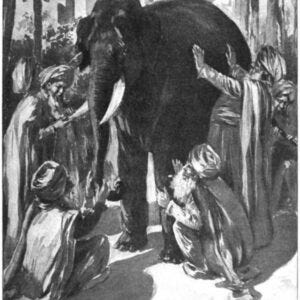
The “Blind Men and the Elephant” Parable: This image vividly illustrates how different schools of psychology (and people in general) grasp one piece of the truth and mistake it for the whole. Jungian psychology tries to honor all those perspectives.
Because this approach encompasses the diversity of human experience and the unconscious, which, by definition, can never be fully known, the parable of the blind men and the elephant is a powerful image for illustrating what is happening in both Jungian psychology, the field of psychology as a whole, and in each of us as we try to relate to our psyche and unconscious. The story concerns a group of blind men who have never encountered an elephant and learn its nature by touching it. Each blind man feels only a different part of the animal’s body, such as the side or the tusk. They then describe the animal based on their limited experience, and their descriptions of the elephant differ. In some versions, they suspect the other person is dishonest and come to blows. The moral of the parable is that humans tend to claim absolute truth based on their limited, subjective experience while ignoring others’ equally valid subjective experiences.
It is easy to see how each branch of psychology and psychotherapy, such as cognitive, somatic, emotionally focused, trauma-informed, relational, developmental, behavioral, social, psychodynamic, personality, etc, has focused itself. We can easily become grandiose when we study only one system, believing we have the right way to understand people and the proper therapeutic methods. Just like each branch of science or religion can do the same. However, as the parable illustrates, they are all just different methods of describing the same thing from a limited perspective. When we become attached to a single right way and try to defend it, it can become violent and ruin relationships, creating further division. Jungian Psychology attempts to educate the practitioner from the perspective that all ways of seeing are valid, and that it is up to the therapist to understand their own ways of seeing and being, and how they compare and relate to the other, while guiding the client to find their own, without dogmatically telling the client what to do. As you can imagine, it takes a lot of work and education to appreciate and see things from many different perspectives.
It Avoids Being Too Bossy: It requires maturity on the part of both the client and the therapist to avoid the “authoritative trap” of wanting someone to give the “right way.” It teaches you to orient yourself.
We all want someone to tell us the right way sometimes, especially when we are at our lowest or most lost. But taking the time to learn to orient ourselves to ourselves and the world around us helps us avoid getting lost and teaches us how to navigate unfamiliar terrain in the future. It Works (Eventually). When we learn what works for us and how other things work for other people, it is much easier to navigate the world and the people around us. That is why there is evidence to suggest depth-oriented approaches and Jungian Psychotherapy in particular is effective in creating long-lasting change . Recognizing we each have things that work better for us, and everyone is different, is a much-needed perspective in our modern, divisive world, which brings more peaceful interpersonal relationships.
So Many Names, Still No Perfect One. Despite being involved in many different forms of Jungian study over the years, I’ve never heard a term to describe it that I really liked. In my quest for a better name for Jungian Analysis, I asked ChatGPT for suggestions, thinking maybe I just haven’t been exposed to the best term yet, but hopefully, in its infinite scouring of the internet, maybe it found a better term. It gave me many suggestions, all accurate in their own ways, and at the same time emphasising one blind man’s perspective — that is, describing one aspect of it at the expense of others. Here are some additional names that convey its various facets.
Relational Depth Work
Relational Jungian Therapy
Depth-Oriented Relational Therapy
Experiential Depth Psychotherapy
Intrapersonal & Interpersonal Depth Work
Relational Soul Work
Soul-Oriented Psychotherapy
Archetypal Soul Work
Symbolic Process Work
Inner Life Work
Psychospiritual Depth Work
Work with the Living Psyche
Soul-Centered Therapy
Archetypal Depth Work
Therapy for the Inner Journey
Shadow & Soul Work
Depth Psychology Counseling
Inner Work Psychotherapy
Unconscious Process Work
Dream-Oriented Psychotherapy
Symbolic Depth Work
Integrative Depth Therapy
Mythopoetic Psychotherapy
Imaginal Psychotherapy
Deep Inner Work Therapy
Transformational Therapy
Therapy for Personal Meaning
Therapy for Self-Discovery
Insight-Oriented Therapy
Mind–Body–Soul Therapy
Therapy for the Deep Self
Inner Exploration Therapy
Whole-Person Depth Therapy
As you can see, many names describe one facet, but no one name can describe it all!
Avoid One-Sided Thinking: The system’s value is in recognizing and avoiding “one-sidedness,” making room for the complexity of reality. This applies to Jung’s theories, the author’s thoughts, and other psychological theories (e.g., CBT, IFS).
For me, one of the most valuable parts of the theory and process is the recognition and avoidance of one-sidedness. Many of the terms fall into this trap. But that doesn’t mean we should avoid words or terminology altogether; we need them to describe and differentiate. And then it is up to us not to let them lock us into a rigid, one-sided, rational way of thinking about things. That includes all of Jung’s theories as well! Neither Jung nor his students have the correct answers, but they point to important things to examine and relate to. So bring all the criticism of Jung and my thoughts on the process! It’s needed! And apply it to all of the other theories as well! CBT, IFS, somatic, trauma-focused, etc…. They are all helpful to a particular person at one specific moment. And let’s see if we can gently pry things open a bit more to get some more space to breathe and maneuver before we get so one-sided and fixed into one way of being in the world. That includes being “Jungian!” I consider this a key essential skill in our increasingly polarized world.
At its core, the process is one of seeing through to the core. That is where the word analysis comes in. Many people have negative associations with the word analysis. Still, the process is one of taking apart, analyzing carefully, seeing what is happening behind the scenes, so that one can be put back together more completely and function more smoothly without being derailed by habitual thoughts, feelings, or patterns. The negative views of analysis are worth unpacking in themselves. The world’s complexity and diversity, and his continued development and evolution throughout his life, account for the extensive rambling and diversity of thought in Jungian writing. However, it is aimed at seeing through, in whatever dimension the client is coming from or needs to work with, what is occurring in life at that time. Most importantly, it helps people derive meaning from and learn from their suffering, thereby growing, developing, and gaining greater mastery over their lives.
“We don’t so much solve our problems as we outgrow them. We add capacities and experiences that eventually make us bigger than the problems.” — C.G. Jung
Relational Aspects are Key: The work on alchemy shows that Jung’s ideas were very relational. The goal is to see past the personal drama to the deeper, “archetypal core” of your relationships.
In The Mystery of Human Relationship, Jungian Analyst Nathan Schwartz-Salant writes:
“In a sense, the alchemical way is one in which the analyst sees with the larger vision of the self; the scientific way is one in which he or she sees through the vision of the ego. The alchemical way sees through the eyes, whereas the scientific way sees with the eyes. Whereas the scientific way cannot encompass both opposites at the same time, the alchemical way can encompass both opposites simultaneously by situating them in a middle realm, the subtle body or the interactive field, the very existence of which scientific thinking denies” (p. 98–99).
Because of the collective cultural biases of our time and the introverted nature of many people who are drawn to Jung, the relational aspects of Jung are sometimes overlooked. Science is very important to much of our world, but it is one of many ways of seeing, all of which are important. Jung’s writings on alchemy and the Rosarium Philosophorum are foundational and closely aligned with the relational schools of psychoanalysis that emerged later in the century. But again, the key is that in a Jungian Analysis, we don’t get caught in the personal, but see through to the archetypal core of the dynamics at play in relationships with the analyst, intimate partners, family, and friends. It’s not about the ego’s desires, feelings, or unmet needs. Yet, being able to see and understand them, and their sources, can help reduce the extent to which they compel us and drive our lives.
It’s All About Individuation: This is the process of developing a relationship between your ego and your Self/soul to become your most whole self. It’s about letting the ego be a healthy part of you — no more, no less.
Lastly, as I’ve explored in other writings, Jungian Analysis is about aiding someone’s process of individuation. Individuation is a process of developing a relationship between the ego and the Self/soul, and all of the multitude of different parts of ourselves, which allows us to become as much of our full, whole self as possible in this lifetime. Not trying to destroy the ego or transcend the ego, just letting it be what it is. No more, no less. This is relativizing the ego.
Don’t Become a Jerk: Individuation means being able to enjoy and relate well to people who are different from you, rather than becoming a self-absorbed, judgmental hermit or dominating others with your beliefs.
We need a healthy ego and relationships with others as we individuate, because if we become a misanthrope who distances from or judges others, we’re only continuing to project our shadow. A good Jungian analysis helps us to appreciate people who are different from us more, rather than creating more distance. It is a process of recognizing and detaching from being controlled by the influence of the other — of our upbringing, of the other person, and of the culture, collective beliefs, and the collective unconscious, while remaining in relationship to the world. If we attend only to ourselves and do not relate well to or care for others, especially those who differ from us, we become more narcissistic. But we also cannot be infected by others’ beliefs and feelings.
It’s an Experience, Not a Theory: All the words and theories are just maps. The process itself is an experience, an initiation into yourself, the world, and transformation, using the symbols that arise in your own life.
You Have What You Need: The answers are already within you; you just need to look, listen, speak, and live.
No matter how we describe the process, it is NOT being led by the client’s, therapist’s, or someone else’s ego, or by anyone’s conceptualization of how to live one’s life. While reading more about Jung’s theories can dangerously lead to following someone else’s path or to intellectualizing the process, it can be helpful to understand the map. However, we cannot mistake the map for the terrain. There is nothing inherently bad about maps or intellectualizing; we don’t want to diminish or prioritize thinking, feeling, sensing, or intuition in our approach to ourselves or the world. We need all of these ways of being. I’ve tried to put some words to it while minimizing jargon. Still, even these words, along with the writings of other Jungian-oriented scholars, are insufficient to describe the process thoroughly. There is no adequate name to describe it. It’s an experience. It’s an initiation. Into yourself. Into the world. Into life. And death. And the natural process transformation. Through the symbols that present themselves to you in your one unique and precious life. You already have everything you need. You don’t need to look outside yourself for answers. They are right there. You just have to look. You just have to listen. And speak. And live.
Chickpea to Cook
Rumi — Translated by Coleman Barks
A chickpea leaps almost over the rim of the pot
where it’s being boiled.
‘Why are you doing this to me?’
The cook knocks him down with the ladle.
‘Don’t you try to jump out.
You think I’m torturing you.
I’m giving you flavor,
so you can mix with spices and rice
and be the lovely vitality of a human being.
Remember when you drank rain in the garden.
That was for this.’
Grace first. Sexual pleasure,
then a boiling new life begins,
and the Friend has something good to eat.
Eventually the chickpea will say to the cook,
‘Boil me some more.
Hit me with the skimming spoon.
I can’t do this by myself.
I’m like an elephant that dreams of gardens
back in Hindustan and doesn’t pay attention
to his driver. You’re my cook, my driver,
my way into existence. I love your cooking.’
The cook says,
‘I was once like you,
fresh from the ground. Then I boiled in time,
and boiled in the body, two fierce boilings.
My animal soul grew powerful.
I controlled it with practices,
and boiled some more, and boiled
once beyond that,
and became your teacher.’
Chuck Hancock, M.Ed., LPC, LMHC, is a licensed psychotherapist and Analytic Psychology Training Candidate practicing in Colorado and New York, guiding individuals, couples, and groups into greater wholeness.
Individuation Is Not Individualism by Chuck Hancock, M.Ed., LPC, LMHC As a psychotherapist working with individuals, couples, and groups, one of the most persistent yet least discussed themes I encounter is the tension between focusing on oneself and focusing on others. I’m also fascinated by how people relate to groups and how group influence shapes individuals. In our modern era, mass media and social media amplify this dynamic: it’s easy to absorb the ideas, beliefs, and emotions of the collective. Digital engagement—through likes, comments, and shares—magnifies one person’s voice into that of a group. Yet, paradoxically, one of the most common concerns I hear in therapy is, “I don’t want to just focus on myself.” Many prefer to look outward, often under the belief that it’s more altruistic and less selfish.
Music has been one of my greatest teachers in understanding this balance. Playing music in a group or band is an excellent metaphor. It requires individuals who have practiced their craft and developed skill, sensitivity, and awareness—people who can both listen and express. A musician who only focuses on others isn’t playing; they’re just listening. Likewise, a musician who only focuses on themselves can’t play something that fits rhythmically or harmonically with others. Musicians who never attend to their own development won’t grow. Good music emerges when each person has cultivated their musicianship, can listen and express authentically, and can adjust fluidly in real time relationship to others. This is individuation.
Individualism, on the other hand, is doing whatever one pleases without regard for the group. It often derails collective harmony. But individuated people—those who know themselves, can listen deeply to self and other, and can contribute authentically from that place, which can create beauty that enhances everyone’s life. When we act from an unindividuated place, we lose creativity at best, trainwreck the group with our out of sync rhythm, or become consumed by the group unable to do anything but merely repeat its chorus. When the group itself is toxic, the results can be destructive as the toxicity is amplified. When people say they don’t want therapy to be “just about themselves,” they raise a valid concern. A narrow focus on self to the exclusion of others can become pathological. The American Heritage Dictionary defines autism in part as “an abnormal absorption with the self; marked by communication disorders and disregard for external realities.” When we neglect the world around us and the validity of other people’s experience, we lose the relational grounding that keeps us human. But the reverse is also true—without self-understanding, it’s impossible to truly relate to others. How can we learn to “play well with others” if we don’t first understand ourselves—our capacities, limitations, and relational patterns? Well-facilitated groups can help people develop both self-awareness and relational skill. I sometimes wonder whether our cultural struggle with self-focus versus self-negation stems from our monotheistic heritage. The idea of “one god,” “one truth,” or “one right way” has deeply shaped Western consciousness—even among those who no longer believe in God. We still search for “the one” best answer, product, diet, or leader. By contrast, polytheistic and animist traditions honor multiplicity: many beings, many perspectives, and the relationships with and between them are the priority. This pluralism mirrors the inner world as well. Even modern systems like Internal Family Systems (IFS), which introduce multiplicity into psychology, can fall into a subtle monotheism by idealizing “Self energy” as the ultimate goal. It struggles to hold the tension in the paradox. While on one hand IFS proclaims there are “no bad parts,” it can hold a dogmatic agenda to increase the traits found in its limited definition of Self energy over other less shiny parts. An overfocus on the self is as problematic as neglecting it. The self is the only being we have 24/7 access to—the one we can truly know and influence. We can never fully know another person, but we can cultivate a deep, lifelong relationship with ourselves. To me, a healthy psyche can move fluidly between self-focus and other-focus, balancing both empathy and autonomy. When we either disregard or over-prioritize ourselves or others, I become curious about what may be causing that imbalance.
The myth of Narcissus offers a useful lens. Popular culture equates narcissism with self-absorption, but the story is richer than that. According to the myth, Narcissus was prophesied to “live a long life, so long as he never knows himself.” His mother, in a misguided attempt trying to protect him (a helicopter parent before there were helicopters), removed all mirrors from their home. Later in life, he rejected the love (and relationship) of all suitors, focusing only on his work. Deprived of reflection, he had no way to know himself. When he finally saw his image, he was transfixed—not out of vanity, but out of deprivation. He didn’t know who he was, so when he first saw his reflection, he became enamored. It was actually so important for him to see himself, that he was fixated in agony till he died on the spot. Having never been mirrored, he was starved for self-recognition. The tragedy was not his love of self, but the absence of it. True self-knowledge requires reflection from others; we come to know ourselves through relationship. There is also widespread misunderstanding of Jung’s concept of individuation. Many equate it with individualism or believe focusing on oneself is selfish. Often, this stems from discomfort with our own inner life. When we dislike what we see in ourselves, it’s tempting to turn outward, focusing on others under the guise of altruism. This “helping” can become a defense against self-contact. Since we can’t change others—especially if they’re unwilling—it’s ultimately ineffective. Individuation means developing a conscious relationship with all aspects of oneself—our diversity, contradictions, and complexity. While we may never know ourselves completely, we have the best chance of doing so because we are the only person we live with every moment of our lives. And it can’t happen without relationships to others, and the whole point is actually healthier relationships to others and a decrease in falling into a mutual unconsciousness. And, of course, living life as fully as possible with our unique constellation of gifts, strengths, weaknesses, shadows, and limitations, while being engaged with people and society at large. Individuation unfolds through relationship; it’s not isolation. Its purpose is more authentic connection—with others and with life itself. And since we can’t change others, focusing solely outward is futile; our most profound work begins within. Groups can profoundly influence individuation—for better or worse. When a group aligns with our true self, it can be supportive, affirming and transformative. When it doesn’t, it can distort or suppress individuality. Today, more than ever, we need deep self-understanding to resist the pull of groupthink. This happens through a greater focus on yourself and your relationship to others, not less of either. True individuality strengthens community; it doesn’t oppose it. Through music groups and therapy groups, I’ve witnessed how collective work can deepen individuation—helping people become more grounded in themselves while staying in meaningful connection. Real relationship requires difference. Without difference, there’s only sameness or fusion, not fruitful connection. Individuation allows us to be distinct and related at once. Jung himself emphasized this balance. In “The Psychology of the Transference” (Collected Works, Vol. 16), he wrote that as internationalism and the weakening of religion erode traditional boundaries, humanity risks dissolving into “an amorphous mass.” The antidote, he said, is “the inner consolidation of the individual,” which must happen consciously. Otherwise, we risk becoming “soulless herd animals governed only by panic and lust.” But Jung warned that individuation doesn’t mean spiritual aloofness; it must “cling to human relationships as to an indispensable condition.” True inner unity depends on conscious fellowship with others. (Jung’s full text in context is quoted below.) In the end, individuation is both an inner and outer process—a deepening relationship with self and a more authentic connection with others. Neither can exist without the other. The goal isn’t isolation, but integration: to live fully engaged in the world, with awareness of our unique gifts, shadows, and limitations, in relationship with the wider world. — Chuck Hancock, M.Ed., LPC, LMHC, has completed comprehensive training in the Hakomi Method of Experiential Psychotherapy—a mindfulness-based, body-centered approach. He integrates depth psychology and nature-based (ecopsychological) perspectives to explore the interplay between conscious and unconscious patterns in relationship to the world. Chuck guides individuals and groups in self-exploration, providing insight and a vessel for transformation. With over a decade of experience leading men’s interpersonal process groups, therapy groups, wilderness programs, and rites of passage, he is highly trained in trauma treatment, mindfulness, and somatic therapy. He continues his study of psychoanalytic work through JPA in New York and is licensed in Colorado and New York.
If you enjoy reading Jung directly, here are a few paragraphs illustrating his take on this:
[443]…Increasing internationalism and the weakening of religion have largely abolished or bridged over these last remaining barriers and will do so still more in the future, only to create an amorphous mass whose preliminary symptoms can already be seen in the modern phenomenon of the mass psyche. Consequently the original exogamous order is rapidly approaching a condition of chaos painfully held in check. For this there is but one remedy: the inner consolidation of the individual, who is otherwise threatened with inevitable stultification and dissolution in the mass psyche. The recent past has given us the clearest possible demonstration of what this would mean. No religion has afforded any protection, and our organizing factor, the State, has proved to be the most efficient machine for turning out mass-men. In these circumstances the immunizing of the individual against the toxin of the mass psyche is the only thing that can help. As I have already said, it is just conceivable that the endogamous tendency will intervene compensatorily and restore the consanguineous marriage, or the union of the divided components of the personality, on the psychic level—that is to say, within the individual. This would form a counterbalance to the progressive dichotomy and psychic dissociation of collective man.
[444] It is of supreme importance that this process should take place consciously , otherwise the psychic consequences of massmindedness will harden and become permanent. For, if the inner consolidation of the individual is not a conscious achievement, it will occur spontaneously and will then take the well-known form of that incredible hard-heartedness which collective man displays towards his fellow men. He becomes a soulless herd animal governed only by panic and lust: his soul, which can live only in and from human relationships, is irretrievably lost. But the conscious achievement of inner unity clings to human relationships as to an indispensable condition, for without the conscious acknowledgment and acceptance of our fellowship with those around us there can be no synthesis of personality. That mysterious something in which the inner union takes place is nothing personal, has nothing to do with the ego, is in fact superior to the ego because, as the self, it is the synthesis of the ego and the supra-personal unconscious. The inner consolidation of the individual is not just the hardness of collective man on a higher plane, in the form of spiritual aloofness and inaccessibility: it emphatically includes our fellow man.
[445] To the extent that the transference is projection and nothing more, it divides quite as much as it connects. But experience teaches that there is one connection in the transference which does not break off with the severance of the projection. That is because there is an extremely important instinctive factor behind it: the kinship libido….Kinship libido—which could still engender a satisfying feeling of belonging together, as for instance in the early Christian communities—has long been deprived of its object. But, being an instinct, it is not to be satisfied by any mere substitute such as a creed, party, nation, or state. It wants the human connection.That is the core of the whole transference phenomenon, and it is impossible to argue it away, because relationship to the self is at once relationship to our fellow man, and no one can be related to the latter until he is related to himself.
[446] If the transference remains at the level of projection, the connection it establishes shows a tendency to regressive concretization, i.e., to an atavistic restoration of the primitive social order. This tendency has no possible foothold in our modern world, so that every step in this direction only leads to a deeper conflict and ultimately to a real transference neurosis. Analysis of the transference is therefore an absolute necessity, because the projected contents must be reintegrated if the patient is to gain the broader view he needs for free decision.
[447] If, however, the projection is broken, the connection—whether it be negative (hate) or positive (love)—may collapse for the time being so that nothing seems to be left but the politeness of a professional tête-à-tête. One cannot begrudge either doctor or patient a sigh of relief when this happens, although one knows full well that the problem has only been postponed for both of them. Sooner or later, here or in some other place, it will present itself again, for behind it there stands the restless urge towards individuation. [448] Individuation has two principal aspects: in the first place it is an internal and subjective process of integration, and in the second it is an equally indispensable process of objective relationship. Neither can exist without the other, although sometimes the one and sometimes the other predominates. This double aspect has two corresponding dangers. The first is the danger of the patient’s using the opportunities for spiritual development arising out of the analysis of the unconscious as a pretext for evading the deeper human responsibilities, and for affecting a certain “spirituality” which cannot stand up to moral criticism; the second is the danger that atavistic tendencies may gain the ascendency and drag the relationship down to a primitive level.
From (Collected Works of CG Jung, Volume 16. Practice of Psychotherapy in the Essay Psychology of the Transference. Emphasis mine.)
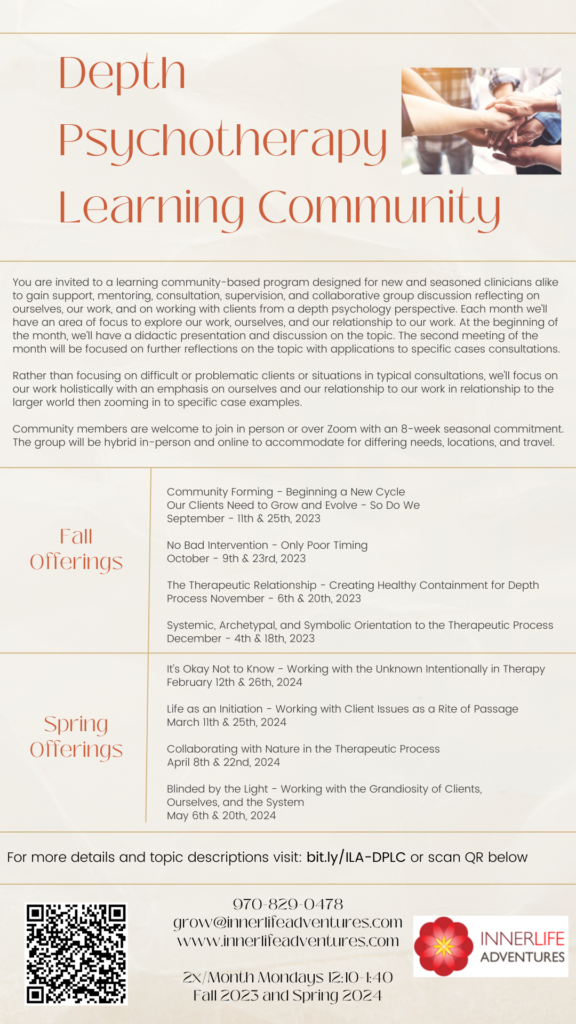
Mark your calendars and register soon for a new offering for professionals. We are forming a depth-oriented learning community next fall to continue growing to better serve our community. We believe the best therapists never stop reflecting on themselves and their work through their own therapy and continued growth process, no matter how long they have been practicing. Come join our learning community to continue your growth from a holistic depth oriented frame that includes many different modalities.
My Life is the Medicine is a new podcast hosted by Chuck Hancock. Chuck sits down to have conversations with people to look at how life has provided numerous lessons and initiations already that we sometimes overlook. Instead, we get lost seeking new, bigger, or better experiences.
In the age of abundant experts and gurus, we take the subversive stance that you are actually the only expert you need for your own life. By looking closer at your own life experiences – both the ones that felt good and the array of challenges you had, you can harvest all the wisdom and medicine you need to guide your unique life and offer your unique gifts and wisdom to the world. We have conversations with ordinary people to look closer at how everyday experiences of living life have shaped us and taught us profound lessons. Often we don’t think much of our choices and experiences, but in reality, they all have a profound meaning. Instead of just moving from one thing to the next, we can slow down and pause to integrate the initiations that life has already provided, to become even more whole, balanced, and able to bring the medicine of our life, the medicine we’ve already been given, into the world.
If you’ve been wanting to join the Men’s Group, good news! There are two openings for new members in our Men’s Interpersonal Process Group.
This men’s interpersonal process group can help you get more real, more honest with yourself and others propelling you into deeper relationships and deeper success through challenge and support by other men. It is a real-time lab, where you will experience yourself and others with greater awareness and be able to try new behaviors and ways of relating to being more effective in your life.
All topics and goals are welcome. Common themes are anger, depression, anxiety, personal identity, masculinity, relationships with women and/or other men, assertiveness, sex/sexuality, disconnect from emotions, work problems, fatherhood, confidence/self-esteem, accountability, honesty, spirituality, and finding purpose and meaning in life.
This group has been running weekly for the past 5 years facilitated by Chuck and over a decade prior to that facilitated by a psychologist who retired passing it on to Chuck. The long-running stability, diversity of age, background, and experience of the members, and experience of the facilitator are rare.
The ideal man will have had previous or current experience in therapy or other personal growth, but motivation and desire for greater self awareness will also enable you to benefit if this is your first growth experience.
All men are welcome in this group. You are welcome with all of your struggles, your gifts, your challenges, your gender, your sexuality, your personality, your pain, your shame, your questions, your desires.
All of you are welcome here! Tuesday Evenings 5:00-6:30
$50 per group. 8 week minimum commitment, but most people will want to continue on long term for the support, authentic relationships, and unique opportunity to grow with a safe, established, circle of men and trained, experienced, professional facilitator.
Facilitated by: Chuck Hancock, M.Ed., LPC. Chuck has over a decade of experience participating in and leading men’s groups, experiential groups, therapy groups, wilderness groups, interpersonal process groups, ritual and rites of passage programs, and teaching college courses. Chuck is highly trained in treating trauma, mindfulness, somatic therapy, and is a member of Colorado Group Psychotherapy Society and a perpetual student of intrapersonal and interpersonal relationship patterns.
A Depth Psychology Growth Group Bridging Inner Life and Outer Life Adventures
Some Definitions of Soul
an active or essential part
the part of the human being that thinks, feels, and makes the body act
the quality that arouses emotion and sentiment
energy or power of mind or feelings; spirit; fervor
the cause of inspiration or energy; leading spirit; prime mover
spiritual or moral force
the embodiment of some quality; personification
the spirit of a dead person
the immaterial essence, animating principle, or actuating cause of an individual life
a person’s total self
You may or may not believe you have a soul. That is not a prerequisite for this group. If you have a desire to deepen your connection with, relationship to, and grow the health of any of the above descriptions, this group is for you. This group is a space to learn about and work with your psyche, personal psychology developed by your experiences and narrative about those experiences, interpersonal relationships (how you show up with others), and the transpersonal (anything bigger than and beyond yourself).
Join us in community for depth healing utilizing the map and mirrors of depth somatic experiential psychology. This group will bridge the world of our ordinary waking life roles and structures with that of our inner world. This is not a group about fixing you, teaching you skills, or requiring you to be “better” – rather it is a group where all of you, in your brilliance and in your struggle with shadow, is welcome. It is a group that is led by psyche, soul, and spirit informed by your life and experience facilitated by a trained guide (not a teacher).
In this group, you bring the topics – based on what is alive in you. What is challenging you? What is inspiring you? What is showing up in your world that feels impactful or meaningful? Whether that aliveness is a dream you had, a poem or song that moved you, a meditation practice that taught you, a social media post that triggered you or brightened your day, grief that brought you to your knees, a stuck-ness so tight it paralyzes you or a movement that opened or freed you, this group is a space to bring more life and soul into your world in a community of fellow practitioners.
Who is this group for?
In the group process, there are many “problems” or pain points that can lead someone to join. It could be anxiety in general, or about the state of the world and its political, social, economic, and health issues. It could be that you are feeling depressed, stuck, stagnant, alone, misunderstood, or constantly sad. You may have a hard time knowing your place in this ever changing world. This group starts with the philosophy that we are all human, and we are all in this together. And through working through our individual “problems” together, we help each other. And perhaps even see that they are not problems, but invitations to grow. This group is for people willing to engage in their own healing by giving and receiving support, and opening to wisdom and support of a variety of modalities that connect you with your heart, mind, body, and soul.
We aim toward self leadership and self actualization. How do we do that?
We are all struggling to know and become the fullest version of our “real,” true, unique selves. We create a space to learn more about ourselves and experience new aspects of ourselves through content, process, and interpersonal relationships with other group members.
We recognize we have the tendency to deny our own needs and feelings. To pretend to be someone we aren’t or to avoid facing our true self inhibits growth. In this group, we take responsibility for owning our needs and feelings and expressing unexpressed thoughts, so the facilitator and other group members co-create the space to meet those new places in yourself and possibly have your needs and feelings met in an embodied way.
We believe each individual is endowed with the urge to expand, develop, mature, and reach self-actualization. We believe that true growth and healing come from within, and this group is designed to help facilitate that process.
Even in the best of times, it is easy to fall into despair – by not living the life that is yours to live or by feeling disconnected from the greater story of life and your place in the order of things. In these times of chaos and uncertainty, this group will help you reconnect to the life that is yours to live and reconnect you with the bigger picture and meaning to provide fuel and inspiration for the challenges we face.
Logistics
Ongoing. Weekly. Thursdays 11:30-1:00. In person with a zoom in option for health or travel.
Open to all genders age 25+.
8-week minimum commitment to allow for relationships and group containers to form. Stay as long as the group is beneficial to you.
Financial Investment $30-$60 per group sliding scale.
About the facilitator:Chuck Hancock, M.Ed, LPC is passionate about group work being an important part of our growth and healing journey. With over a decade of experience guiding individual and group processes in council, dreamwork, interpersonal process groups, psychodrama, meditation, Hakomi somatic psychotherapy, ego state (parts) work, Jungian psychology, movement, music, and nature based practices. He weaves all of these practices together to help clients locate themselves in the world co-creating new experiences of authenticity, depth, meaning, insight, and inspiration. With the diversity of members, modalities, and lineages the community formed in a group experience offers more possibility and amplification of the growth process.
To register for more information to decide if this group is right for you, email [email protected] or call 970.829.0478.
“The guest is inside you, and also inside me;
you know the sprout is hidden inside the seed.
We are all struggling; none of us has gone far.
Let your arrogance go, and look around inside.
The blue sky opens out farther and farther,
the daily sense of failure goes away,
the damage I have done to myself fades,
a million suns come forward with light,
when I sit firmly in that world.
I hear bells ringing that no one has shaken,
inside “love” there is more joy than we know of,
rain pours down, although the sky is clear of clouds,
there are whole rivers of light.
The universe is shot through in all parts by a single sort of love.
How hard it is to feel that joy in all our four bodies!
Those who hope to be reasonable about it fail.
The arrogance of reason has separated us from that love.
With the word “reason” you already feel miles away.”
Thankfully, there is no shortage of advice available on how to reduce stress and have more peace. In our (over) information age, practically any mainstream media, social media, and all the flavors of helpers have made clear the benefits of mindfulness, yoga, exercise, and ….
Yet for some reason, people are still struggling, in some ways more than ever! Why is that?
Yes, you could point to the pandemic along with social and political upheaval, however if we are really honest, you’ll see these problems existed long before 2020. In the Interpersonal Process Men’s group I run, whenever someone would start to blame the pandemic and social isolation, I would ask, “So which of these problems that you are struggling with the most are new since the start of the pandemic?” The answer was always none of them.
When I get new clients who have been following all the media advice, the first sessions sometimes sound like, “I know I just need to meditate more, or exercise more, or talk to my partner about it, and it will all be fine.” That’s not wrong, but it ignores the fact that something is keeping them from actually doing it, and worse it can be turned into a “should weapon.” That is “I should do this, I know this, what is wrong with me for not?”
Further, all of these skills fall into the category of “coping skills.” These are things that you can do either immediately or proactively reduce stress and live a healthier life. They don’t, however, actually change any of the deeper patterns that create high levels of stress in the first place. I’ve worked with many highly educated, top-of-their-field type people who have very disciplined self-care and meditation practices, yet are still struggling and suffering deeply. The higher you climb, and the higher the stress, the more coping skills become a band-aid, not a cure.
So what brings true peace then? In my experience, it is knowing yourself deeply, which includes knowing your human ego and what influences it, as well as knowing your soul and being in harmony with yourself. This means disarming the critical voices and being able to love and see the value of all parts of us. Once we know these things, we can then live in better balance and alignment with our values and purpose. This does not mean retreating from society, changing careers, having a better education, or a better-paying job. Rather, it means you know how to engage fully with life, effectively coming from a place of knowing and trusting in yourself.
“In the midst of winter, I found there was, within me, an invincible summer.
And that makes me happy. For it says that no matter how hard the world pushes against me, within me, there’s something stronger – something better, pushing right back.”
― Albert Camus
Fully knowing yourself and achieving a fuller consciousness happen through living life and through honest self-reflection and self-appraisal, which can only occur in the context of a relationship with others. If we do it alone, we stay stuck because we can’t see our blind spots. Meditation and mindfulness is a great start and an essential tool. But it doesn’t fully illuminate all parts of ourselves like being in a therapeutic relationship with a trusted mentor, guide, therapist, or friend.
So, don’t just settle for coping while adding more and more self-care to your busy schedule, especially if you then don’t get it done and beat yourself up about it. Healthy coping and self-care routines are a great start and necessary foundation, but eventually you’ll need to get off the treadmill and carve out the time to truly know yourself in your shadow and in your brilliance. And then you will be free to thrive in the world, no matter what challenges are thrown at you.
Chuck Hancock, M.Ed, LPC is a Licensed Professional Counselor in the state of CO. He has completed comprehensive training in the Hakomi Method of Experiential Psychotherapy, a mindfulness mind-body centered approach. Chuck guides individuals and groups in self-exploration providing them with insight and tools for change. He also incorporates nature as a therapy tool to help shift perspective and inspire new patterns.


 The main character, Carol, is a reluctant, chaotic, alcoholic hero who wants to save the world and restore it to its former state. At first motivated by her grief and loss, which eventually gave way to loneliness. She begins befriending the collective and settling into the new normal. Eventually, though, she recognizes all that is lost and the moral problems obscured by the collective’s kindness, and she starts to investigate, discover, and analyze everything she can about them, hoping to find a way to set things straight.

 This article examines the differences between ego-based and soul-based psychological work and why both are necessary at different times. We should not conflate the two.