New outdoor nature based men’s group offering starting in March as soon as the group is full.
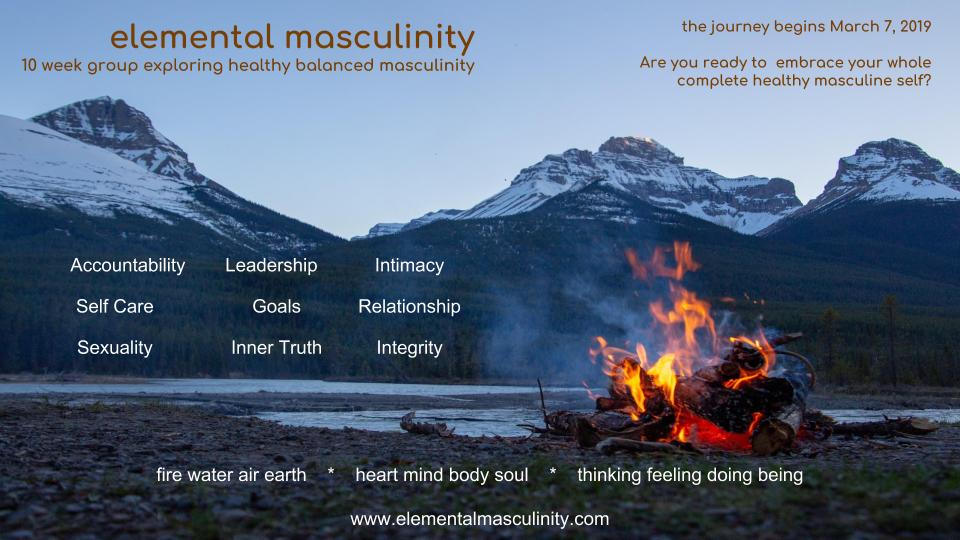
elemental masculinity flyer
Learn more:

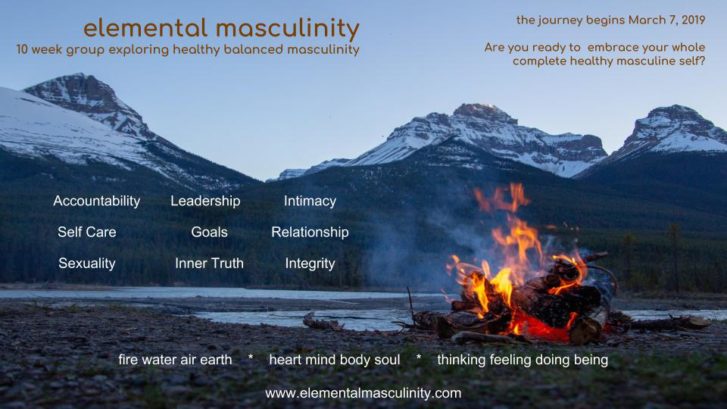
New outdoor nature based men’s group offering starting in March as soon as the group is full.
elemental masculinity flyer
Learn more:

With these elements, trust can be built, and it can be destroyed.
While it is common to make trust black and white and say things like, “I trust you” or “I don’t trust you,” trust is anything but black and white. It is actually more of a spiral, you c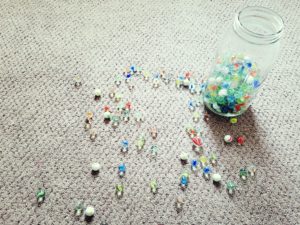 an trust someone with one piece of information, but not another. Then trust deepens, and that thing that wasn’t safe to say or do before becomes safe, while there are still other things that are unsafe with the current level of trust.
Charles Feltman defines trust as this: “Choosing to make something important to you vulnerable to the actions of someone else.” And his definition of distrust follows with, “What I have chosen to share with you that is important to me is not safe with you.” Wow. That is clear. That “something” could be anything. Your feelings, hopes, dreams, desires, wants, needs, body, favorite objects, or anything important to you. So, how we trust, really?
To learn how to trust, Dr. Brene Brown dug into her own research and research by a well-known relationship expert John Gottman. Gottman says: trust is built in small moments over time. Stopping what you are doing to attend to someone in need or pick up the phone to check in when you are thinking about someone and asking about specific things you know are important to them builds trust and connection. Failure to choose connection and support when the opportunity is there is a betrayal of trust and relationship, such as when your obviously upset partner walks in the door with a big sigh and you ignore them choosing a screen instead.
An example I use often with clients is a jar of marbles. We automatically give more or less marbles to other people when we first meet, based on how they look, talk, common people they know, credentials, and our own degree of trustworthiness. Each marble represents a building block of trust, either given freely or earned by demonstrated trust. Breaches of trust can be small, like not returning a phone call or text, or they can be large like a damaging lie, slander, or an affair. The marbles can be dumped out slowly or quickly, but they have to be put back in one at a time.
Another surprising finding by Dr. Brown is that asking people for help when needed helps prove trustworthiness. It shows we won’t take on more than we can handle and we will ask for help when we do. When we don’t do this, people won’t come to us because they don’t believe we can handle what they want to ask or share. This one was huge for me and speaks so much about honoring ourselves and our limits and boundaries.
Diving deeper into trust, we see when we trust, we are BRAVING connection. With ourselves and with others. Brene Brown came up with the acronym BRAVING to describe in more detail the components of trust.
B – Boundaries – When I know your boundaries, and you hold them, and you know my boundaries and respect them, there can be trust. Without clear boundaries and respect of boundaries, there is distrust. Boundaries create safety; safety creates trust. Its why we build fences and walls. So much more can be said about this, I’ll save it for a future post.
R – Reliability – There can only be trust if you do what you say you are going to do and I do what I say I’m going to do consistently over time, not just once. How many times do we not do what we say we will do. “It was really great seeing you. Let’s get together again soon for lunch.” And it never happens? I know it’s just a saying and everyone says it, but trust is broken. Let’s just share the awkwardness of knowing it may be a while before we meet again. Being reliable creates trust.
A – Accountability – You are allowed to make mistakes. I can only trust you if when you make a mistake you are willing to own it and make amends and you can only trust me if I am allowed to make a mistake, be honest about it, and make amends. Being accountable creates trust.
V – Vault – What I share with you, you will hold in confidence. What you share with me I will hold in confidence. When we gossip about someone sharing something that is not ours to share, we think we are connecting over juicy information, but we are proving ourselves untrustworthy. Keeping confidence creates trust.
I – Integrity – I cannot be in a trusting relationship with you unless you act from a place of integrity and encourage me to do the same. What is integrity? Doing what is right, even when nobody else is looking. Brene’s definition is far more challenging and eloquent. “Choosing courage over comfort. Choosing what is right over what is fun, fast or easy. Practicing your values, not just professing your values.” Let’s meet each other in integrity. Being in integrity creates trust.
N – Non-Judgement – I can fall apart, ask for help, struggle, suffer, and make mistakes without being judged by you and you will find the same with me. Without this, we can’t be safe to ask for help and we can’t truly reciprocate it. When we assign a value to reaching out or needing help by thinking less of the other person or judging them in any way for what they are doing or feeling it destroys trust. Or even more importantly when we think less of ourselves for reaching out or needing help, we are consciously or unconsciously thinking less of the other person for their needing help. You can’t have true trust if you are judging the other person, or ourselves in big or small ways. Acceptance creates trust.
G – Generosity. Our relationship is only trusting if you can assume the most generous thing about me and my intentions and then check in about it if it doesn’t feel right. I will do the same for you to help us both stay in integrity. There is a lack of trust when we assume poor intentions and don’t check it out with the other person. Assuming positive intentions and having unconditional positive regard creates trust.
Building trust, strengthening the weak spots, and sharing about breakdowns in trust facilitates connection. Trust makes connection easy.
And these same principles apply to trusting and connecting with ourselves as well as trusting and connecting with someone else. Looking at ourselves: How well do we know our own boundaries and honor them? How often do we do what we tell ourselves we are going to do? How good are we at admitting and forgiving ourselves for our mistakes and shortcomings? How good are we at choosing who to share with and how much is in our best interest to share? Are we in integrity with ourselves and our value? Can we refrain from judging and being critical of our thoughts and actions? Do we assume that we are doing our best and had positive intentions? By these measures, do we really trust ourselves?
When we become aware we are not trusting ourselves or are in connection with ourselves, reflecting on these definitions can give us benchmarks. This map shows us where our obstacles are to deeper relationship, trust, and connection are happening so we can name it, repair it, and ask for what we need from ourselves and from others. It’s important to build trust first within yourself.
When you trust yourself and are in integrity with yourself, or own it and make amends quickly when you are not, it is easier to be a trustworthy person, which makes it easier to assume the good intent of others, to respect your own and other people’s boundaries, and have honest check in’s with others, and build safe, trusting relationships.
You can use BRAVING as a benchmark to identify breaches of trust in yourself, in your relationships. And then it’s easier to correct course and repair trust faster.
Chuck Hancock, M.Ed, LPC is a Licensed Professional Counselor in the state of CO. He has completed comprehensive training in the Hakomi Method of Experiential Psychotherapy, a mindfulness mind-body centered approach. Chuck guides individuals and groups in self-exploration providing them with insight and tools for change. He also incorporates nature as a therapy tool to help shift perspective and inspire new patterns.

How Leave No Trace (LNT) Camping Ethics Apply to Your Shame and Pain
Yes, you read that right! Scatter your shame and pain, intentionally! What have you been doing with your shame and pain? If you are like most people, you hide it, deny it, or perhaps unload it on one best friend or your romantic partner. But the problem with that is it comes out sideways, when you least expect it. Or it stagnates and rots inside you. Or you overburden your best friend or partner expecting too much. So what do you do about it?

In LNT principles, you minimize your impact on our environment by scattering cool ashes and scattering your strained dishwater. Why? You pack out trash, but you don’t want to carry dead organic material from the past with you. That is best left to return to the earth to be broken down and fertilize the next generations of life And leaving a pile of waste is an eyesore, attracts animals, and over-taxes one spot. Especially if you leave food scraps in a pile, it will decompose and stink.
Pain and shame is a natural organic human experience. Just like the lifecycle represented with food and ashes. Our emotional “yucky stuff” needs to be handled just like physical “yucky stuff.” It can’t be ignored, don’t let it accumulate, don’t leave it for others to deal with. Give it a proper treatment by straining out the big bits, and dispersing the small pieces where they don’t cause harm and in some cases can even nourish other forms of life.
Shame and vulnerability researcher Dr. Brene Brown advises that we handle these feelings just like we strain our dishwater or separate ashes from incompletely burned charred firewood. First separate what you do from who you are. You may have done something you regret, but it doesn’t mean you are bad. Guilt is feeling bad about what you did, which can be a healthy emotion that causes a change in behavior. Shame is saying who you are is bad. This is destructive and causes future harm, to yourself obviously, but to others in your life as well. Shamed people shame people. Don’t allow your shame to fester, rot, or accumulate or it will impact others by you shaming or judging them.
After we strain our dishwater or cool our ashes, we spread them so we don’t concentrate them in one spot. The next step of dealing with shame or pain is the same. Find lots of people who can share a little bit of your story. Shame lives in secrecy. The best way to free yourself of shame or pain is to shed light on it rather than hide it. Unloading everything on one person can be too much. But by having good friends, a partner, family, a support group, a therapist and/or therapy group, etc you can share appropriate parts with trustworthy people, eventually freeing yourself of the burden, while not overtaxing one person.
If you put shame in a Petri dish, it needs three things to grow exponentially: secrecy, silence and judgment. If you put the same amount in a Petri dish and douse it with empathy, it can’t survive. The two most powerful words when we’re in struggle: me too. – Brene Brown, TED Talk (linked above)
Doing what I do, I am exposed to the pain, shame, and trauma of lots of people. And of course I’m human too and create plenty of my own! I’m trained to work with these hazardous feelings and am better equipped than your average friend, but even I can’t hold that myself. And you too may have experienced more than your fair share of “yucky stuff,” so this tip can apply to you too. Over the years of doing therapy, I’ve assembled my own pain dispersal system. I have my own therapist, a men’s group, mentor(s), a peer consultation group, and several good male and female friends, a great relationship with my romantic partner, and spiritual practices and rituals that I can share and disperse my own pain and “yucky stuff” with. Due to confidentiality, I obviously can’t and don’t talk about other people’s details, but I certainly can talk about my own pain and how I am impacted by what I experience in my life. Often that is a better way to connect anyhow. People don’t always need to know the details, and often can’t even relate to your specific experience, but everyone can connect and empathize with the feelings you have. Get to the point, get real, and connect on your shared emotional human experience. And assemble a your own personal tribe of people so each person can handle a little bit, and nobody gets overburdened, especially the people closest to you.
When you don’t own your story, your story owns you. When you own your story, you are free to edit and re-author it any way you choose. When you don’t own your story, it controls your feelings and behaviors, often perpetuating the shame and pain. When you own your guilt, shame, or pain and spread it intentionally, it doesn’t harm you or anyone else. In fact, sometimes it can be a gift to teach others from your experience. But when you hold it, deny it, or repress it, it rots and overburdens you. It gets worse and will get spread unconsciously and possibly cause more harm to you and others in your life. With great circle of trustworthy people you can be real and vulnerable with, you can unburden yourself, without burdening others to free yourself up to write the next chapter of your life with more joy and ease. Spread it! Carefully and intentionally.
Bonus Videos on the Topic:
Here’s Mindfulness Based Stress Reduction (MBSR) expert Jon Kabat Zin speaking about this topic and to use mindfulness with these feelings.
And for a lighter more humorous look, here’s comedian Kyle Cease.
Chuck Hancock, M.Ed, LPC is a Licensed Professional Counselor in the state of CO. He has completed comprehensive training in the Hakomi Method of Experiential Psychotherapy, a mindfulness mind-body centered approach. Chuck guides individuals and groups in self-exploration providing them with insight and tools for change. He also incorporates nature as a therapy tool to help shift perspective and inspire new patterns.

As I was hiking this morning, I was watching myself, being aware of what I was doing, thinking, feeling, and sensing and a thought occurred, that mindfulness is about so much more than our mind. As a former software engineer, I was living in a world of thought and cognition, which of course is helpful for many things, but not everything life gives us. There is so much more to the mind than just thought, and if our definition of mindfulness is  only on thoughts or the absence of thought, there’s so much more we are missing.
Don’t hear me wrong, being more aware of our thoughts, evaluating them as fact/opinion, true/false, helpful/not helpful and working to actively change thought is an essential first step. It is the foundational basis of Cognitive Behavioral Therapy (CBT) which has been the primary treatment for a couple decades now, but of course there is more.
First let’s be clear that our “mind” is different than our brain (the lump of cells in our skull). And even our brain is not just thought. As anyone who has seen the movie Inside Out will know, there are memories, emotions, core beliefs, and more that shape our personality and all are contained in our brain. (As a side note, if you have not seen this movie yet, go see it!) Our “mind” is much broader and includes all of the components of the brain mentioned above, the remainder of our nervous system, body, and more. Dr. Dan Siegel, clinical professor of psychiatry at UCLA School of Medicine defines the mind as “an embodied and relational process that regulates energy and information flow.”
His definition is dense and can be broken down into much detail, but for now I just want to elaborate on a couple of points. The mind regulates information flow – taking in information from our environment, information occurring within us, and information that may or may not leave us through expression. The mind regulates energy input and output, such as the clamping down and low energy state known as depression. The mind is embodied, that it is includes our central nervous system and peripheral nervous system that runs throughout our body and feels and expresses through the body. And the mind is relational – our mind is influenced, shaped, impacted, and includes our relationships of the past and present.
So when we talk about mindfulness, we have to keep in mind that our mind is not just our brain, which is not just our thoughts. It’s helpful to start with tools that help us learn awareness and focus, but then we also need to keep in mind that when we talk about mindfulness, we also need to consider and work with body-fulness, emotion-fulness, sense-fulness, thought-fulness, memory-fulness, self-fulness, other-fulness, relation-fulness, heart-fulness, personality-fulness, habitual behavioral pattern-fulness, and all the other components of being human.
You can try some exercises and see a diagram of this on my Mindful Practice page.
To explore all these areas, it takes awareness, skill, willingness, patience, and it is quite helpful to have a guide. After all, how do you explore the relational aspects of mind by yourself? Further, most of us tend to stay in our habitual comfort zone, and having someone to help point out the things we are not seeing on our own is an important part of the process of growth and healing. Exploring all of this is what Dan Siegel calls “Mindsight,” and I call it your Inner (and outer) Life Adventure.
Happy exploring!
Chuck Hancock, M.Ed, LPC is a Licensed Professional Counselor in the state of CO. He has completed comprehensive training in the Hakomi Method of Experiential Psychotherapy, a mindfulness mind-body centered approach. Chuck guides individuals and groups in self-exploration providing them with insight and tools for change. He also incorporates nature as a therapy tool to help shift perspective and inspire new patterns.
A reflection on Relationship, Connection, Trust
Around the new year, I reflect on the past year and reevaluate my direction for the new year. This year, I’m clear that I’ve made a lot of progress on my goals, and yet they are big enough that I’m still working toward them. Sometimes it takes years or even a lifetime of revisiting and refining the same things to accomplish the things that are really important to us. That’s what it is like to live your mission. What is your mission?
My mission is connection. Connection to myself, to others, to my community, and to the world as a whole. And partly because we teach what we need to learn for ourselves and because I want to share the gifts and lessons I’ve

Taking Steps, Exposed, Vulnerable
received in my life, much of the way I work with individuals, couples, and groups invites people into deeper connection with themselves, each other, and the world as well. Your mission may be different, yet I’d bet there is something in what I’m learning about living my mission that will help you with your mission as well. (Or if nothing else, you might find some ideas that help with your relationships.)
In recent years, I’ve learned that the two biggest things that hold me back are fear and lack of trust (which are closely related by the way). So when I stumbled on a video of Brene Brown outlining what it really takes to trust, I ate it up. It shined a spotlight on where I’ve been falling short in my mission and inspired me to take more responsibility for trusting and connecting – both to myself and others. Wait, so what is trust?
Charles Feltman defines trust as this: “Choosing to make something important to you vulnerable to the actions of someone else.” And his definition of distrust follows with, “what I have chosen to share with you that is important to me is not safe with you.” Wow. That is clear. So , how we you trust, really?
To learn how to trust, Brene Brown dug into her own research and research by as well-known relationship expert John Gottman. Gottman says: trust is built in small moments over time. Stopping what you are doing to attend to someone in need or pick up the phone to check in when you are thinking about someone and asking about specific things you know are important to them builds trust and connection. Failure to choose connection and support when the opportunity is there is a betrayal of trust and relationship.
Another surprising finding is that asking people for help when needed helps prove trustworthiness. It shows we won’t take on more than we can handle and we will ask for help when we do. When we don’t do this, people won’t come to us because they don’t believe we can handle what they want to ask or share. This one was huge for me and speaks so much about honoring ourselves and our limits and boundaries.
Diving deeper into trust, we see when we trust, we are BRAVING connection. With ourselves and with others. Brene Brown came up with the acronym BRAVING to describe in more detail the components of trust.
B – Boundaries – When I know your boundaries, and you hold them, and you know my boundaries and respect them, there can be trust. Without clear boundaries and respect of boundaries, there is distrust. Boundaries create safety; safety creates trust. Its why we build fences and walls. So much more can be said about this, I’ll save it for a future post.
R – Reliability – There can only be trust if you do what you say you are going to do and I do what I say I’m going to do consistently over time, not just once. How many times do we not do what we say we will do. “It was really great seeing you. Let’s get together again soon for lunch.” And it never happens? I know it’s just a saying and everyone says it, but trust is broken. Let’s just share the awkwardness of knowing it may be a while before we meet again. Being reliable creates trust.
A – Accountability – You are allowed to make mistakes. I can only trust you if when you make a mistake you are willing to own it and make amends and you can only trust me if I am allowed to make a mistake, be honest about it, and make amends. Being accountable creates trust.
V – Vault – What I share with you, you will hold in confidence. What you share with me I will hold in confidence. When we gossip about someone sharing something that is not ours to share, we think we are connecting over juicy information, but we are proving ourselves untrustworthy. Keeping confidence creates trust.
I – Integrity – I cannot be in a trusting relationship with you unless you act from a place of integrity and encourage me to do the same. What is integrity? Doing what is right, even when nobody else is looking. Brene’s definition is far more challenging and eloquent. “Choosing courage over comfort. Choosing what is right over what is fun, fast or easy. Practicing your values, not just professing your values.” Let’s meet each other in integrity. Being in integrity creates trust.
N – Non-Judgement – I can fall apart, ask for help, struggle, suffer, and make mistakes without being judged by you and you will find the same with me. Without this, we can’t be safe to ask for help and we can’t truly reciprocate it. When we assign a value to reaching out or needing help by thinking less of the other person or judging them in any way for what they are doing or feeling it destroys trust. Or even more importantly when we think less of ourselves for reaching out or needing help, we are consciously or unconsciously thinking less of the other person for their needing help. You can’t have true trust if you are judging the other person, or ourselves in big or small ways. Acceptance creates trust.
G – Generosity. Our relationship is only trusting if you can assume the most generous thing about me and my intentions and then check in about it if it doesn’t feel right. I will do the same for you to help us both stay in integrity. There is a lack of trust when we assume poor intentions and don’t check it out with the other person. Assuming positive intentions and having unconditional positive regard creates trust.
Building trust, strengthening the weak spots, and sharing about breakdowns in trust facilitates connection. Trust makes connection easy.
And these same principles apply to trusting and connecting with ourselves as well as trusting and connecting with someone else. Looking at ourselves: How well do we know our own boundaries and honor them? How often do we do what we tell ourselves we are going to do? How good are we at admitting and forgiving ourselves for our mistakes and shortcomings? How good are we at choosing who to share with and how much is in our best interest to share? Are we in integrity with ourselves and our value? Can we refrain from judging and being critical of our thoughts and actions? Do we assume that we are doing our best and had positive intentions? By these measures, do we really trust ourselves? Can we achieve our mission if we don’t trust ourselves?
When we become aware we are not trusting or in connection with ourselves, reflecting on these definitions can give us benchmarks. This map shows us where our obstacles are to deeper relationship, trust, and connection are happening so we can name it, repair it, and ask for what we need from ourselves and from others.
To tie this all together: Do you know your mission? Are you living it? In every small moment? Can you achieve your mission alone or is it so big do you need the help and support of others? You probably need strong relationship with yourself and others to achieve your mission. Do you have strong relationship and connection with yourself and others? Do you trust yourself to achieve your mission? Do you trust others to help? If not, where are your obstacles?
Thanks for joining me on this small part of my mission. Will you join me for more?
Chuck Hancock, M.Ed, LPC is a Licensed Professional Counselor in the state of CO. He has completed comprehensive training in the Hakomi Method of Experiential Psychotherapy, a mindfulness mind-body centered approach. Chuck guides individuals and groups in self-exploration providing them with insight and tools for change. He also incorporates nature as a therapy tool to help shift perspective and inspire new patterns.

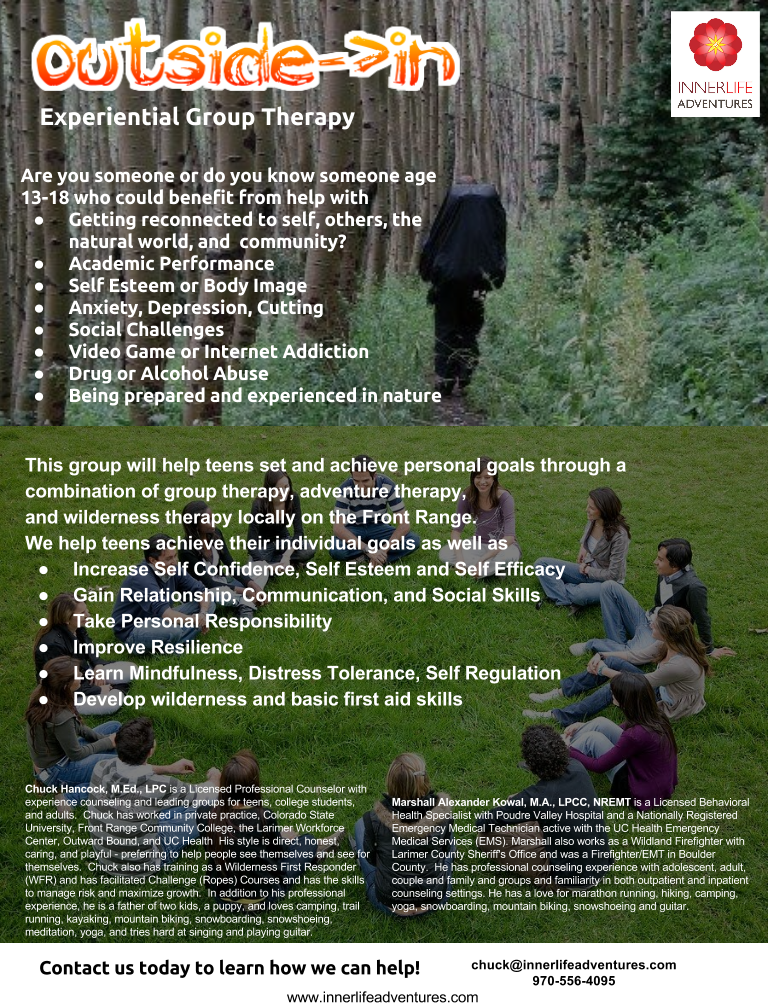
Join us for a new first of its kind hybrid group therapy and wilderness therapy group for teenagers locally on the Front Range based out of Fort Collins, CO. This outdoor group was created to offer the best of coaching, therapy, and wilderness adventures to adolescents without the cost and time commitment of traditional backcountry programs.
This group is open to all teens of all genders regardless of “issue” who are simply looking for personal growth by getting outside and joining in a community of peers, connecting with themselves, others, and nature. Through exploring themselves, overcoming challenges, developing new skills, and being guided by expert facilitators our participants learn to bring the best of the lessons and experiences of the outside…. in.
For more details, click here and or contact Chuck directly at [email protected] or 970.556.4095.
Download a pdf version of the flyer to print, email, and share with someone who could benefit.

With so many “healers,” coaches, counselors, psychotherapists, and psychologists out there practicing thousands of methods, there are many misconceptions about what therapy is and isn’t. I can’t dispel all the myths, but here are a few things I’d like you to know.
 1. People who go to therapy are not crazy. You are not crazy.
We all have challenges and unique ways of approaching them. Most people feel like they are unique and nobody has ever had the thoughts, feelings, or behaviors that they have. Guess what? We are all human. There is nothing inherently bad, embarrassing, or shameful about anything you are thinking or experiencing. Most of us only feel this way because we don’t take the risk to be vulnerable and share the details of our inner worlds with others. You can be assured, no matter what you are facing, it may be challenging, you may be coping in ineffective ways, but you are not crazy.
2. Relationship is everything.
There are literally thousands of theories and techniques for doing therapy. You know what the one thing is that research shows will be a predictor of a successful outcome? Relationship. The level of trust and safety you feel with your therapist is the best predictor of success. If you don’t feel able to explore the deeper levels of truth first with yourself and also with your therapist, it will be really hard to make lasting changes. Trust and relationship take time to build, really. It can’t be rushed. It is the most important thing we will do. Nobody exists outside of some sort of relationship, and most of us have limited or no access to a truly supportive, deeply caring, and profoundly accepting relationship like can be developed here.
3. I’m not here to give you advice.
You will probably want it at some point, but I am not the expert in you or your life. You are. My job is to help you gain more trust and confidence in your own ability to lead your own life. I will gladly offer  reflections of what you are saying, what it seems like you are saying that you are not aware of, and questions to help you get more clear, but your life is yours to live.
4. My job is not to psychoanalyze you.
See above. A good therapist will not claim to have all the answers. I certainly don’t. We are humans just like you. You are the expert in you. My job is to help you peel back the layers to become even more intimate with yourself, so that you know and feel that you are indeed the only one who can be the expert in you. And you are the only one that can make the changes in your life. My job is to be curious as we explore the unknown together, and maybe I can guide a little and empower you to continue with your own self-leadership.
5. All emotions are welcome. Especially anger.
Most of us have a challenged relationship with our emotions. Either we don’t feel or acknowledge them at all or we are totally ruled by them. Neither is helpful. Emotions serve a purpose: they repel us from things that aren’t good for us and bring us closer to things that are. Ignoring the wisdom of your emotions results in poor decision making and disconnection from yourself. And yet if your emotions are controlling you, you probably could use some balance by engaging your thoughts and rational mind more. The point is, therapy provides a safe and welcoming space where all your emotions are welcome, valid, and supported, even the ones that get a bad reputation such as anger. Emotions are an important part of being human.
6. You will probably backslide to old behavior patterns and I won’t judge you.
Most of us have been engaged in habitual thinking and automatic behaviors for a long time. There is a saying in neuroscience that says, “neurons that fire together wire together.” The longer you have a habitual way of thinking or behaving, the more that pattern gets imprinted in our brain. Our old patterns are kind of like the most popular hiking trails near town – they are well-trodden and easy to find. But when you try to make changes to your thinking and behaving, it is like starting a new trail by simply veering off the main trail. It takes many times walking the new path to wear it in, and even then it is still faint. It is much easier, safer, and more comfortable to stay on the familiar trail. It takes much more effort and intention to forge a new trail, but with time, it will also be easy for you to find and then you will have a choice of which path to take. Relapse is part of the change process, it is not failure. This is another reason it helps to have a guide who knows the terrain.
7. You deserve to be happy and only you are in control of that. I want to support you in having the life you want.
This is a complicated topic, but I want you to know that you only have one life and you deserve to enjoy it. Even if the changes you want to make seem huge and there are a lot of factors that seem in your way – relationships, finances, family, job, education, and more, there are ways to be happy in any circumstance, and there are ways to move toward something better for you. It’s worth it.
8. Therapy is weird. And special. And priceless. And takes courage.
Before people come to therapy, they usually try almost everything they can think of to do it on their own. Some approaches are helpful, others are not. People come to therapy for all kinds of different reasons. Therapy can help with many mental, emotional, and relational challenges – and even some physical (somatic) symptoms. But it can be hard to meet with someone who is a total stranger at first and talk about the most vulnerable and personal things that we sometimes don’t even want to share with our closest friends or family. And that is part of what makes it special and priceless. For most of us, we can’t find any other relationship like this where it is safe to talk about anything, and have it met with 100% acceptance, no judgment, and even some gentle support on how to do things differently.
Our automatic habitual thoughts and behaviors are mostly unconscious. Without outside input, it is likely we will stay stuck doing and thinking the same thing. When you are ready for a trained guide to take you out of the familiar and into a new life, we’ll be here. See you then.
~chuck
Edit: Right after publishing this, I came across this post written from a therapy client. Great insights from an experienced client’s perspective.
What do you think? Better yet, what do you feel? What do you experience? Let’s continue the conversation! You can find me at www.innerlifeadventures.com or email [email protected]. Want to meet? Here’s how.
Chuck Hancock, M.Ed, LPC is a National Certified Counselor, Licensed Professional Counselor, and a Registered Psychotherapist in the state of CO. He has completed comprehensive training in the Hakomi Method of Experiential Psychotherapy, a mindfulness mind-body centered approach. Chuck guides individuals and groups in self-exploration providing them with insight and tools for change. He also incorporates nature as a therapy tool to help shift perspective and inspire new patterns.

Authentic, attuned relationship is a huge focus of mine both personally and in my therapy practice. There is a lot of research supporting the importance of relationship as a healing factor. In this video, psychologist and sociologist Sherry Turkle who has been studying how technology changes not only what we do but who we are discusses the impact of technology on our lives. Some highlight quotes to tempt your curiosity:
“We expect more from technology and less from each other.”
“Technology appeals to us most where we are most vulnerable.”
“We are lonely, but we are afraid of intimacy.”
“From social networks to sociable robots we are designing technologies that give us the illusion of companionship without the demands of friendship. We turn to technology to help us feel connected in ways we can comfortably control.”
Relationships are hard, and messy, and we often don’t know what to say. Communicating only through technology gives us time to present our best self, craft the perfect message, but we miss each other in our authenticity. Despite being more connected than ever, I talk to more people than ever reporting feeling alone.
Watch this for a few reasons why:

Sherry Turkle: Connected, but alone?
And then let’s talk about how to get more authentically connected to yourself and others.
What do you think? Better yet, what do you feel? What do you experience? Let’s continue the conversation! You can find me at www.innerlifeadventures.com or email [email protected]. Want to meet? Here’s how.
Chuck Hancock, M.Ed, LPC is a National Certified Counselor, Licensed Professional Counselor, and a Registered Psychotherapist in the state of CO. He has completed comprehensive training in the Hakomi Method of Experiential Psychotherapy, a mindfulness mind-body centered approach. Chuck guides individuals and groups in self-exploration providing them with insight and tools for change. He also incorporates nature as a therapy tool to help shift perspective and inspire new patterns.

My heart is hurting for the children – the children who survived the shooting who were there in the school and all the children and teachers who attend schools everyday who were exposed to this news. My heart is hurting for the parents – the parents who lost their young children, the parents who’s children were in the school when it happened, and the all the parents around the world who send their children to school everyday. All of these lives are forever impacted. Rather than focus on the pain of the tragedy, I hope we can focus on the blessing. And it for those directly impacted, it will take time.

~chuck
What do you think? Better yet, what do you feel? What do you experience? Let’s continue the conversation! You can find me at www.innerlifeadventures.com or email chuck @ innerlifeadventures.com. Want to meet? Here’s how.
Chuck Hancock, M.Ed., LPC is a National Certified Counselor and Psychotherapist in the state of CO. He has completed comprehensive training in the Hakomi Method of Experiential Psychotherapy, a mindfulness mind-body centered approach. Chuck guides individuals and groups in self-exploration providing them with insight and tools for change. He also incorporates nature as a therapy tool to help shift perspective and inspire new patterns.

Here’s an article I wrote recently published in the fall edition of the Yoga Connection magazine.
– Jill Satterfield
~chuck
What do you think? Better yet, what do you feel? What do you experience? Let’s continue the conversation! You can find me at www.innerlifeadventures.com or email [email protected]. Want to meet? Here’s how.
Chuck Hancock, M.Ed, LPC is a National Certified Counselor, Licensed Professional Counselor, and a Registered Psychotherapist in the state of CO. He has completed comprehensive training in the Hakomi Method of Experiential Psychotherapy, a mindfulness mind-body centered approach. Chuck guides individuals and groups in self-exploration providing them with insight and tools for change. He also incorporates nature as a therapy tool to help shift perspective and inspire new patterns.