Some forms of isolation aren’t solved by more effort, insight, or self-improvement. They arise not because something is wrong with you—but because psyche was never meant to be carried alone.
This small, facilitated psychotherapy group offers a place to tend the deeper waters of inner life in the presence of others. It is a space for reflection, shared meaning-making, and slow relational work—where what is often held privately can be spoken, witnessed, and metabolized together.
Why Group?
Many people come to individual therapy having already done a great deal of inner work—thinking, reading, reflecting, understanding themselves more clearly. And yet something remains unmoved.
Group therapy works differently.
In group, isolation is named, shared, and gradually transformed through relationship. Experience is no longer held in the solitary mind, but enters a living relational field. Patterns emerge. Resonance happens. Something human and essential is restored.
This group is not about advice-giving or problem-solving. It is about presence, honesty, and the slow unfolding of psyche in relationship.
What This Group Tends
Chronic or subtle feelings of isolation or disconnection
Life transitions, midlife questions, or loss of meaning
Relationship patterns that repeat despite insight
Dream material and symbolic inner life
Longing for depth, authenticity, and shared reflection
The tension between a functional outer life and a neglected inner one
This group welcomes complexity. Nothing needs to be fixed. What matters is showing up as you are.
Who This Group Is For
This group may be a good fit if you:
Are an adult drawn to psychological depth and inner life
Have done some therapy, reflection, or personal work before
Feel inwardly alone, stagnant, or unseen despite outward competence
Are curious about dreams, meaning, and symbolic experience
Want relational contact that goes beyond surface conversation
Are open to being impacted by others—and to impacting them
This group is not a class, a support group, or a drop-in experience. It is an ongoing relational process.
Format & Practical Details
Format: Live, facilitated psychotherapy group on Zoom
Group Size: Limited (approximately 6–8 members)
Location: Participants must reside in Colorado or New York
Frequency: Weekly
Length: 90 minutes – 12 week minimum
Time: Wednesdays, 12:00-1:30EST/10:00-11:30MST
Fee: $60-$90, some sliding scale flexibility if cost is the only barrier to a good fit
All participants complete an initial conversation to assess fit and readiness for group work.
About the Facilitator
The group is facilitated by Chuck Hancock, M.Ed., LPC, LMHC, a depth-oriented psychotherapist with over 15 years of experience. His work integrates relational psychodynamic psychotherapy, Jungian psychology, mindfulness-based somatic awareness, and group process.
Chuck’s approach emphasizes presence, meaning, and the living relational field—supporting both psychological insight and embodied experience.
Next Step
If something in this description resonates, the next step is a brief, no-cost, no-pressure conversation to explore whether this group is a good fit for you.
Individuation Is Not Individualism by Chuck Hancock, M.Ed., LPC, LMHC As a psychotherapist working with individuals, couples, and groups, one of the most persistent yet least discussed themes I encounter is the tension between focusing on oneself and focusing on others. I’m also fascinated by how people relate to groups and how group influence shapes individuals. In our modern era, mass media and social media amplify this dynamic: it’s easy to absorb the ideas, beliefs, and emotions of the collective. Digital engagement—through likes, comments, and shares—magnifies one person’s voice into that of a group. Yet, paradoxically, one of the most common concerns I hear in therapy is, “I don’t want to just focus on myself.” Many prefer to look outward, often under the belief that it’s more altruistic and less selfish.
Music has been one of my greatest teachers in understanding this balance. Playing music in a group or band is an excellent metaphor. It requires individuals who have practiced their craft and developed skill, sensitivity, and awareness—people who can both listen and express. A musician who only focuses on others isn’t playing; they’re just listening. Likewise, a musician who only focuses on themselves can’t play something that fits rhythmically or harmonically with others. Musicians who never attend to their own development won’t grow. Good music emerges when each person has cultivated their musicianship, can listen and express authentically, and can adjust fluidly in real time relationship to others. This is individuation.
Individualism, on the other hand, is doing whatever one pleases without regard for the group. It often derails collective harmony. But individuated people—those who know themselves, can listen deeply to self and other, and can contribute authentically from that place, which can create beauty that enhances everyone’s life. When we act from an unindividuated place, we lose creativity at best, trainwreck the group with our out of sync rhythm, or become consumed by the group unable to do anything but merely repeat its chorus. When the group itself is toxic, the results can be destructive as the toxicity is amplified. When people say they don’t want therapy to be “just about themselves,” they raise a valid concern. A narrow focus on self to the exclusion of others can become pathological. The American Heritage Dictionary defines autism in part as “an abnormal absorption with the self; marked by communication disorders and disregard for external realities.” When we neglect the world around us and the validity of other people’s experience, we lose the relational grounding that keeps us human. But the reverse is also true—without self-understanding, it’s impossible to truly relate to others. How can we learn to “play well with others” if we don’t first understand ourselves—our capacities, limitations, and relational patterns? Well-facilitated groups can help people develop both self-awareness and relational skill. I sometimes wonder whether our cultural struggle with self-focus versus self-negation stems from our monotheistic heritage. The idea of “one god,” “one truth,” or “one right way” has deeply shaped Western consciousness—even among those who no longer believe in God. We still search for “the one” best answer, product, diet, or leader. By contrast, polytheistic and animist traditions honor multiplicity: many beings, many perspectives, and the relationships with and between them are the priority. This pluralism mirrors the inner world as well. Even modern systems like Internal Family Systems (IFS), which introduce multiplicity into psychology, can fall into a subtle monotheism by idealizing “Self energy” as the ultimate goal. It struggles to hold the tension in the paradox. While on one hand IFS proclaims there are “no bad parts,” it can hold a dogmatic agenda to increase the traits found in its limited definition of Self energy over other less shiny parts. An overfocus on the self is as problematic as neglecting it. The self is the only being we have 24/7 access to—the one we can truly know and influence. We can never fully know another person, but we can cultivate a deep, lifelong relationship with ourselves. To me, a healthy psyche can move fluidly between self-focus and other-focus, balancing both empathy and autonomy. When we either disregard or over-prioritize ourselves or others, I become curious about what may be causing that imbalance.
The myth of Narcissus offers a useful lens. Popular culture equates narcissism with self-absorption, but the story is richer than that. According to the myth, Narcissus was prophesied to “live a long life, so long as he never knows himself.” His mother, in a misguided attempt trying to protect him (a helicopter parent before there were helicopters), removed all mirrors from their home. Later in life, he rejected the love (and relationship) of all suitors, focusing only on his work. Deprived of reflection, he had no way to know himself. When he finally saw his image, he was transfixed—not out of vanity, but out of deprivation. He didn’t know who he was, so when he first saw his reflection, he became enamored. It was actually so important for him to see himself, that he was fixated in agony till he died on the spot. Having never been mirrored, he was starved for self-recognition. The tragedy was not his love of self, but the absence of it. True self-knowledge requires reflection from others; we come to know ourselves through relationship. There is also widespread misunderstanding of Jung’s concept of individuation. Many equate it with individualism or believe focusing on oneself is selfish. Often, this stems from discomfort with our own inner life. When we dislike what we see in ourselves, it’s tempting to turn outward, focusing on others under the guise of altruism. This “helping” can become a defense against self-contact. Since we can’t change others—especially if they’re unwilling—it’s ultimately ineffective. Individuation means developing a conscious relationship with all aspects of oneself—our diversity, contradictions, and complexity. While we may never know ourselves completely, we have the best chance of doing so because we are the only person we live with every moment of our lives. And it can’t happen without relationships to others, and the whole point is actually healthier relationships to others and a decrease in falling into a mutual unconsciousness. And, of course, living life as fully as possible with our unique constellation of gifts, strengths, weaknesses, shadows, and limitations, while being engaged with people and society at large. Individuation unfolds through relationship; it’s not isolation. Its purpose is more authentic connection—with others and with life itself. And since we can’t change others, focusing solely outward is futile; our most profound work begins within. Groups can profoundly influence individuation—for better or worse. When a group aligns with our true self, it can be supportive, affirming and transformative. When it doesn’t, it can distort or suppress individuality. Today, more than ever, we need deep self-understanding to resist the pull of groupthink. This happens through a greater focus on yourself and your relationship to others, not less of either. True individuality strengthens community; it doesn’t oppose it. Through music groups and therapy groups, I’ve witnessed how collective work can deepen individuation—helping people become more grounded in themselves while staying in meaningful connection. Real relationship requires difference. Without difference, there’s only sameness or fusion, not fruitful connection. Individuation allows us to be distinct and related at once. Jung himself emphasized this balance. In “The Psychology of the Transference” (Collected Works, Vol. 16), he wrote that as internationalism and the weakening of religion erode traditional boundaries, humanity risks dissolving into “an amorphous mass.” The antidote, he said, is “the inner consolidation of the individual,” which must happen consciously. Otherwise, we risk becoming “soulless herd animals governed only by panic and lust.” But Jung warned that individuation doesn’t mean spiritual aloofness; it must “cling to human relationships as to an indispensable condition.” True inner unity depends on conscious fellowship with others. (Jung’s full text in context is quoted below.) In the end, individuation is both an inner and outer process—a deepening relationship with self and a more authentic connection with others. Neither can exist without the other. The goal isn’t isolation, but integration: to live fully engaged in the world, with awareness of our unique gifts, shadows, and limitations, in relationship with the wider world. — Chuck Hancock, M.Ed., LPC, LMHC, has completed comprehensive training in the Hakomi Method of Experiential Psychotherapy—a mindfulness-based, body-centered approach. He integrates depth psychology and nature-based (ecopsychological) perspectives to explore the interplay between conscious and unconscious patterns in relationship to the world. Chuck guides individuals and groups in self-exploration, providing insight and a vessel for transformation. With over a decade of experience leading men’s interpersonal process groups, therapy groups, wilderness programs, and rites of passage, he is highly trained in trauma treatment, mindfulness, and somatic therapy. He continues his study of psychoanalytic work through JPA in New York and is licensed in Colorado and New York.
If you enjoy reading Jung directly, here are a few paragraphs illustrating his take on this:
[443]…Increasing internationalism and the weakening of religion have largely abolished or bridged over these last remaining barriers and will do so still more in the future, only to create an amorphous mass whose preliminary symptoms can already be seen in the modern phenomenon of the mass psyche. Consequently the original exogamous order is rapidly approaching a condition of chaos painfully held in check. For this there is but one remedy: the inner consolidation of the individual, who is otherwise threatened with inevitable stultification and dissolution in the mass psyche. The recent past has given us the clearest possible demonstration of what this would mean. No religion has afforded any protection, and our organizing factor, the State, has proved to be the most efficient machine for turning out mass-men. In these circumstances the immunizing of the individual against the toxin of the mass psyche is the only thing that can help. As I have already said, it is just conceivable that the endogamous tendency will intervene compensatorily and restore the consanguineous marriage, or the union of the divided components of the personality, on the psychic level—that is to say, within the individual. This would form a counterbalance to the progressive dichotomy and psychic dissociation of collective man.
[444] It is of supreme importance that this process should take place consciously , otherwise the psychic consequences of massmindedness will harden and become permanent. For, if the inner consolidation of the individual is not a conscious achievement, it will occur spontaneously and will then take the well-known form of that incredible hard-heartedness which collective man displays towards his fellow men. He becomes a soulless herd animal governed only by panic and lust: his soul, which can live only in and from human relationships, is irretrievably lost. But the conscious achievement of inner unity clings to human relationships as to an indispensable condition, for without the conscious acknowledgment and acceptance of our fellowship with those around us there can be no synthesis of personality. That mysterious something in which the inner union takes place is nothing personal, has nothing to do with the ego, is in fact superior to the ego because, as the self, it is the synthesis of the ego and the supra-personal unconscious. The inner consolidation of the individual is not just the hardness of collective man on a higher plane, in the form of spiritual aloofness and inaccessibility: it emphatically includes our fellow man.
[445] To the extent that the transference is projection and nothing more, it divides quite as much as it connects. But experience teaches that there is one connection in the transference which does not break off with the severance of the projection. That is because there is an extremely important instinctive factor behind it: the kinship libido….Kinship libido—which could still engender a satisfying feeling of belonging together, as for instance in the early Christian communities—has long been deprived of its object. But, being an instinct, it is not to be satisfied by any mere substitute such as a creed, party, nation, or state. It wants the human connection.That is the core of the whole transference phenomenon, and it is impossible to argue it away, because relationship to the self is at once relationship to our fellow man, and no one can be related to the latter until he is related to himself.
[446] If the transference remains at the level of projection, the connection it establishes shows a tendency to regressive concretization, i.e., to an atavistic restoration of the primitive social order. This tendency has no possible foothold in our modern world, so that every step in this direction only leads to a deeper conflict and ultimately to a real transference neurosis. Analysis of the transference is therefore an absolute necessity, because the projected contents must be reintegrated if the patient is to gain the broader view he needs for free decision.
[447] If, however, the projection is broken, the connection—whether it be negative (hate) or positive (love)—may collapse for the time being so that nothing seems to be left but the politeness of a professional tête-à-tête. One cannot begrudge either doctor or patient a sigh of relief when this happens, although one knows full well that the problem has only been postponed for both of them. Sooner or later, here or in some other place, it will present itself again, for behind it there stands the restless urge towards individuation. [448] Individuation has two principal aspects: in the first place it is an internal and subjective process of integration, and in the second it is an equally indispensable process of objective relationship. Neither can exist without the other, although sometimes the one and sometimes the other predominates. This double aspect has two corresponding dangers. The first is the danger of the patient’s using the opportunities for spiritual development arising out of the analysis of the unconscious as a pretext for evading the deeper human responsibilities, and for affecting a certain “spirituality” which cannot stand up to moral criticism; the second is the danger that atavistic tendencies may gain the ascendency and drag the relationship down to a primitive level.
From (Collected Works of CG Jung, Volume 16. Practice of Psychotherapy in the Essay Psychology of the Transference. Emphasis mine.)
Usually in our culture we only touch grief when we lose a loved one, however now more than ever much is being lost and there is much to grieve.
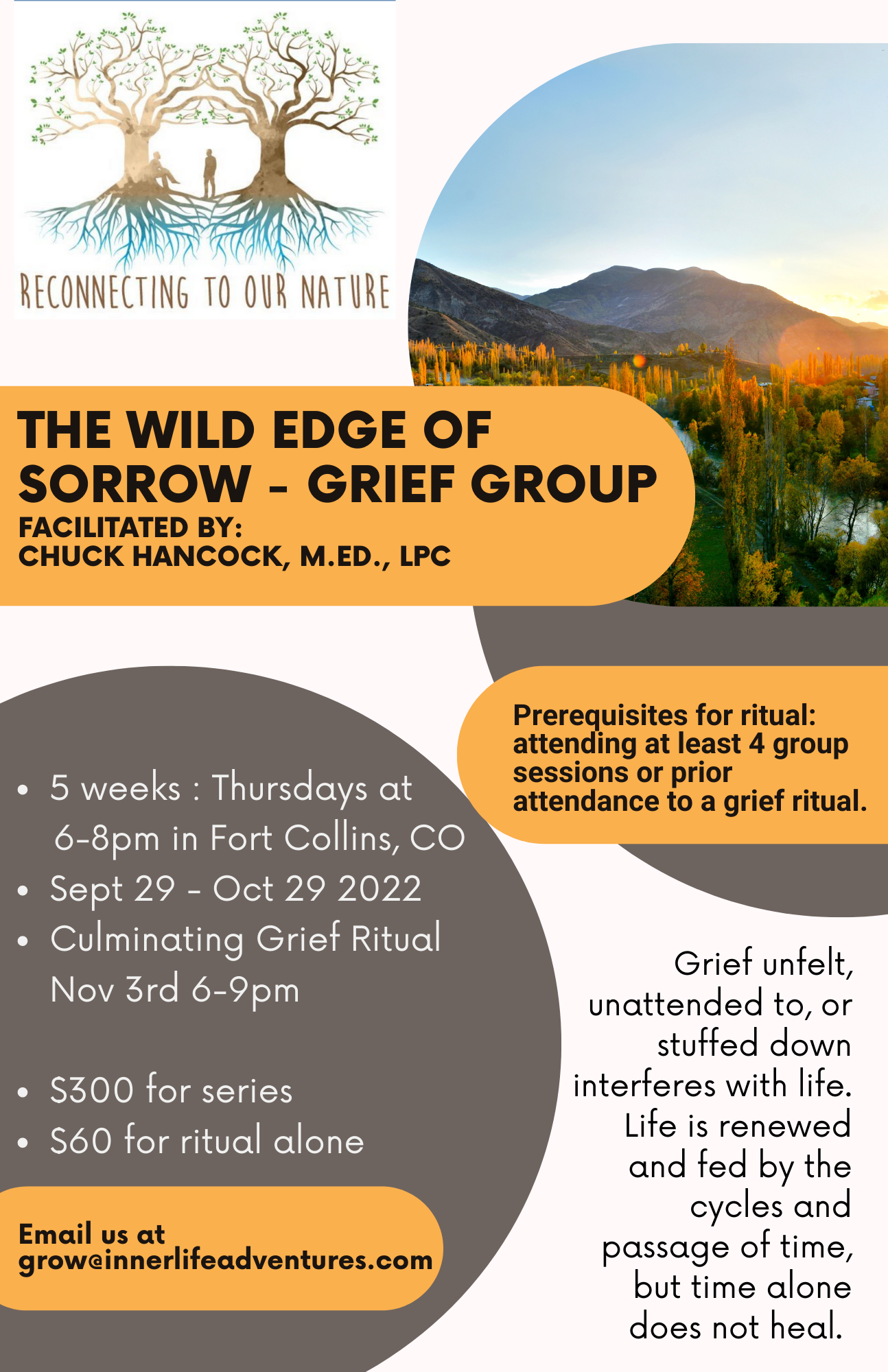
You are invited to learn and work with your grief in this group. Whether your loss is a loved one, a job, environmental destruction, racial trauma and systemic oppression, ancestral lineage or anything that stirs sorrow or grief for you. Together we will share and grow our relationship with grief as we read The Wild Edge of Sorrow by Francis Weller. Anchored by the book, we will heal with our grief through writing, sharing, listening, and both individual and group ritual.
Everything we love we will lose. Most of us have lost someone or something valuable already. Grief unfelt, unattended to, or stuffed down interferes with life. Life is renewed and fed by the cycles and passage of time, but time alone does not heal. We can re-align back into the flow of life gain vibrancy by harvesting the meaning and purpose from our experiences, especially those that stir grief by tending to these processes intentionally.
Join us for a 6 week experiential group to deepen in relationship to grief, form community, be in ritual, support others, and connect more fully to your human experience including life, death, and more renewed vibrant life.
In this group you will explore, deepen, and strengthen your connection and relationships to:
Yourself
Grief and Loss
Healthy Adult Life Development
The World’s Challenges and Sorrows
Our Relationship with and Impact on Nature
People that have lived before you
Your ancestry
Cycles of life and death
Shared human experience
You will leave renewed and re-committed to living fully, nourished and enlivened by the depths of your soul.
Group will meet for 5 weeks of educational and prep work culminating with a final ritual to move through the energies of grief in a supportive community container.
Thursdays 6:00-8:00PM, September 29-November 3, 2022. (Ritual will be 6:00-9:00).
$300 for series. $60 for ritual alone. (Stand alone ritual is only an option if you have previously attended a grief ritual. Otherwise, you need to attend at least 4 sessions of the group.)
Facilitator: Chuck Hancock, M.Ed., LPC has been apprenticing with grief since childhood and has been focusing on healthier expressions of grief through ritualized community shared practices over the past decade. Drawing on conventional western approaches as well as his study with mentors of indigenous practices of America and West Africa Chuck creates a group container creating a supportive healing relationship with all forms of grief we experience in life.
‘‘When we don’t feel safe, our brains fall into a fear mindset and don’t allow forour natural states of joy, calm and happiness to arise.’’
SAFE is a simple acronym for a practice you can use to ignite the natural anti-depressant and anti-anxiety medicine of self-compassion. In this time of uncertainty, there are lots of things being felt. To make it through, we have to be able to work with our emotions in a healthy way, not ignore them or “just think positively.” It might work for a short time, but eventually you’ll run out of energy to keep supressing other feelings and welcoming only positive ones. When you are feeling something you don’t want to be feeling, try this practice.
S – Soften into the feeling. This implies a type of gentle recognition of the feeling or sensation in your body. Focus your awareness toward it softly. If you can, maybe even naming it. “Breathing in, opening to the sadness/fear/vulnerability that is there, breathing out, softening into it.” But if you can’t name it easily, don’t get hung up on it. Sometimes it is even better to not, as words and labels may make us jump to assumptions about it. But do make sure it is a feeling or sensation in your body, not a belief or narrative about something.
A – Allow it to be as it is, without resisting, trying to change it, or clinging to it. For as long as needed, but aim for at least a few minutes. Most likely not more than a few days. If it lasts more than a few days or weeks, some outside help or support may be needed.
F – Feel into the emotion that is there even more with a kind attention and compassion for it. In doing this we can also drop in questions to connect our mind with our feelings: “What is it trying to tell me?” “What is it’s message for me right now?“ “What does this feeling believe?”” or “What do I need right now?” When we discover this we might give that to ourselves. For example, if we sense that we need to feel loved and to feel safe, we might say, “May I feel loved, May I feel safe, etc…” We may need rest, connection, care, food, movement, etc. I’d encourage you to keep your gift related to your inner process, rather than feeling like you need to take external action, especially to change or avoid the feeling.
E – Expand awareness of all people who also experience this feeling. Remind yourself that while your situation may feel unique to you, the feeling you are experiencing is also experienced by virtually every human on this planet. This feeling, this vulnerability of sadness, fear, anger, guilt, shame, depression, anxiety, resistance, or any difficult experience is a universal human experience. This is a core component of self-compassion. Here is where we understand that we are not alone and that in this very moment there are thousands if not millions of people who are experiencing this very same feeling. The “E” of SAFE is where we inspire connection with the rest of humanity. In this practice we can also take what we learned from the “F” of SAFE and send it outward to specific people you know that also experience this or to humanity in general saying, “May we all feel loved, May we all feel safe, etc… Some people find it helpful to do this with a hand on their heart, stomach or both.
If you have trouble focusing on your inner experience in this way, it may be helpful to first ground yourself with input from your 5 senses. Paying attention to information first from the outside world of what you can hear, see, smell, touch/feel, and taste. Ask yourself, am I really SAFE in this moment? Is there an immediate threat? Most likely, there is not anything that has to happen this exact moment. Then allow yourself to come back to the SAFE exercise.
SAFE Acronym by Elisha Goldstein, PhD, explanations and expansion provided by Chuck Hancock, LPC, EMDR II of Inner Life Adventures
Authentic, attuned relationship is a huge focus of mine both personally and in my therapy practice. There is a lot of research supporting the importance of relationship as a healing factor. In this video, psychologist and sociologist Sherry Turkle who has been studying how technology changes not only what we do but who we are discusses the impact of technology on our lives. Some highlight quotes to tempt your curiosity:
“We expect more from technology and less from each other.”
“Technology appeals to us most where we are most vulnerable.”
“We are lonely, but we are afraid of intimacy.”
“From social networks to sociable robots we are designing technologies that give us the illusion of companionship without the demands of friendship. We turn to technology to help us feel connected in ways we can comfortably control.”
Relationships are hard, and messy, and we often don’t know what to say. Communicating only through technology gives us time to present our best self, craft the perfect message, but we miss each other in our authenticity. Despite being more connected than ever, I talk to more people than ever reporting feeling alone.
Chuck Hancock, M.Ed, LPC is a National Certified Counselor, Licensed Professional Counselor, and a Registered Psychotherapist in the state of CO. He has completed comprehensive training in the Hakomi Method of Experiential Psychotherapy, a mindfulness mind-body centered approach. Chuck guides individuals and groups in self-exploration providing them with insight and tools for change. He also incorporates nature as a therapy tool to help shift perspective and inspire new patterns.