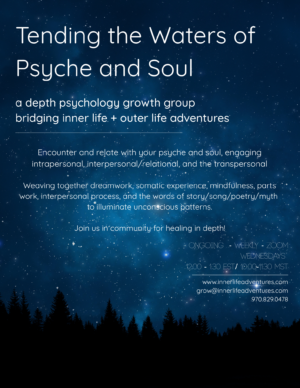
Psyche and Soul Group Flyer

Tending the Waters of Psyche and Soul – Video Group Launching Soon!

Tending the Waters of Psyche and Soul

A depth-oriented psychotherapy group

Some forms of isolation aren’t solved by more effort, insight, or self-improvement.
They arise not because something is wrong with you—but because psyche was never meant to be carried alone.

This small, facilitated psychotherapy group offers a place to tend the deeper waters of inner life in the presence of others. It is a space for reflection, shared meaning-making, and slow relational work—where what is often held privately can be spoken, witnessed, and metabolized together.


Why Group?

Many people come to individual therapy having already done a great deal of inner work—thinking, reading, reflecting, understanding themselves more clearly. And yet something remains unmoved.

Group therapy works differently.

In group, isolation is named, shared, and gradually transformed through relationship. Experience is no longer held in the solitary mind, but enters a living relational field. Patterns emerge. Resonance happens. Something human and essential is restored.

This group is not about advice-giving or problem-solving. It is about presence, honesty, and the slow unfolding of psyche in relationship.


What This Group Tends

  • Chronic or subtle feelings of isolation or disconnection

  • Life transitions, midlife questions, or loss of meaning

  • Relationship patterns that repeat despite insight

  • Dream material and symbolic inner life

  • Longing for depth, authenticity, and shared reflection

  • The tension between a functional outer life and a neglected inner one

This group welcomes complexity. Nothing needs to be fixed. What matters is showing up as you are.


Who This Group Is For

This group may be a good fit if you:

  • Are an adult drawn to psychological depth and inner life

  • Have done some therapy, reflection, or personal work before

  • Feel inwardly alone, stagnant, or unseen despite outward competence

  • Are curious about dreams, meaning, and symbolic experience

  • Want relational contact that goes beyond surface conversation

  • Are open to being impacted by others—and to impacting them

This group is not a class, a support group, or a drop-in experience. It is an ongoing relational process.


Format & Practical Details

  • Format: Live, facilitated psychotherapy group on Zoom

  • Group Size: Limited (approximately 6–8 members)

  • Location: Participants must reside in Colorado or New York

  • Frequency: Weekly

  • Length: 90 minutes – 12 week minimum

  • Time: Wednesdays, 12:00-1:30EST/10:00-11:30MST
  • Fee: $60-$90, some sliding scale flexibility if cost is the only barrier to a good fit

All participants complete an initial conversation to assess fit and readiness for group work.


About the Facilitator

The group is facilitated by Chuck Hancock, M.Ed., LPC, LMHC, a depth-oriented psychotherapist with over 15 years of experience. His work integrates relational psychodynamic psychotherapy, Jungian psychology, mindfulness-based somatic awareness, and group process.

Chuck’s approach emphasizes presence, meaning, and the living relational field—supporting both psychological insight and embodied experience.


Next Step

If something in this description resonates, the next step is a brief, no-cost, no-pressure conversation to explore whether this group is a good fit for you.

👉 Schedule a free 20-minute consultation

970-829-0478 or email [email protected]

You don’t need to know exactly what you’re seeking—only that tending inner life alone is no longer enough.

While this particular group is new, an in-person group has been running for 5 years. Once you get a feel for this type of soulful community, people don’t want to lose it.  Want more information or to get a feel of the language of the group? 

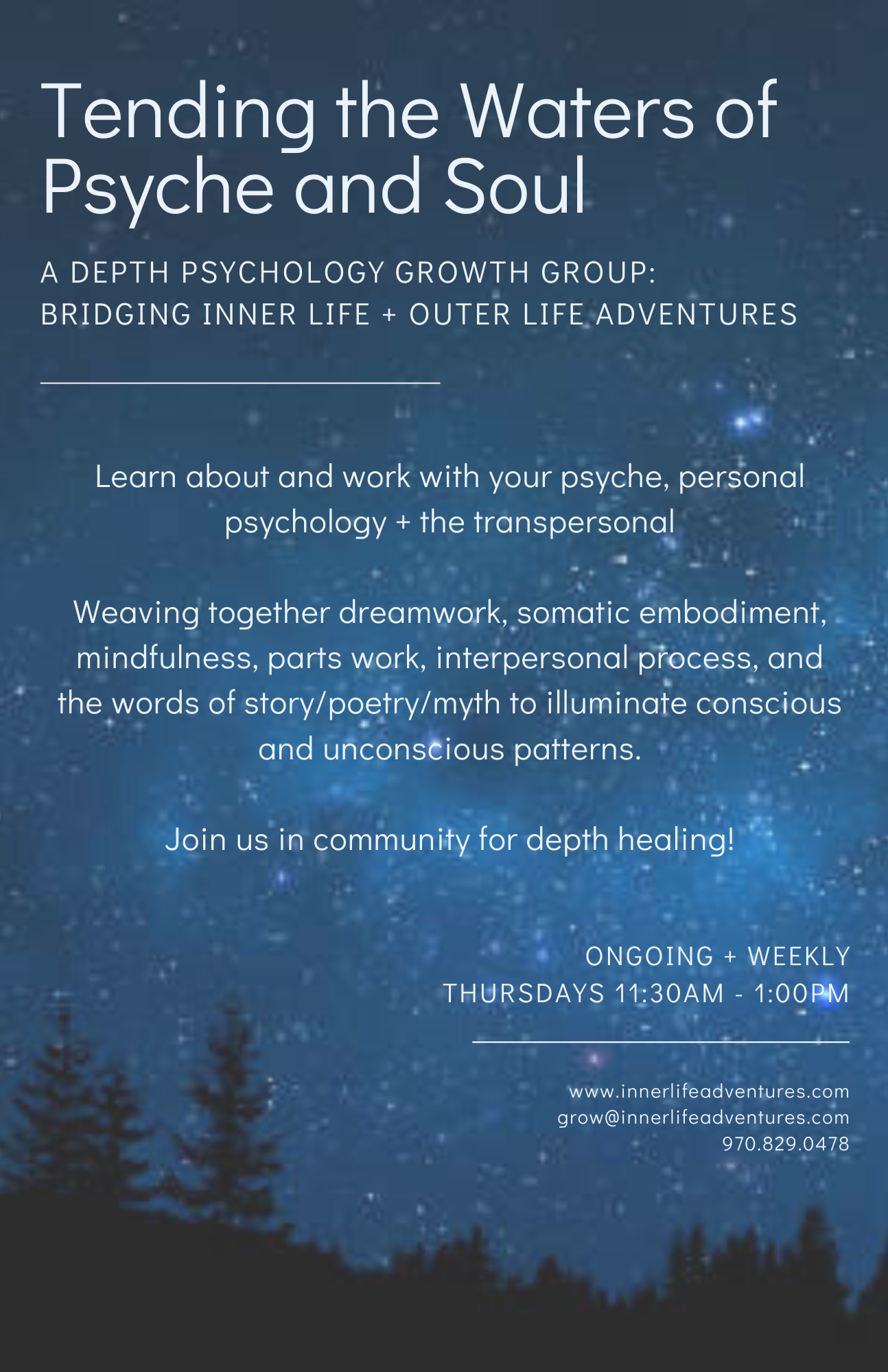
Psyche and Soul Group Flyer

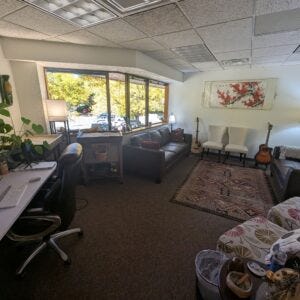
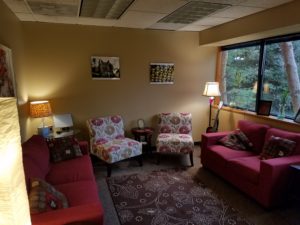
Chucks office and Group Therapy room

Showing Up: For Yourself and Others How True Relationship and Group Work Shape the Self

Individuation isn’t a solo project—it’s a shared journey of showing up for yourself and others.

In our modern age, how many of us truly have a place where we regularly meet with others to build ongoing relationship? Not just a place where we see familiar faces or exchange pleasantries, but a space where we share and listen personally -authentically, honestly, and vulnerably-so that we can be seen and known, and in turn, see and know others.

The Illusion of Connection

Perhaps you’re someone who, through the gift of extroversion or fortunate life circumstances, has a strong social circle. You might see one another often enough to feel cared for and supported by the community. Yet how many of these circles include -not only demographic diversity, but differences in worldview, politics, religion, relationship status, and belief? Most of us tend to surround ourselves with people who are more like us than not.

The importance of relationships that unfold over years, not just days or months, has been apparent to me throughout my life. In an era of technological “connection,” the reality for most of us is a landscape of disconnection. This makes it all the more vital to have real, sustained relationships.

Social media tends to either reinforce our existing views or inflame us with opposing views, casting others as wrong or even dangerous. It takes intention to cultivate caring relationships with people who see the world differently from us.

The Limits of Temporary Community

Over the years, I’ve attended countless retreats, workshops, and classes that promised community. Many of them even use the word in their marketing. Yet something was always missing.

I’ve come to realize that, no matter how inspiring the experience or language, without an ongoing relationship, these offerings often perpetuate the same consumerist pattern that dominates our culture. We sign up, pay a fee, attend, perhaps feel nourished-and then return to our individual, isolated homes until it’s time to purchase the next experience we hope will fill the gap. Despite our digital connections and community-themed events, many people still feel profoundly lonely. It might feel good to see a familiar face, but it does not replace a sustained, authentic relationship.

What’s the Alternative? Real, Ongoing Relationship

Ongoing, authentic relationship with multiple people. In other words: a group.

Many religious and community organizations attempt to meet this need, but the community is often transient. People attend for a while and move on when it no longer meets their expectations, or worse, they must trade parts of their authentic selves to belong.

In most groups, belonging has a cost. The essential question is whether that cost is conscious and transparent or unconscious, requiring us to abandon parts of ourselves in order to stay connected.

Why Commitment Matters

That’s why I’ve been running men’s groups every week for over a decade, and more recently, an all-gender group that includes explicitly transpersonal elements. All of my groups require a screening to ensure participants are ready to make a real commitment to themselves and to others. Members agree to show up week after week, especially during an introductory period, because making and keeping commitments has become rare. Especially when things feel hard and awkward, and our sense of belonging is called into question. Ending relationships explicitly and intentionally is even more rare. And both are essential parts of relationships.

Group Therapy Office

It’s not uncommon for people to question why they should pay to participate in a group. I’ve had those same questions myself. However, over the years, I’ve come to realize that financial and attendance commitments help sustain investment, accountability, and awareness around our choices to show up or not, and to end relationships with intention. And it ensures the cost of belonging to the group is conscious, consensual, and is not enacted unconsciously through joining in a particular belief system.

Think about how often we cancel plans with a friend or therapist because we “don’t feel like going.” We might not even be fully honest with them or ourselves about our reasons, allowing the truth to remain unconscious. Yet being honest and exploring what’s behind our desire to avoid is often the more authentic way to show up for ourselves.

Some of the most generative moments in relationships and groups occur when someone brings forward they don’t want to be there. Avoidance gives way to awareness.

Beyond Transactional Relationship

Another reason I believe ongoing groups are so powerful is that the relationships they foster are transformative. Too often, people leave relationships because the other person isn’t meeting their needs. Seeing others primarily as sources of need fulfillment is a limited way of relating.

Nearly every day in my practice, someone contemplates leaving a partner or friend for this reason. In a diverse group, we learn to relate differently-to ask for what we need, to notice what happens when we don’t get it, and to continue showing up anyway. We begin to experience a connection that is less transactional and more human.

The Mirror of Relationship

There’s a saying in both Zen and group therapy: “Wherever you go, there you are.” In group language, we might say, “How you show up in group is how you show up everywhere.”

How we show up in relationship to ourselves mirrors how we relate to others. Of course, the expression changes depending on the context and person, but the deeper patterns remain.

We can’t fully understand ourselves in isolation-we need the reflection of others to see who we are. And that reflection can only happen if we keep showing up: for ourselves and for each other, again and again. Whether we want to or not, we need to discuss what is happening in the relationship until we communicate that it is time for the relationship to end. Every step of the relationship journey is illuminating and transformative when it is expressed and not hidden. Our patterns of avoidance are varied and often have very valid justifications

Avoidance is easy. Commitment is harder. But showing up, truly showing up, for yourself and others is where transformation begins.

Chuck Hancock, M.Ed., LPC, LMHC, is a licensed psychotherapist in Colorado and New York, guiding individuals, couples, and groups into greater wholeness.

#psychology #grouptherapy #jungianpsychology #relationships #spiritualgrowth #selfdevelopment #authenticity

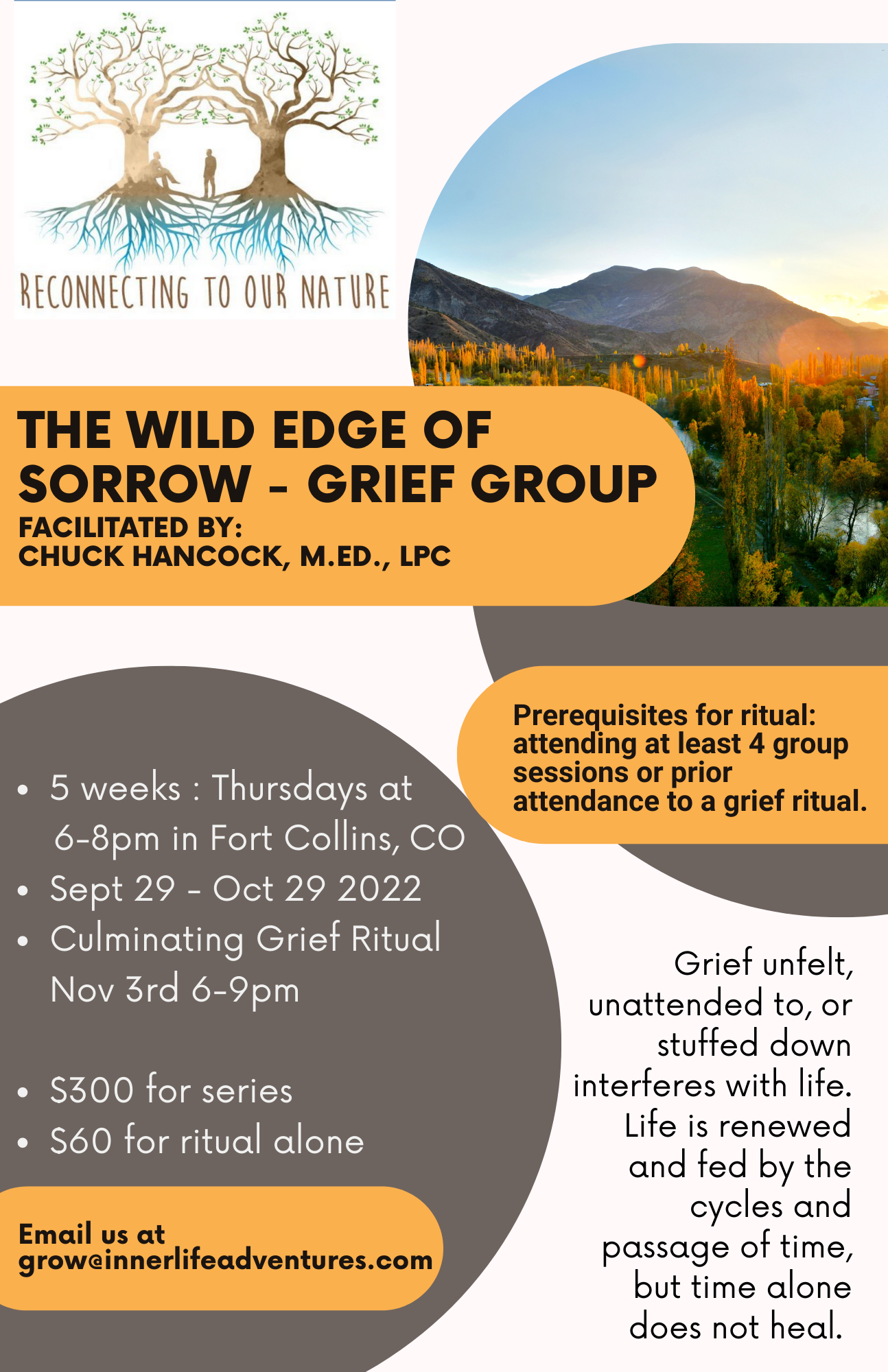
Grief Group: The Wild Edge of Sorrow

Rituals of Renewal and the Sacred Work of Grief


Usually in our culture we only touch grief when we lose a loved one,
however now more than ever much is being lost and there is much to grieve.


You are invited to learn and work with your grief in this group. Whether your loss is a loved one, a job, environmental destruction, racial trauma and systemic oppression, ancestral lineage or anything that stirs sorrow or grief for you. Together we will share and grow our relationship with grief as we read The Wild Edge of Sorrow by Francis Weller.  Anchored by the book, we will heal with our grief through writing, sharing, listening, and both individual and group ritual.

Everything we love we will lose.  Most of us have lost someone or something valuable already.  Grief unfelt, unattended to, or stuffed down interferes with life.  Life is renewed and fed by the cycles and passage of time, but time alone does not heal.  We can re-align back into the flow of life gain vibrancy by harvesting the meaning and purpose from our experiences, especially those that stir grief by tending to these processes intentionally.

Join us for a 6 week experiential group to deepen in relationship to grief, form community, be in ritual, support others, and connect more fully to your human experience including life, death, and more renewed vibrant life.

In this group you will explore, deepen, and strengthen your connection and relationships to:

  • Yourself
  • Grief and Loss
  • Healthy Adult Life Development
  • The World’s Challenges and Sorrows
  • Our Relationship with and Impact on Nature
  • People that have lived before you
  • Your ancestry
  • Cycles of life and death
  • Shared human experience

You will leave renewed and re-committed to living fully, nourished and enlivened by the depths of your soul.

Group will meet for 5 weeks of educational and prep work culminating with a final ritual to move through the energies of grief in a supportive community container.

Thursdays 6:00-8:00PM, September 29-November 3, 2022. (Ritual will be 6:00-9:00).

$300 for series. $60 for ritual alone.  (Stand alone ritual is only an option if you have previously attended a grief ritual. Otherwise, you need to attend at least 4 sessions of the group.)

Facilitator: Chuck Hancock, M.Ed., LPC has been apprenticing with grief since childhood and has been focusing on healthier expressions of grief through ritualized community shared practices over the past decade.  Drawing on conventional western approaches as well as his study with mentors of indigenous practices of America and West Africa Chuck creates a group container creating a supportive healing relationship with all forms of grief we experience in life.


Tending the Waters of Psyche and Soul

A Depth Psychology Growth Group Bridging Inner Life and Outer Life Adventures

Some Definitions of Soul

  • an active or essential part
  • the part of the human being that thinks, feels, and makes the body act
  • the quality that arouses emotion and sentiment
  • energy or power of mind or feelings; spirit; fervor
  • the cause of inspiration or energy; leading spirit; prime mover
  • spiritual or moral force 
  • the embodiment of some quality; personification
  • the spirit of a dead person
  • the immaterial essence, animating principle, or actuating cause of an individual life
  • a person’s total self

You may or may not believe you have a soul. That is not a prerequisite for this group. If you have a desire to deepen your connection with, relationship to, and grow the health of any of the above descriptions, this group is for you. This group is a space to learn about and work with your psyche, personal psychology developed by your experiences and narrative about those experiences, interpersonal relationships (how you show up with others), and the transpersonal (anything bigger than and beyond yourself).

Join us in community for depth healing utilizing the map and mirrors of depth somatic experiential psychology. This group will bridge the world of our ordinary waking life roles and structures with that of our inner world. This is not a group about fixing you, teaching you skills, or requiring you to be “better” – rather it is a group where all of you, in your brilliance and in your struggle with shadow, is welcome. It is a group that is led by psyche, soul, and spirit informed by your life and experience facilitated by a trained guide (not a teacher).

In this group, you bring the topics – based on what is alive in you.  What is challenging you? What is inspiring you? What is showing up in your world that feels impactful or meaningful? Whether that aliveness is a dream you had, a poem or song that moved you, a meditation practice that taught you, a social media post that triggered you or brightened your day, grief that brought you to your knees, a stuck-ness so tight it paralyzes you or a movement that opened or freed you, this group is a space to bring more life and soul into your world in a community of fellow practitioners.


Who is this group for?

In the group process, there are many “problems” or pain points that can lead someone to join.  It could be anxiety in general, or about the state of the world and its political, social, economic, and health issues.  It could be that you are feeling depressed, stuck, stagnant, alone, misunderstood, or constantly sad.  You may have a hard time knowing your place in this ever changing world.  This group starts with the philosophy that we are all human, and we are all in this together.  And through working through our individual “problems” together, we help each other. And perhaps even see that they are not problems, but invitations to grow. This group is for people willing to engage in their own healing by giving and receiving support, and opening to wisdom and support of a variety of modalities that connect you with your heart, mind, body, and soul.

We aim toward self leadership and self actualization.  How do we do that?

We are all struggling to know and become the fullest version of our “real,” true, unique selves. We create a space to learn more about ourselves and experience new aspects of ourselves through content, process, and interpersonal relationships with other group members.

We recognize we have the tendency to deny our own needs and feelings. To pretend to be someone we aren’t or to avoid facing our true self inhibits growth. In this group, we take responsibility for owning our needs and feelings and expressing unexpressed thoughts, so the facilitator and other group members co-create the space to meet those new places in yourself and possibly have your needs and feelings met in an embodied way.

We believe each individual is endowed with the urge to expand, develop, mature, and reach self-actualization. We believe that true growth and healing come from within, and this group is designed to help facilitate that process. 

Even in the best of times, it is easy to fall into despair – by not living the life that is yours to live or by feeling disconnected from the greater story of life and your place in the order of things. In these times of chaos and uncertainty, this group will help you reconnect to the life that is yours to live and reconnect you with the bigger picture and meaning to provide fuel and inspiration for the challenges we face.

Logistics

Ongoing. Weekly. Thursdays 11:30-1:00. In person with a zoom in option for health or travel.

Open to all genders age 25+.

8-week minimum commitment to allow for relationships and group containers to form.  Stay as long as the group is beneficial to you.

Financial Investment $30-$60 per group sliding scale.

About the facilitator: Chuck Hancock, M.Ed, LPC is passionate about group work being an important part of our growth and healing journey.  With over a decade of experience guiding individual and group processes in council, dreamwork, interpersonal process groups, psychodrama, meditation, Hakomi somatic psychotherapy, ego state (parts) work, Jungian psychology, movement, music, and nature based practices. He weaves all of these practices together to help clients locate themselves in the world co-creating new experiences of authenticity, depth, meaning, insight, and inspiration.  With the diversity of members, modalities, and lineages the community formed in a group experience offers more possibility and amplification of the growth process.  


To register for more information to decide if this group is right for you, email [email protected] or call 970.829.0478.


“The guest is inside you, and also inside me;

you know the sprout is hidden inside the seed.

We are all struggling; none of us has gone far.

Let your arrogance go, and look around inside.

The blue sky opens out farther and farther,

the daily sense of failure goes away,

the damage I have done to myself fades,

a million suns come forward with light,

when I sit firmly in that world.

I hear bells ringing that no one has shaken,

inside “love” there is more joy than we know of,

rain pours down, although the sky is clear of clouds,

there are whole rivers of light.

The universe is shot through in all parts by a single sort of love.

How hard it is to feel that joy in all our four bodies!

Those who hope to be reasonable about it fail.

The arrogance of reason has separated us from that love.

With the word “reason” you already feel miles away.”

~Kabir

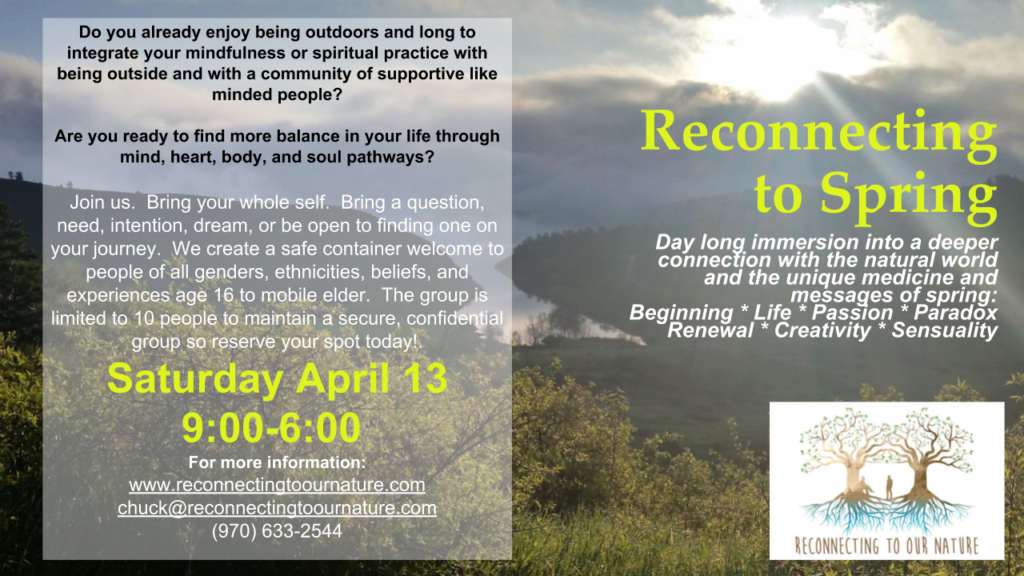
Reconnecting to Spring


We are not separate from the natural world.  This myth that we are separate from nature and everything  around us is one of the greatest things causing humans suffering.  Even “visiting” nature implies we have to go somewhere to experience  it. In this day long program, we will be in nature to remember the age old practice of wandering  and listening, connecting intimately with nature both outside and inside of us to experience greater health and wholeness.  

  • Experience and connect with the season of summer in it’s unique personality and relationship to the rest of the year.
  • Find and relate to plants, animals, birds, insects, rocks, and landscape that can help you deepen into your understanding of yourself and our world.
  • Utilize Ecopsychology  and transpersonal psychology to remember your wholeness, the wholeness of our world, and experience health and healing in nature.
  • Learn about the passages and cycles of days, years, seasons, and life itself.
  • Utilize practices to help you connect deeper to yourself and your own sources of guidance, wisdom, and support.
  • Spend time together as a community in council,  gain direct teachings on nature connected practices.
  • Have solo time on the land having direct experience with these practices in your own way..


For more information: http://reconnectingtoournature.com/

New Trauma Therapy Group Forming


Owning our story can be hard but not nearly as difficult as spending our lives running from it. Embracing our vulnerabilities is risky but not nearly as dangerous as giving up on love and belonging and joy—the experiences that make us the most vulnerable. Only when we are brave enough to explore the darkness will we discover the infinite power of our light.  ~Brene Brown

All of you is welcome here.  Living with traumatic experiences often makes us feel like we have to hide a part of ourselves because of our own shame or because we don’t believe the world will understand or support us.  Many who have experienced trauma live with depression, isolation, anxiety, addictions, or other issues. Engaging in group therapy may sound scary, but it has been my experience that healing occurs most profoundly when we can experience human connection while being with the events and parts of us with which we felt the most alone and unsafe.  You don’t have to handle difficult things on your own.

Utilizing the latest research in treating trauma, this group draws upon the work somatic psychotherapy, experiential psychotherapy, attachment, mindfulness practices, interpersonal relationship, Acceptance and Commitment Therapy (ACT), DBT self regulation and distress tolerance skills, EMDR, ecotherapy, and Internal Family Systems.

Format

This weekly group is open to all genders and will provide a safe, supportive space that teaches mindfulness, 

grounding, and resourcing skills and developing strength and resilience as a foundation.  Moving beyond skills, participants will discuss and support each other in managing current life triggers. As safety and trust deepen and when the time is right, there will be opportunities for each member to be able to process and do therapeutic work around their trauma in a group format. Harnessing the power of a safe supportive group container, people can feel even more held and safe to process events and receive support from a community of understanding people.  

Consent is key, and sometimes healing in and of itself.  Learning how to say yes when you mean yes and no when you mean no is a part of every group.  You will be empowered to participate or not participate to whatever level you are ready and wanting.  

The group meets weekly and is ongoing every Thursday evening.  In order to establish safety, rapport, and trust in the group, each person is asked to make at least an 8 week commitment to the group.  Many will stay on beyond the minimum to continue building trust, healthy healing relationships, and being able to work through challenges slowly and safely.  The group will have at least 4 and at most 8 members.

To enroll
Contact Chuck ([email protected] or 970.829.0478) to setup a free 30 minute group screening and consultation.  If it seems like a good fit, you will be able to start as soon as the group feels it is ready for a new member.  It is highly recommended that you have an individual therapist as well, but exceptions may be made depending on your situation.

Cost

$50 per group.  Some insurance accepted.  Call your insurance company and ask about coverage for group therapy.  

Still not sure?

Articles for further reading on trauma specific therapy groups

https://psychcentral.com/blog/4-things-i-learned-in-trauma-group-therapy/

https://www.verywellmind.com/the-benefits-of-group-therapy-for-ptsd-2797656


Download the Trauma Therapy Group Flyer  to print or email to someone who may need this group.

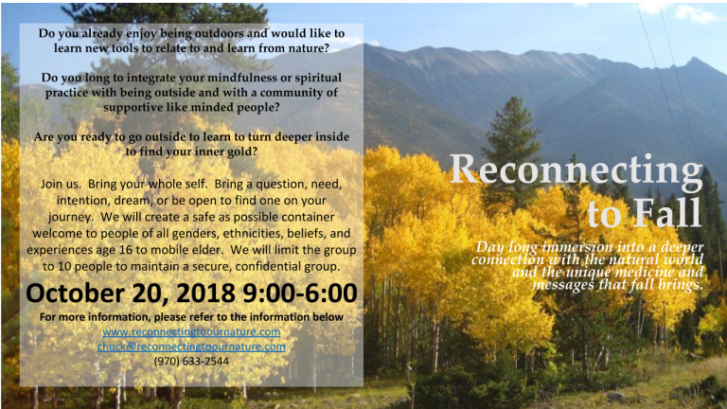
Reconnecting to Fall

We are not separate from the natural world.  This myth that we are separate from nature and everything  around us is one of the greatest things causing humans suffering.  Even “visiting” nature implies we have to go somewhere to experience  it. In this day long program, we will be in nature to remember the age old practice of wandering  and listening, connecting intimately with nature both outside and inside of us to experience greater health and wholeness.  

  • Experience and connect with the season of summer in it’s unique personality and relationship to the rest of the year.
  • Find and relate to plants, animals, birds, insects, rocks, and landscape that can help you deepen into your understanding of yourself and our world.
  • Utilize Ecopsychology  and transpersonal psychology to remember your wholeness, the wholeness of our world, and experience health and healing in nature.
  • Learn about the passages and cycles of days, years, seasons, and life itself.
  • Utilize practices to help you connect deeper to yourself and your own sources of guidance, wisdom, and support.
  • Spend time together as a community in council,  gain direct teachings on nature connected practices.
  • Have solo time on the land having direct experience with these practices in your own way..

Join us.  Bring your whole self.  Bring a question, need, intention, dream, or be open to find one on your journey.  We will create a safe as possible container welcome to people of all genders, ethnicities, beliefs, and experiences age 16 to mobile elder.  We will limit the group to 10 people to maintain a tight group.

Financial Investment: $25 non-refundable registration holds your spot in the circle.  Suggested additional donation of $20-120 for programming, teachings, first aid supplies and support, organization, planning, and other energy invested in creating and holding space for you.  Nobody will be turned away for financial reasons. Let’s discuss if you have questions or needs around money.

Location and final logistics to be disclosed upon registration.  Will be within 1 hour of Fort Collins and we will coordinate a carpool to minimize impact on the environment.

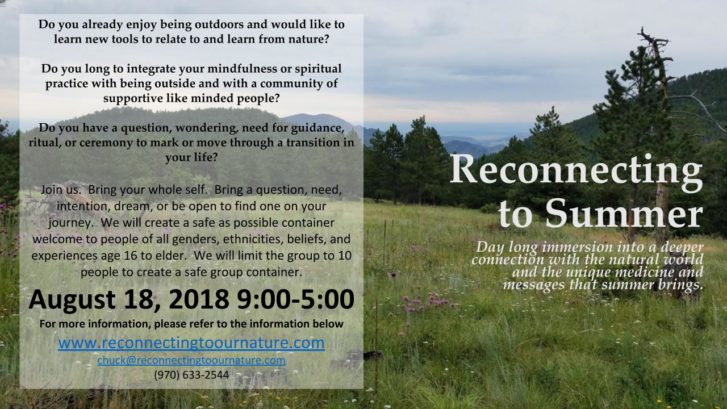
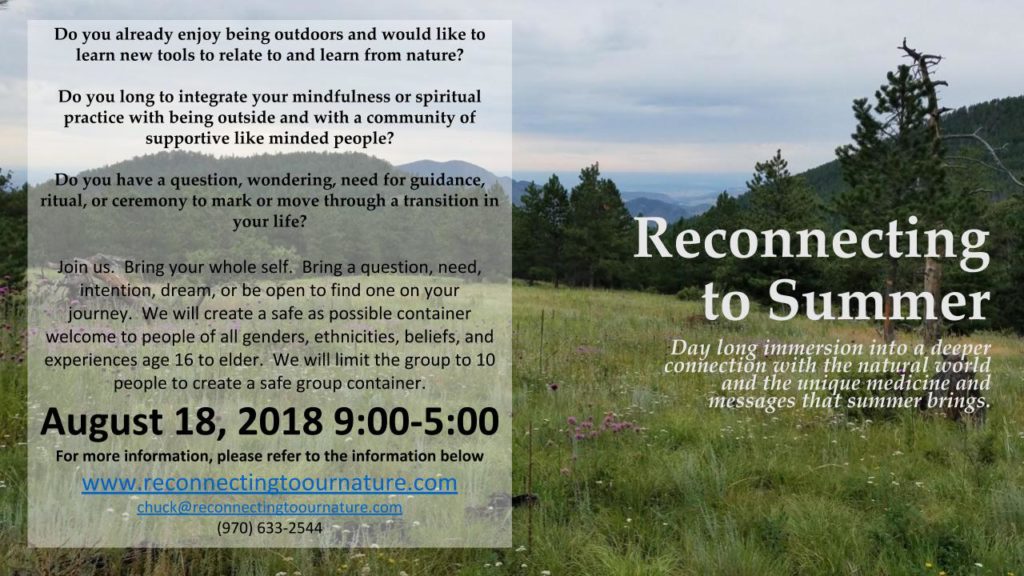
Reconnecting to Summer Ad

Reconnecting to Summer – Nature Based Workshop

Utilizing deep nature connection for growth and healing is available to us at all times.  Chuck is also facilitating workshops, mentoring, and coaching in the wilderness with Reconnecting to Our Nature.

Reconnecting to Summer Ad

Reconnecting to Summer Ad

Consider joining for a day long immersion on untouched private land in the foothills of Northern Colorado.  August 18, 2018.  9-5.

For more information and registration: http://reconnectingtoournature.com/offerings/reconnecting-to-summer/


You Should Get Outside More (says science)

Summary of research and a few exercises you can useCanyon in NM

I don’t use the word should very often.  It’s a dirty word. And who am I to tell anyone they should do anything? But I will right now: you should get outside more!  And it’s not just me saying this, it’s science!

I’ve long been a lover of the outdoors participating in numerous sports and other outdoor activities over the course of my life. However it was about 10 years ago when I was on a 4 day backpacking trip with a self admitted stress-loving over-working friend of mine that I first caught a glimpse of the true power of the wilderness beyond being just a venue for recreation. It was on this trip that I solidified my decision to go back to grad school to become a counselor because I wanted to help people get to the place of openness, self-exploration, relaxation, and motivation that I saw in my friend that day.  I’ve learned a lot of skills and tools over the years, but none have been as good as nature to get the effects I saw that trip.

One of my biggest fears is being judged, so I’ve only dipped my toe in the outdoor therapy world until this point. The last thing I want to be judged as is a long haired tree hugging hippy who takes people into the woods to reconnect with nature with drum circles to find their lost soul (Not that there is anything wrong with any of that – I’ve done them all and they are great! You may consider trying those things too 😉 ).  But I know that scene is repulsive to some people so I’ve purposely stayed away from it professionally, because I know that sometimes people who are afraid to drop their guard enough to try something that far out of their comfort zone can be the people that need the power of the outdoors most.

So lately, I’ve been excited to find that more research is being done to understand what effects being outside does have on our minds and bodies. In this recent National Geographic article, the author does a great job summarizing the results of international research from the past few years. I still recommend reading it, but here are some of the main research points if you don’t have time.

Scroll down to the bold print to skip the research and get right to the exercise.

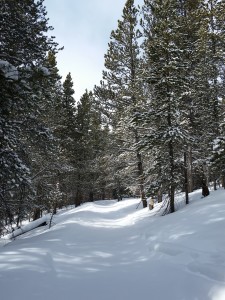
Being outside helps your brain take a break from it’s constant use. This can reduce stress, increase creativity, Snowy Trailand produce a difference in qualitative thinking. We think it lets the pre-frontal cortex unplug for a bit (the part of our brain in charge of cognitive function, rational thought, planning, personality, social expression,
inhibitions, decision making, executive functioning, and more.)  The most pronounced changes happens after being outside for 3 days.

But even a 15-minute walk in the woods causes measurable changes in physiology. Japanese researchers at Chiba University sent 84 subjects to stroll in seven different forests, while the same number of volunteers walked around city centers. The forest walkers hit a relaxation jackpot: Overall they showed a 16 percent decrease in the stress hormone cortisol, a 2 percent drop in blood pressure, and a 4 percent drop in heart rate. Researcher Miyazaki believes our bodies relax in pleasant, natural surroundings because they evolved there. Our senses are adapted to interpret information about plants and streams, he says, not traffic and high-rises.

The South Koreans have been doing research on the impact of work stress, long hours, digital addiction, and academic pressures. They are now devoting some forests as healing centers and prescribing time in nature to help combat these maladies. They have research that shows forest healing reduces medical costs

Several unrelated studies in England, Denmark, Canada, and Scotland all showed lower mortality, fewer stress hormones, less mental distress and lower incidence of 15 diseases including depression, anxiety, heart disease, diabetes, asthma, and migraines even when adjusted for confounding variables. That is levels of income, education, employment, and exercise did not effect the data. Just living near green space made aHorsetooth Reservoir in Fort Collins difference. If anything, lower income people seemed to benefit the most.
“In Finland, a country that struggles with high rates of depression, alcoholism, and suicide, government-funded researchers asked thousands of people to rate their moods and stress levels after visiting both natural and urban areas. Based on that study and others, Professor Liisa Tyrväinen and her team at the Natural Resources Institute Finland recommend a minimum nature dose of five hours a month—several short visits a week—to ward off the blues. “A 40- to 50-minute walk seems to be enough for physiological changes and mood changes and probably for attention,” says Kalevi Korpela, a professor of psychology at the University of Tampere. He has helped design a half dozen “power trails” that encourage walking, mindfulness, and reflection. Signs on them say things like, “Squat down and touch a plant.””

“Korean researchers used functional MRI to watch brain activity in people viewing different images. When the volunteers were looking at urban scenes, their brains showed more blood flow in the amygdala, which processes fear and anxiety. In contrast, the natural scenes lit up the anterior cingulate and the insula—areas associated with empathy and altruism. It may also make us nicer to ourselves. Stanford researcher Greg Bratman and his colleagues scanned the brains of 38 volunteers before and after they walked for 90 minutes, either in a large park or on a busy street in downtown Palo Alto. The nature walkers, but not the city walkers, showed decreased activity in the subgenual prefrontal cortex—a part of the brain tied to depressive rumination—and from their own reports, the nature walkers beat themselves up less.”

And the nature you visit doesn’t have to be in a wilderness area and it doesn’t just affect mood. Another study showed a 50-minute walk in an arboretum improved executive attention skills, such as short-term memory, while walking along a city street did not. “Imagine a therapy that had no known side effects, was readily available, and could improve your cognitive functioning at zero cost,” the researchers wrote in their paper. It exists, they continued, and it’s called “interacting with nature.”

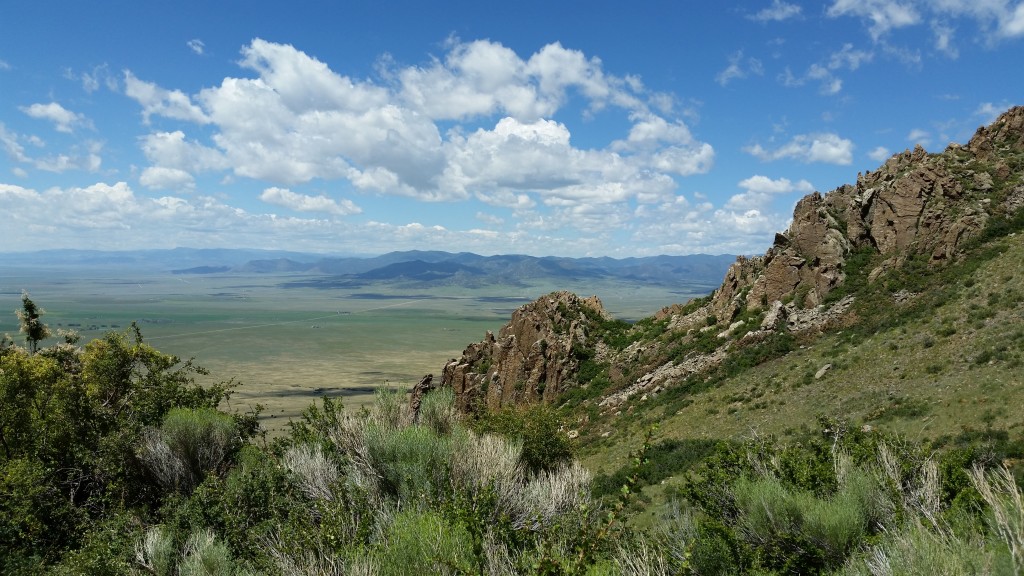
San Luis Valley

To summarize, there is research that suggests viewing and/or being in nature can reduce stress, reduce disease (including depression, anxiety, heart disease, diabetes, asthma, and migraines), decrease blood pressure and heart rate, improve attention, improve mood, increase empathy and altruism, increase creativity, decrease depressive rumination, and while I haven’t seen research that supports this, my experience is that most people tend to enjoy themselves and have a good time. Not bad for something that is free.

So like I said earlier, you really should get outside more. Just getting outside can help. Do it regularly, do it often, and at least once in a while, go for longer periods of time. If you want to make your time outside even more restorative and connecting, here’s a few tips and tools I’ve learned from personal observation that can enhance your experience.

  1. Disconnect from time. If you have a time limit, set a timer or alarm for 1/2 the amount of time you are willing to give to this experience. When this sounds, you will need to turn around and make your way back. Until then, don’t worry about time, your timer will tell you when you need to head back. Let yourself be fully present to the natural environment.
  2. Mark your transition from your urban/suburban/societal/structured/scheduled life into the natural world. When you leave the parking lot, sidewalk, building, etc and enter into natural space, make a mental note that you are shifting from one way of being into another. At this point, be sure your phone is on silent, your to-do list is put away, your calendar holds your obligations, and anything that is taking mental space is put on hold for the duration of your journey.If necessary, physically stop and mentally put down stresses, issues, people, thoughts, feelings, responsibilities, or anything currently bothering you that could get in the way of you being present with the natural world. Imagine a container to hold them and/or put them near a rock, tree, or entrance and leave them there. You can pick them up again on your way out (if you want).
  3. If there is something you are pondering or something is really bothering you and you would be open to letting your creative subconscious mind work on it for you, set an intention or ask a question as you enter this space. Then drop it. Notice what you notice (see below) while you are in the natural environment, and maybe there will be some insight into your situation. Or maybe not, but it doesn’t hurt to try.
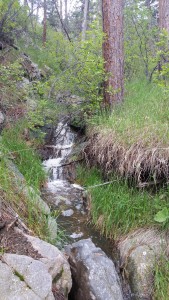
  4. Come back to your senses!  Just notice what you notice. When in natural space, let your Mountain Streamanalytical mind take a break and instead focus on your senses. What do you sense outside of you with your sight, hearing, smell, taste, and touch? What do you notice in your body as you move? What do you notice in your emotional and
    energetic state? What thoughts pop into your mind automatically? Just notice what you notice, then notice something else. Over and over again while you are there.
  5. Let your curiosity awaken. What do your eyes get drawn to? What sounds do you hear? What made them?  Don’t worry about right and wrong or really knowing the answer. Just be curious. Which direction will you head? Let your curiosity and intuition be your guide. When you find something interesting, stop and study it with all your senses.  What will you discover?  I’m getting excited for you!
  6. When it is time to leave, before you leave the space pause for a minute or two and reflect on all that you noticed. Offer thanks to yourself for letting yourself have the time and thanks to the space and any creatures, insights, or special moments that presented themselves.
  7. Bring the experience back into your ordinary life. Write about your experience and/or tell somebody that will just listen. Let these questions guide you: What happened here? (Recount as much as you can) What did you learn from it? What are the bigger picture deeper lessons? How can it inform my life? How did this time outside help me?Sun Shining Through the Trees

So there you go. Get outside. Deepen in your relationship with yourself and with the natural world. Do this with a friend or family member and deepen in your relationship with them. If you have questions or would like to share your experience with this exercise, I’d love to hear from you. Email me at [email protected].  Hope to see you outside!


Chuck Hancock, M.Ed, LPC is a Licensed Professional Counselor in the state of CO. He has completed comprehensive training in the Hakomi Method of Experiential Psychotherapy, a mindfulness mind-body centered approach. Chuck guides individuals and groups in self-exploration providing them with insight and tools for change. He also incorporates nature as a therapy tool to help shift perspective and inspire new patterns.


Is your analytic brain still not convinced? Here are links to more articles and research.

Nature and Mental Health, Cognitive Function, Attention: https://depts.washington.edu/hhwb/Thm_Mental.html

Exploring the Mental Health Benefits of Natural Environments
http://journal.frontiersin.org/article/10.3389/fpsyg.2014.01178/full

Stanford researchers find mental health prescription: Nature.
http://news.stanford.edu/news/2015/june/hiking-mental-health-063015.html

2 Minute Walk May Reverse Harms of Sitting
http://well.blogs.nytimes.com/2015/05/13/a-2-minute-walk-may-counter-the-harms-of-sitting/

Benefits Of Ecotherapy: Being In Nature Fights Depression, Improves Mental Health And Well-Being
http://www.medicaldaily.com/benefits-ecotherapy-being-nature-fights-depression-improves-mental-health-and-well-being-261075

Nature experience reduces rumination and subgenual prefrontal cortex activation
http://www.pnas.org/content/112/28/8567.abstract

Creativity in the Wild: Improving Creative Reasoning through Immersion in Natural Settings
http://journals.plos.org/plosone/article?id=10.1371/journal.pone.0051474


Offline Sources

Hartig, T., Mang, M., and Evans, G. (1991). Restorative effects of natural environment experiences. Environment and behavior , 23 (1), 3-26.

Kaplan, R. and Kaplan, S. (1989). The Experience of nature . Cambridge Press.

Kaplan. S. and Talbot, J. (1983). Psychological benefits of a wilderness experience. In Altman, I. and Wohlwill, (Eds.), Behavior and the natural environment . New York: Plenum Press.

Turner, V. (1969). The ritual process . Chicago: Aldine.

Ulrich, R. S. et al. (1991). Stress recovery during exposure to natural and urban environments. Journal of environmental psychology , 11 (3), 201-230.


Do you know of a good study not cited here? Please send it my way.  I’m collecting good empirical support to make time in nature an “Evidence Based Practice.”


New Therapy Group for Teens


Join us for a new first of its kind hybrid group therapy and wilderness therapy group for teenagers locally on the Front Range based out of Fort Collins, CO.  This outdoor group was created to offer the best of coaching, therapy, and wilderness adventures to adolescents without the cost and time commitment of traditional backcountry programs.

This group is open to all teens of all genders regardless of “issue” who are simply looking for personal growth by getting outside and joining in a community of peers, connecting with themselves, others, and nature. Through exploring themselves, overcoming challenges, developing new skills,  and being guided by expert facilitators our participants learn to bring the best of the lessons and experiences of the outside…. in.

For more details, click here and or contact Chuck directly at [email protected] or 970.556.4095.

Download a pdf version of the flyer to print, email, and share with someone who could benefit.

Outside--in flyer


1 2