Colorful image of the word word

On the Importance of Words

On the Importance of Words


Words are hard.  So are feelings.  A picture is worth 1000 words. How many feelings is it worth?  How many feelings is a word worth?  I’m not sure those questions have been answered. What is a question worth? Maybe very little if it has a quick answer. But what about the questions that live in us, unanswerable completely? Those are priceless.  Can we have a question without words?

I’ve had many such questions in my life. It’s frustrating not to have immediate answers to, but extremely valuable in all the partial answers I’ve found while living the questions and looking for answers. And those questions are formed with words. So are the answers. Well, they do start with a feeling. An impulse.  A longing.  A somatic experience and an emotion. A question forms with a desire, a curiosity, seeking something missing.  An answer with a form.  Eventually, both become more solid when we put words to them. And then it all becomes even more solid when the loop reverses direction – that is, we start to live the word, creating more somatic experience and more feelings. They all become integrated into us. One dimension alone, thought, word, intuition, somatic experience, or feeling, is incomplete. All together, they make us whole.

I practiced primarily somatic therapy for the first many years in private practice. It was very important to me as it was a neglected part of my human experience. By prioritizing the soma, we reconnect with the old patterns from early childhood, from before there were words. This can be an important and necessary part of therapy for many people. But it’s not just early childhood. Every time we have a new experience, it starts in the body and with feeling, which is some sort of valuation of that experience, and it takes us time to make sense of what the experience is, how we feel about it, and what we think about it.  Further, we need to differentiate feelings.  Many stay stuck in the simple notion that if something feels good, it is good, and if it feels bad, it is bad.  It takes words and thought to make that happen.  Without words and thoughts, it stays unconscious.  An unexplainable mystery.

Images are powerful. In our modern age, we are bombarded with billions of images every day on our various screens. Each of these images creates experiences in our bodies that we are mostly unconscious of. Do you feel erotic charge with some images?  Or lightness and whimsy with others?  Do you ever cringe when you watch someone being hit in a TV show or movie? What about the examples of war, violence, and brutality shown on the news every day? Do you feel those things, or do you numb them and tune them out? Keeping them at a distance on the screen and in a location far, far away? Or perhaps even more challenging, do you experience them as if they were happening to you right now, unable to differentiate that you are currently safe and it is happening to someone else, somewhere else, at some other time? 

Putting words to the experience helps bring clarity, definition, and separation from the raw, primal experience so that we can make sense of it. If we never take the step of putting words to our experience, it remains primarily unconscious and can continue to drive further thoughts, feelings, and behaviors without our awareness. Just as a baby learns to differentiate itself from its mother and eventually expresses its feelings and experiences in words, this is a necessary developmental step in everything we experience in life. 

Just like the gluttony of images, we are also bombarded with words every day.  Some of us more than others, depending on our profession, but regardless, more words than we can completely consciously register and digest.  That is part of why we don’t recognize the power of words or images.  They are common, ordinary, and present in an overabundance.  They are easy to overlook and dismiss, but as Bob Marley sang (paraphrasing a bible verse), “The stone that the builder refuse, will always be the head cornerstone.”  What we want to overlook, because it is common, ordinary, and found everywhere, can actually be the most important part of what we are building.  In fact, one of the core principles of Alchemy is that the things we want to reject the most are actually the most vital ingredients of our transformation.

Words, of course, can bring more confusion because your definition of a word and my definition of a word might be slightly different, even if we read the same dictionary definition, but eventually, they bring us closer to clarity. Especially when, in a relational interaction, we can continue to use words to explore our mutual understanding and come as close as possible to an authentic connection that may or may not involve sameness but might also make room for difference. When it stays within the realm of feeling or somatic experience that isn’t discussed, there might be a felt sense of connection, but it’s often an illusion arising from unconscious projections and assumptions. Once we start to talk about it, we may realize that while we feel connected because we might be feeling the same things, the way we interpret it and the sense we make of it might be vastly different. People may not want to talk about it because they would prefer the illusion of connection, but a deeper connection is possible when these things are clarified, and both people’s perspectives and positions are valued.

Using words with the stance of compassion, curiosity, and empathy brings us authentic connection and interpersonal subjectivity. In my opinion, that’s the only way out of this increasingly intensely divisive world we are living in. Using words disconnected from any sense of feeling is a tool for distancing rationality, or, at worst, for manipulation.  I think this is why words sometimes get a bad rap.  While words can bring us closer, words can also divide and distance us.  It is all about the words we use and the feelings they evoke in the people who deliver and receive them.  

We are simultaneously both all the same as humans and vastly different, even within easily perceived categories such as gender, skin, color, education, political affiliation, ethnicity, etc. In any given moment, we prioritize sameness or difference, which has the cost of excluding the other. When we focus on our sameness, we forget our differences. When we focus on our differences, we forget our sameness. It’s actually a defensive maneuver: choosing to prioritize sameness or difference.  We combat our aloneness by focusing on sameness, and we protect ourselves by separation, focusing on our differences.  Using words to talk about our thoughts, feelings, and experiences enables us to dance together, moving in and out of our differences and sameness into a more accurate reality and a more authentic relationship that honors both.

Due to the glut of images, the speed of life, and countless digital connections, it’s rare to slow down and take the time to put words to our experience. We reply with an emoji, assuming we know exactly what we mean by it and that the other person will receive our message. Does that really happen? Like pictures, each emoji and GIF can have 1000 meanings. What meaning is received? Usually, whatever meaning the person wants to make of it, it carries the illusion of being effective, but I’m not so sure we’re actually communicating the same message.  We wouldn’t actually know unless we ask and talk about it.

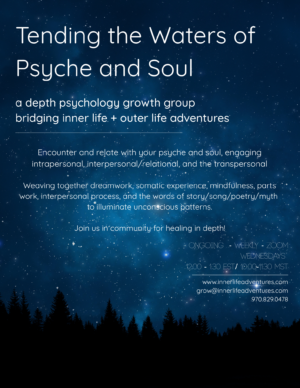
I’ve been offering groups I call “Tending the Waters of Psyche and Soul” to invite us into this process of navigating the relationship between self, other, and the archetypal images in our lives. We work with the images that come to us in our dreams and through our screens to explore the feelings, somatic experiences, and meanings that arise in our lives. And we do it in community because each of us has an important piece of the puzzle that our isolated, limited individual perspectives can only grasp a small part alone. 

Admittedly, as powerful as this group work is, it is still slow.  We can assume we understand the message in a big, intense experience, but I’m not sure we do if we can’t put words to it.  It takes time to unpack, process, digest, metabolize, and use that as fuel to change our lives and live differently.  But perhaps slowness is exactly the medicine we need in our manic times.  For me, taking time to find the words can be a humbling experience.  The right words don’t seem to come; I don’t know the right words.  I may misunderstand the meaning of the word, leading me to feel stupid.  I’m confronted with my limitations and inadequacies.  When I try a word, it doesn’t feel quite right.  I feel alone and disconnected while struggling to find the right words from deep in my psyche.   But the effort is worth it.  Because words are a perspective.  A standpoint.  A lens through which to look at the situation and develop a connection or relationship to it.  It’s only through finding our words that we can truly change something.  Otherwise, we continue to live through the same unconscious patterns.  There is a reason that when magic was a thing, it was invoked with words.  Finding the right words casts a spell. A spell that can change us, others, or the situation.  

In Harry Potter, a boggart takes on the form of what the person fears most.  To neutralize the boggart, it required a combination of somatic, emotional, and mental activity.  Remus Lupin explains, “The charm that repels a boggart is simple, yet it requires force of mind. You see, the thing that really finishes a boggart is laughter. What you need to do is force it to assume a shape that you find amusing. We will practice the charm without wands first. After me, please … riddikulus!”  The boggart is immortal.  You can’t kill it, but you can recognize what it is, and using the power of the word, calling it what it is, while somatically pointing your wand, feeling a feeling of amusement, mentally picturing something amusing, and calling it what it really is – “ridiculous”, you can change its form.  

Over and over again in life, we will have feelings and face difficult things.  We can’t escape that.  But we can study ourselves, we can study history, we can study words, and we can call things by what they truly are, using the power of words.  Not just empty words, but words imbued with feeling, with soma, and with imagination.  Just as in Harry Potter, we often project our greatest fears and unconscious, unspeakable patterns, which appear to us as monsters – usually in another person.  But when we name them, they lose the power to harm us.  Speaking the unspeakable thoughts, feelings, fantasies, and experiences is a key ingredient in the transformation of our psyche, soul, and ego.  Speaking words is a vital part of being human that can’t be replaced.  No other creature on the planet communicates with words.  Words make us human, make us whole, and help us become masters over our lives and psyche, especially when paired with emotion, imagination, relationship, and somatic experience.  

Chuck Hancock, M.Ed., LPC, LMHC, is a licensed psychotherapist and Analytic Psychology Training Candidate practicing in Colorado and New York, guiding individuals, couples, and groups into greater wholeness.  Inner Life Adventures.

Psyche and Soul Group Flyer

Tending the Waters of Psyche and Soul – Video Group Launching Soon!

Tending the Waters of Psyche and Soul

A depth-oriented psychotherapy group

Some forms of isolation aren’t solved by more effort, insight, or self-improvement.
They arise not because something is wrong with you—but because psyche was never meant to be carried alone.

This small, facilitated psychotherapy group offers a place to tend the deeper waters of inner life in the presence of others. It is a space for reflection, shared meaning-making, and slow relational work—where what is often held privately can be spoken, witnessed, and metabolized together.


Why Group?

Many people come to individual therapy having already done a great deal of inner work—thinking, reading, reflecting, understanding themselves more clearly. And yet something remains unmoved.

Group therapy works differently.

In group, isolation is named, shared, and gradually transformed through relationship. Experience is no longer held in the solitary mind, but enters a living relational field. Patterns emerge. Resonance happens. Something human and essential is restored.

This group is not about advice-giving or problem-solving. It is about presence, honesty, and the slow unfolding of psyche in relationship.


What This Group Tends

  • Chronic or subtle feelings of isolation or disconnection

  • Life transitions, midlife questions, or loss of meaning

  • Relationship patterns that repeat despite insight

  • Dream material and symbolic inner life

  • Longing for depth, authenticity, and shared reflection

  • The tension between a functional outer life and a neglected inner one

This group welcomes complexity. Nothing needs to be fixed. What matters is showing up as you are.


Who This Group Is For

This group may be a good fit if you:

  • Are an adult drawn to psychological depth and inner life

  • Have done some therapy, reflection, or personal work before

  • Feel inwardly alone, stagnant, or unseen despite outward competence

  • Are curious about dreams, meaning, and symbolic experience

  • Want relational contact that goes beyond surface conversation

  • Are open to being impacted by others—and to impacting them

This group is not a class, a support group, or a drop-in experience. It is an ongoing relational process.


Format & Practical Details

  • Format: Live, facilitated psychotherapy group on Zoom

  • Group Size: Limited (approximately 6–8 members)

  • Location: Participants must reside in Colorado or New York

  • Frequency: Weekly

  • Length: 90 minutes – 12 week minimum

  • Time: Wednesdays, 12:00-1:30EST/10:00-11:30MST
  • Fee: $60-$90, some sliding scale flexibility if cost is the only barrier to a good fit

All participants complete an initial conversation to assess fit and readiness for group work.


About the Facilitator

The group is facilitated by Chuck Hancock, M.Ed., LPC, LMHC, a depth-oriented psychotherapist with over 15 years of experience. His work integrates relational psychodynamic psychotherapy, Jungian psychology, mindfulness-based somatic awareness, and group process.

Chuck’s approach emphasizes presence, meaning, and the living relational field—supporting both psychological insight and embodied experience.


Next Step

If something in this description resonates, the next step is a brief, no-cost, no-pressure conversation to explore whether this group is a good fit for you.

👉 Schedule a free 20-minute consultation

970-829-0478 or email [email protected]

You don’t need to know exactly what you’re seeking—only that tending inner life alone is no longer enough.

While this particular group is new, an in-person group has been running for 5 years. Once you get a feel for this type of soulful community, people don’t want to lose it.  Want more information or to get a feel of the language of the group? 

Psyche and Soul Group Flyer

You Should Get Outside More (says science)

Summary of research and a few exercises you can useCanyon in NM

I don’t use the word should very often.  It’s a dirty word. And who am I to tell anyone they should do anything? But I will right now: you should get outside more!  And it’s not just me saying this, it’s science!

I’ve long been a lover of the outdoors participating in numerous sports and other outdoor activities over the course of my life. However it was about 10 years ago when I was on a 4 day backpacking trip with a self admitted stress-loving over-working friend of mine that I first caught a glimpse of the true power of the wilderness beyond being just a venue for recreation. It was on this trip that I solidified my decision to go back to grad school to become a counselor because I wanted to help people get to the place of openness, self-exploration, relaxation, and motivation that I saw in my friend that day.  I’ve learned a lot of skills and tools over the years, but none have been as good as nature to get the effects I saw that trip.

One of my biggest fears is being judged, so I’ve only dipped my toe in the outdoor therapy world until this point. The last thing I want to be judged as is a long haired tree hugging hippy who takes people into the woods to reconnect with nature with drum circles to find their lost soul (Not that there is anything wrong with any of that – I’ve done them all and they are great! You may consider trying those things too 😉 ).  But I know that scene is repulsive to some people so I’ve purposely stayed away from it professionally, because I know that sometimes people who are afraid to drop their guard enough to try something that far out of their comfort zone can be the people that need the power of the outdoors most.

So lately, I’ve been excited to find that more research is being done to understand what effects being outside does have on our minds and bodies. In this recent National Geographic article, the author does a great job summarizing the results of international research from the past few years. I still recommend reading it, but here are some of the main research points if you don’t have time.

Scroll down to the bold print to skip the research and get right to the exercise.

Being outside helps your brain take a break from it’s constant use. This can reduce stress, increase creativity, Snowy Trailand produce a difference in qualitative thinking. We think it lets the pre-frontal cortex unplug for a bit (the part of our brain in charge of cognitive function, rational thought, planning, personality, social expression,
inhibitions, decision making, executive functioning, and more.)  The most pronounced changes happens after being outside for 3 days.

But even a 15-minute walk in the woods causes measurable changes in physiology. Japanese researchers at Chiba University sent 84 subjects to stroll in seven different forests, while the same number of volunteers walked around city centers. The forest walkers hit a relaxation jackpot: Overall they showed a 16 percent decrease in the stress hormone cortisol, a 2 percent drop in blood pressure, and a 4 percent drop in heart rate. Researcher Miyazaki believes our bodies relax in pleasant, natural surroundings because they evolved there. Our senses are adapted to interpret information about plants and streams, he says, not traffic and high-rises.

The South Koreans have been doing research on the impact of work stress, long hours, digital addiction, and academic pressures. They are now devoting some forests as healing centers and prescribing time in nature to help combat these maladies. They have research that shows forest healing reduces medical costs

Several unrelated studies in England, Denmark, Canada, and Scotland all showed lower mortality, fewer stress hormones, less mental distress and lower incidence of 15 diseases including depression, anxiety, heart disease, diabetes, asthma, and migraines even when adjusted for confounding variables. That is levels of income, education, employment, and exercise did not effect the data. Just living near green space made aHorsetooth Reservoir in Fort Collins difference. If anything, lower income people seemed to benefit the most.
“In Finland, a country that struggles with high rates of depression, alcoholism, and suicide, government-funded researchers asked thousands of people to rate their moods and stress levels after visiting both natural and urban areas. Based on that study and others, Professor Liisa Tyrväinen and her team at the Natural Resources Institute Finland recommend a minimum nature dose of five hours a month—several short visits a week—to ward off the blues. “A 40- to 50-minute walk seems to be enough for physiological changes and mood changes and probably for attention,” says Kalevi Korpela, a professor of psychology at the University of Tampere. He has helped design a half dozen “power trails” that encourage walking, mindfulness, and reflection. Signs on them say things like, “Squat down and touch a plant.””

“Korean researchers used functional MRI to watch brain activity in people viewing different images. When the volunteers were looking at urban scenes, their brains showed more blood flow in the amygdala, which processes fear and anxiety. In contrast, the natural scenes lit up the anterior cingulate and the insula—areas associated with empathy and altruism. It may also make us nicer to ourselves. Stanford researcher Greg Bratman and his colleagues scanned the brains of 38 volunteers before and after they walked for 90 minutes, either in a large park or on a busy street in downtown Palo Alto. The nature walkers, but not the city walkers, showed decreased activity in the subgenual prefrontal cortex—a part of the brain tied to depressive rumination—and from their own reports, the nature walkers beat themselves up less.”

And the nature you visit doesn’t have to be in a wilderness area and it doesn’t just affect mood. Another study showed a 50-minute walk in an arboretum improved executive attention skills, such as short-term memory, while walking along a city street did not. “Imagine a therapy that had no known side effects, was readily available, and could improve your cognitive functioning at zero cost,” the researchers wrote in their paper. It exists, they continued, and it’s called “interacting with nature.”

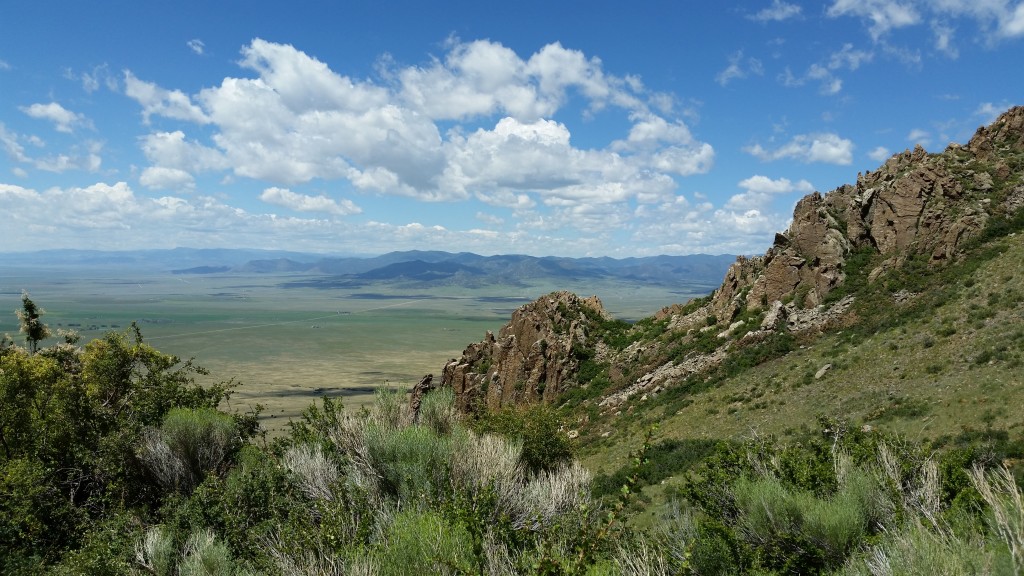
San Luis Valley

To summarize, there is research that suggests viewing and/or being in nature can reduce stress, reduce disease (including depression, anxiety, heart disease, diabetes, asthma, and migraines), decrease blood pressure and heart rate, improve attention, improve mood, increase empathy and altruism, increase creativity, decrease depressive rumination, and while I haven’t seen research that supports this, my experience is that most people tend to enjoy themselves and have a good time. Not bad for something that is free.

So like I said earlier, you really should get outside more. Just getting outside can help. Do it regularly, do it often, and at least once in a while, go for longer periods of time. If you want to make your time outside even more restorative and connecting, here’s a few tips and tools I’ve learned from personal observation that can enhance your experience.

  1. Disconnect from time. If you have a time limit, set a timer or alarm for 1/2 the amount of time you are willing to give to this experience. When this sounds, you will need to turn around and make your way back. Until then, don’t worry about time, your timer will tell you when you need to head back. Let yourself be fully present to the natural environment.
  2. Mark your transition from your urban/suburban/societal/structured/scheduled life into the natural world. When you leave the parking lot, sidewalk, building, etc and enter into natural space, make a mental note that you are shifting from one way of being into another. At this point, be sure your phone is on silent, your to-do list is put away, your calendar holds your obligations, and anything that is taking mental space is put on hold for the duration of your journey.If necessary, physically stop and mentally put down stresses, issues, people, thoughts, feelings, responsibilities, or anything currently bothering you that could get in the way of you being present with the natural world. Imagine a container to hold them and/or put them near a rock, tree, or entrance and leave them there. You can pick them up again on your way out (if you want).
  3. If there is something you are pondering or something is really bothering you and you would be open to letting your creative subconscious mind work on it for you, set an intention or ask a question as you enter this space. Then drop it. Notice what you notice (see below) while you are in the natural environment, and maybe there will be some insight into your situation. Or maybe not, but it doesn’t hurt to try.
  4. Come back to your senses!  Just notice what you notice. When in natural space, let your Mountain Streamanalytical mind take a break and instead focus on your senses. What do you sense outside of you with your sight, hearing, smell, taste, and touch? What do you notice in your body as you move? What do you notice in your emotional and
    energetic state? What thoughts pop into your mind automatically? Just notice what you notice, then notice something else. Over and over again while you are there.
  5. Let your curiosity awaken. What do your eyes get drawn to? What sounds do you hear? What made them?  Don’t worry about right and wrong or really knowing the answer. Just be curious. Which direction will you head? Let your curiosity and intuition be your guide. When you find something interesting, stop and study it with all your senses.  What will you discover?  I’m getting excited for you!
  6. When it is time to leave, before you leave the space pause for a minute or two and reflect on all that you noticed. Offer thanks to yourself for letting yourself have the time and thanks to the space and any creatures, insights, or special moments that presented themselves.
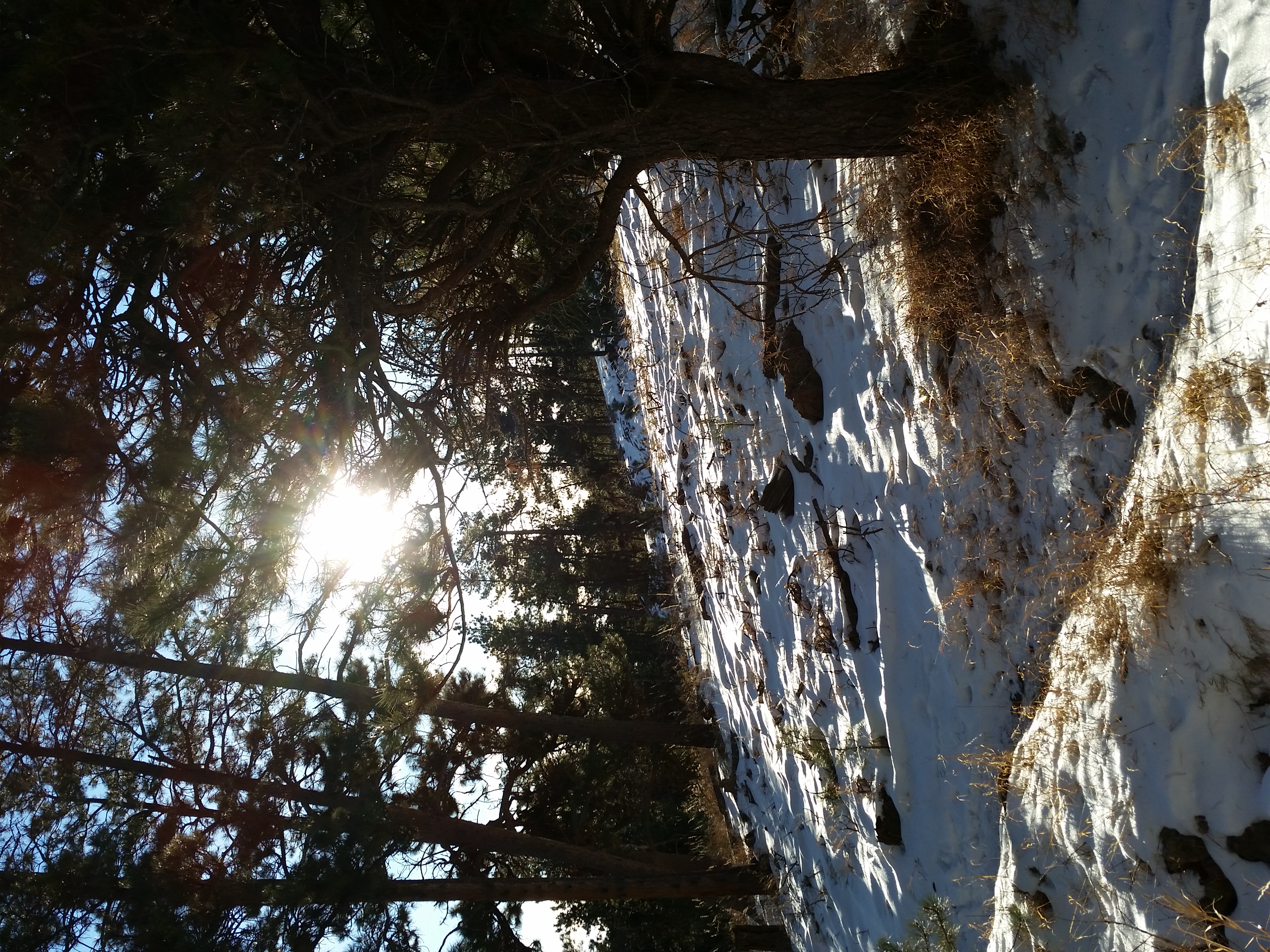
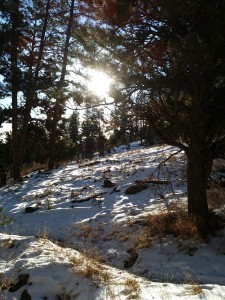
  7. Bring the experience back into your ordinary life. Write about your experience and/or tell somebody that will just listen. Let these questions guide you: What happened here? (Recount as much as you can) What did you learn from it? What are the bigger picture deeper lessons? How can it inform my life? How did this time outside help me?Sun Shining Through the Trees

So there you go. Get outside. Deepen in your relationship with yourself and with the natural world. Do this with a friend or family member and deepen in your relationship with them. If you have questions or would like to share your experience with this exercise, I’d love to hear from you. Email me at [email protected].  Hope to see you outside!


Chuck Hancock, M.Ed, LPC is a Licensed Professional Counselor in the state of CO. He has completed comprehensive training in the Hakomi Method of Experiential Psychotherapy, a mindfulness mind-body centered approach. Chuck guides individuals and groups in self-exploration providing them with insight and tools for change. He also incorporates nature as a therapy tool to help shift perspective and inspire new patterns.


Is your analytic brain still not convinced? Here are links to more articles and research.

Nature and Mental Health, Cognitive Function, Attention: https://depts.washington.edu/hhwb/Thm_Mental.html

Exploring the Mental Health Benefits of Natural Environments
http://journal.frontiersin.org/article/10.3389/fpsyg.2014.01178/full

Stanford researchers find mental health prescription: Nature.
http://news.stanford.edu/news/2015/june/hiking-mental-health-063015.html

2 Minute Walk May Reverse Harms of Sitting
http://well.blogs.nytimes.com/2015/05/13/a-2-minute-walk-may-counter-the-harms-of-sitting/

Benefits Of Ecotherapy: Being In Nature Fights Depression, Improves Mental Health And Well-Being
http://www.medicaldaily.com/benefits-ecotherapy-being-nature-fights-depression-improves-mental-health-and-well-being-261075

Nature experience reduces rumination and subgenual prefrontal cortex activation
http://www.pnas.org/content/112/28/8567.abstract

Creativity in the Wild: Improving Creative Reasoning through Immersion in Natural Settings
http://journals.plos.org/plosone/article?id=10.1371/journal.pone.0051474


Offline Sources

Hartig, T., Mang, M., and Evans, G. (1991). Restorative effects of natural environment experiences. Environment and behavior , 23 (1), 3-26.

Kaplan, R. and Kaplan, S. (1989). The Experience of nature . Cambridge Press.

Kaplan. S. and Talbot, J. (1983). Psychological benefits of a wilderness experience. In Altman, I. and Wohlwill, (Eds.), Behavior and the natural environment . New York: Plenum Press.

Turner, V. (1969). The ritual process . Chicago: Aldine.

Ulrich, R. S. et al. (1991). Stress recovery during exposure to natural and urban environments. Journal of environmental psychology , 11 (3), 201-230.


Do you know of a good study not cited here? Please send it my way.  I’m collecting good empirical support to make time in nature an “Evidence Based Practice.”


Expanding Beyond “Mindfulness”

As I was hiking this morning, I was watching myself, being aware of what I was doing, thinking, feeling, and sensing and a thought occurred, that mindfulness is about so much more than our mind.  As a former software engineer, I was living in a world of thought and cognition, which of course is helpful for many things, but not everything life gives us.  There is so much more to the mind than just thought, and if our definition of mindfulness is Sun shining through the treesonly on thoughts or the absence of thought, there’s so much more we are missing.

Don’t hear me wrong, being more aware of our thoughts, evaluating them as fact/opinion, true/false, helpful/not helpful and working to actively change thought is an essential first step.    It is the foundational basis of Cognitive Behavioral Therapy (CBT) which has been the primary treatment for a couple decades now, but of course there is more.

First let’s be clear that our “mind” is different than our brain (the lump of cells in our skull).  And even our brain is not just thought.  As anyone who has seen the movie Inside Out will know, there are memories, emotions, core beliefs, and more that shape our personality and all are contained in our brain.  (As a side note, if you have not seen this movie yet, go see it!) Our “mind” is much broader and includes all of the components of the brain mentioned above, the remainder of our nervous system, body, and more.  Dr. Dan Siegel, clinical professor of psychiatry at UCLA School of Medicine defines the mind as “an embodied and relational process that regulates energy and information flow.”

His definition is dense and can be broken down into much detail, but for now I just want to elaborate on a couple of points.  The mind regulates information flow – taking in information from our environment, information occurring within us, and information that may or may not leave us through expression.  The mind regulates energy input and output, such as the clamping down and low energy state known as depression.  The mind is embodied, that it is includes our central nervous system and peripheral nervous system that runs throughout our body and feels and expresses through the body.  And the mind is relational – our mind is influenced, shaped, impacted, and includes our relationships of the past and present.

So when we talk about mindfulness, we have to keep in mind that our mind is not just our brain, which is not just our thoughts.  It’s helpful to start with tools that help us learn awareness and focus, but then we also need to keep in mind that when we talk about mindfulness, we also need to consider and work with body-fulness, emotion-fulness, sense-fulness, thought-fulness, memory-fulness, self-fulness, other-fulness, relation-fulness, heart-fulness, personality-fulness, habitual behavioral pattern-fulness, and all the other components of being human.

You can try some exercises and see a diagram of this on my Mindful Practice page.

To explore all these areas, it takes awareness, skill, willingness, patience, and it is quite helpful to have a guide.  After all, how do you explore the relational aspects of mind by yourself?  Further, most of us tend to stay in our habitual comfort zone, and having someone to help point out the things we are not seeing on our own is an important part of the process of growth and healing.  Exploring all of this is what Dan Siegel calls “Mindsight,” and I call it your Inner (and outer) Life Adventure.

Happy exploring!


Chuck Hancock, M.Ed, LPC is a Licensed Professional Counselor in the state of CO. He has completed comprehensive training in the Hakomi Method of Experiential Psychotherapy, a mindfulness mind-body centered approach. Chuck guides individuals and groups in self-exploration providing them with insight and tools for change. He also incorporates nature as a therapy tool to help shift perspective and inspire new patterns.

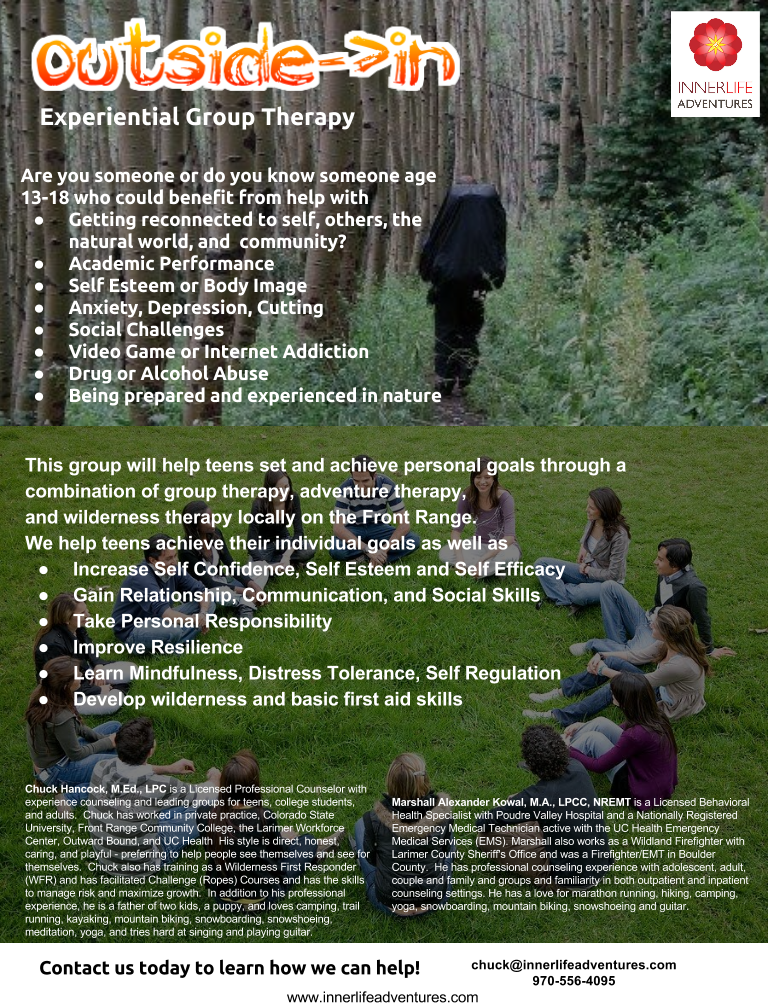
New Therapy Group for Teens


Join us for a new first of its kind hybrid group therapy and wilderness therapy group for teenagers locally on the Front Range based out of Fort Collins, CO.  This outdoor group was created to offer the best of coaching, therapy, and wilderness adventures to adolescents without the cost and time commitment of traditional backcountry programs.

This group is open to all teens of all genders regardless of “issue” who are simply looking for personal growth by getting outside and joining in a community of peers, connecting with themselves, others, and nature. Through exploring themselves, overcoming challenges, developing new skills,  and being guided by expert facilitators our participants learn to bring the best of the lessons and experiences of the outside…. in.

For more details, click here and or contact Chuck directly at [email protected] or 970.556.4095.

Download a pdf version of the flyer to print, email, and share with someone who could benefit.

Outside--in flyer


True Fear vs Worry

Ever since having a rattlesnake swim toward me and my kids a couple of weeks ago, every stick looks like a snake.  Every stick causes a slight pause, a re-evaluation, and worry about getting bit.  But this morning I got to see how unhelpful this really is.

This morning I was running on a familiar trail, after many false snake sightings my brain started to grow tired of it. Then I heard it, the loudest most intense rattle I’ve ever heard. And it’s close.  My body freezes, my eyes search for the sound, my feet shufflerattlesnake to a stop like the Road Runner cartoon character on the edge of a cliff.  A rattlesnake tumbles off the rock next to me dead center on the trail in front of me.  Only 6” from my feet, my body hovered over it still being pulled by my forward momentum.
I hear myself utter a fearful sound I’ve never heard myself make before.  My breathing stops.  All of my attention and focus goes to regaining my balance. I’m feeling real fear, much stronger than all the pointless worry of a few minutes ago. True fear totally consumes my body, giving me an alertness and activation that helps me with this threat.  Yet there is enough focus and stillness inside, to watch what is happening and notice I have not been bit.  The snake too was startled and all of its energy was going into curling up in it’s defensive position, which gave me time to back away.

We both stand our ground and stare at each other.  My heart pounding, I breathe deep and regain my composure. It too is still, not rattling, just watching me.  We both hold our places, no longer in the grips of fear. After a few minutes of watching each other and soaking in what just happened, I thank it for the experience and find an alternate route to continue on my journey.

Curiously, I notice that the rest of my run I’m actually not going on alert with every stick like before the meeting.  The real encounter with an actual danger seems to have increased my ability to discern the real threat from the perceived threat.

My brain thought it was keeping me safe by raising my fear any time it saw a stick, but in fact it wasn’t real fear, and it was only distracting me from what was real.  Having a snake 6” away from my foot triggered the real thing.  And it reminded me that most things that can really hurt us can’t be predicted anyway, we just have to trust ourselves, trust our body, trust our experience, and trust our support to do what needs to be done when action is needed.

As tends to happen on my outings in nature, I realize there are so many ways this experience speaks to the challenges and ways I’m needing to grow right now.  There are so many false fears in my mind about life, social situations, business decisions, my career, relationships, and more.  And I see how they are all distractions.  And the level of fear my worries present me with is so low, compared to a real danger.  But I often perceive them as real, I don’t like feeling them, and I let them limit me.

Well, I used to. Knowing how the brain works, I know this experience created some new pathways in my brain.  Just thinking about these things isn’t enough to change, but this helpful rattlesnake gave me a valuable experience.  It will now be that much easier to see worry for what it is now that my perception has been changed.  And I get to be grateful for yes, even a rattlesnake.

I hope you get out in the world and have your own lessons and life changing experiences.  They happen anywhere, when you are open to your experience, whatever it may be.  Just try not to play with rattlesnakes if you don’t have to. Hopefully you can learn your lessons easier.  🙂

~chuck

What do you think? Better yet, what do you feel? What do you experience? Let’s continue the conversation! You can find me at www.innerlifeadventures.com or email[email protected].  Want to meet?  Here’s how.

Chuck Hancock, M.Ed, LPC is a National Certified Counselor, Licensed Professional Counselor, and a Registered Psychotherapist in the state of CO. He has completed comprehensive training in the Hakomi Method of Experiential Psychotherapy, a mindfulness mind-body centered approach. Chuck guides individuals and groups in self-exploration providing them with insight and tools for change. He also incorporates nature as a therapy tool to help shift perspective and inspire new patterns.


Image Used under Creative Commons by David O on Flickr


The Remedy is the Experience

Here’s an article I wrote recently published in the fall edition of the Yoga Connection magazine.


The Remedy is the Experience
And experience is magnified in relationship


Often I hear from people, “What good is it to talk about things?” And I have to agree with that sentiment on some level. Talking about things is a good start. It helps you gain clarity and understanding about whatever it is you are facing, but it often falls short of actually creating any change. It’s the difference between reading a book on self-help and actually doing it, or reading a book on spirituality and actually practicing it.

When we engage with only the mind, we are neglecting a good portion of the rest of our system – like our body, emotions, nervous system, intuition, and what is showing up in our interactions in relationships. In this culture, I feel we have placed a premium on intellectual thought while discounting all other forms of learning and expressing, resulting in our ability to think ourselves in circles rather than actually breaking out of patterns of thought that keep us stuck. To actually change, it takes engaging your entire system possibly starting with intellectual learning, followed by experience combined with awareness to witness ourselves in our experience to fully anchor it in our being.

For example, someone I know well likes to do everything herself. Well, she may not like to, but it is much easier for her to take on super human amounts of work and do it herself rather than ask for help. Do you know anyone like this? We’ve talked about this many times over the years, she is aware of it, but there is some deep seated belief that it does no good to ask for help because it won’t be there anyhow – there’s probably no such thing as help. It’s just a myth. And even if there were, she wouldn’t want to be judged for or inconvenience someone in asking. No amount of talking about this and knowing intellectually where it may have come from has helped. It’s just another thought, competing in her mind with all the other millions of thoughts, why would she believe this one over any other?

Luckily experience came to the rescue. Recently, she was able to have the experience of being supported by multiple people in community, over a period of 10 days. So as quickly as her mind wanted to doubt it, there was another experience proving her mind wrong. Now it is not just a conversation about receiving help, but she has evidence, by many people, over a period of time constantly reinforcing the new possibility that there actually is such a thing as help, and most importantly she knows what it feels like to receive help without judgment. Now it has moved from just another thought in her mind to something that is actually real and tangible in her system because she has experience and she knows what it feels like to receive help.   

As I mentioned above, experience on its own is not enough either. If we are too busy in our head, planning our next move, evaluating, judging, worrying, or regretting, we are missing the experience.  One way to escape from this is through present moment awareness – mindfulness, but even this term is starting to feel heady to me. Instead, just getting into the heart-space of allowing, accepting, celebrating, witnessing and enjoying every moment with playful curiosity without trying to change or judge it allows us me to be more present to our experience.  Yes, that is mindfulness, but it is easier to accomplish when coming from the heart, rather than the mind and engaging with the heart gets us about 14” farther into our body.

In this same week referenced above, we had our kids present, which in the past has caused me to be on edge about what they were doing, how much noise they are making, who they are interrupting and so on. But this time we found the space to allow them to be kids, and so did all the other adults there. This was a huge lesson for me that if we can allow the kids to be fully themselves and do no wrong, what happens when we allow each other and ourselves to be like that too? Now don’t get me wrong, we are not the permissive anything goes parents, there are directions and boundaries for them clearly. The difference being we didn’t treat what they were doing as wrong when we asked them to do something else. It is subtle, but there is a definite felt difference there of allowing their being to be, and appreciating them, then redirecting behavior, rather than telling them they are wrong.

And this was a corrective experience for me: shifting from trying to control to accepting and allowing and experiencing how okay it was. So much of my life I’m worried about if I’m doing things “right” or being “acceptable” which saps my energy. Again, by being a part of a circle of people who allow my kids, and myself to just be, to make mistakes, to say the wrong thing, to look stupid, to be fully human, and still fundamentally okay, I now have that experience, which is worth at least 100,000 positive affirmations, mantras, or the like. It is a corrective experience that starts to override all the countless experiences at work, at school, with parents, and with “friends” where it wasn’t okay to simply be me. And at the same time they give us the gift of acceptance, the same circle of people can also redirect us when we get too far out of bounds just as we do with our kids.

“The next Buddha will not take the form of an individual. The next Buddha will take the form of a community; a community practicing understanding and loving kindness, a community practicing mindful living. This may be the most important thing we can do for the survival of the Earth”.
~ Thich Nhat Hanh


On the way home from this trip, I heard a kids joke: “What did the triangle say to the circle? – You’re pointless.”  And that is a good thing! Being supported in an accepting community of people holds so much power, without the sharp points that leave us wounded. 

I hear many people talking about building community these days, but I wonder if we are failing to recognize the community we already have by not fully engaging in it. How well do you know the people you work with, the people in your yoga class, the people you see at the grocery store, your neighbors, and all the others in your life? How much to you allow you to be fully you, honest, open, and vulnerable with others in your life? If we are neglecting the community all around us or holding ourselves back, we are missing out on so much support, so many reflections, so much priceless experience. 

As a sister of mine is fond of saying, “It’s all done with mirrors.” If we are alone, the mirror is colored and distorted by our own thoughts and beliefs. If we are fully engaged in honest open hearted relationship with others, we gain experiences and mirrors to see ourselves more clearly and help us get out of ourselves and actually change.

As we inhabit our body with increasing sensitivity, we learn its unspoken language and patterns, which gives us tremendous freedom to make choices. The practice of cutting thoughts and dispersing negative repetitive patterns can be simplified by attending to the patterns in the body first, before they begin to be spun around in the mind. 

– Jill Satterfield

So let’s seek out experience, actual human experience. Not just living theoretically through books or vicariously through the TV. We have an amazing sensing machine that we don’t always fully inhabit.  Engaging life fully embodied is an entirely different experience! Let’s back into our bodies and all our senses, engage with our breath, and each other fully, deeply, and lovingly to do the best we can and get the most out of our short time here. As Alan Cohen said, “You can be helping many people, but if you are not helping yourself, you have missed the one person you were born to heal.”  And that comes through human experience.

~chuck

What do you think? Better yet, what do you feel? What do you experience? Let’s continue the conversation! You can find me at www.innerlifeadventures.com or email [email protected].  Want to meet?  Here’s how.

Chuck Hancock, M.Ed, LPC is a National Certified Counselor, Licensed Professional Counselor, and a Registered Psychotherapist in the state of CO. He has completed comprehensive training in the Hakomi Method of Experiential Psychotherapy, a mindfulness mind-body centered approach. Chuck guides individuals and groups in self-exploration providing them with insight and tools for change. He also incorporates nature as a therapy tool to help shift perspective and inspire new patterns.