Some forms of isolation aren’t solved by more effort, insight, or self-improvement. They arise not because something is wrong with you—but because psyche was never meant to be carried alone.
This small, facilitated psychotherapy group offers a place to tend the deeper waters of inner life in the presence of others. It is a space for reflection, shared meaning-making, and slow relational work—where what is often held privately can be spoken, witnessed, and metabolized together.
Why Group?
Many people come to individual therapy having already done a great deal of inner work—thinking, reading, reflecting, understanding themselves more clearly. And yet something remains unmoved.
Group therapy works differently.
In group, isolation is named, shared, and gradually transformed through relationship. Experience is no longer held in the solitary mind, but enters a living relational field. Patterns emerge. Resonance happens. Something human and essential is restored.
This group is not about advice-giving or problem-solving. It is about presence, honesty, and the slow unfolding of psyche in relationship.
What This Group Tends
Chronic or subtle feelings of isolation or disconnection
Life transitions, midlife questions, or loss of meaning
Relationship patterns that repeat despite insight
Dream material and symbolic inner life
Longing for depth, authenticity, and shared reflection
The tension between a functional outer life and a neglected inner one
This group welcomes complexity. Nothing needs to be fixed. What matters is showing up as you are.
Who This Group Is For
This group may be a good fit if you:
Are an adult drawn to psychological depth and inner life
Have done some therapy, reflection, or personal work before
Feel inwardly alone, stagnant, or unseen despite outward competence
Are curious about dreams, meaning, and symbolic experience
Want relational contact that goes beyond surface conversation
Are open to being impacted by others—and to impacting them
This group is not a class, a support group, or a drop-in experience. It is an ongoing relational process.
Format & Practical Details
Format: Live, facilitated psychotherapy group on Zoom
Group Size: Limited (approximately 6–8 members)
Location: Participants must reside in Colorado or New York
Frequency: Weekly
Length: 90 minutes – 12 week minimum
Time: Wednesdays, 12:00-1:30EST/10:00-11:30MST
Fee: $60-$90, some sliding scale flexibility if cost is the only barrier to a good fit
All participants complete an initial conversation to assess fit and readiness for group work.
About the Facilitator
The group is facilitated by Chuck Hancock, M.Ed., LPC, LMHC, a depth-oriented psychotherapist with over 15 years of experience. His work integrates relational psychodynamic psychotherapy, Jungian psychology, mindfulness-based somatic awareness, and group process.
Chuck’s approach emphasizes presence, meaning, and the living relational field—supporting both psychological insight and embodied experience.
Next Step
If something in this description resonates, the next step is a brief, no-cost, no-pressure conversation to explore whether this group is a good fit for you.
There are No Shortcuts Here: Forget TikTok attention spans and bullet points. This process takes time, and you can’t rush it. Your conscious “ego” isn’t the boss.
This will be a long article. It will be long because it is a broad framework, and much can be said about Jungian Analysis, Jungian-oriented psychoanalysis, or Analytic Psychology, as it is most often called, or Archetypal Psychology, as James Hillman developed from his Jungian training. However, I hope this will not be overly rambling, as is common in Jung’s writings. In the modern age, when attention must be captured in short TikTok bursts or in bulleted lists, I will do exactly as Jungian work does. I will go against the grain and take as much time as it takes to develop, share, and reveal as much as I can about the process with words. The ego is not in charge here. It cannot be shortened or simplified by ideas alone, as understanding Jungian work from a cognitive dimension is at best only 1/4 of the picture. It is counter-cultural and non-consumerist, in that there is no linear set of steps to follow, no specific set of diagnoses it treats (though there are certainly contraindications), no guaranteed outcome, and it can’t be reduced to a bullet-point list or described in a social media post.
It Evolves as We Evolve: Unlike some other theories, this approach recognizes that people and ideas evolve over lifetimes (even Jung contradicted himself repeatedly — this is a sign of growth, not a weakness of the theory).
I reserve the right to change my mind and describe it completely differently in the future. This is being written in December 2025, after about five years of study in Jungian Psychology and about eight years of my own analysis. This may sound like a lot of time, but I’ll be the first to admit I’m not fully cooked yet, and I’m still learning, growing, and being shaped by my studies and analytic process. Many people don’t take this much time, but everyone’s timeline is different. One of the reasons I’ve chosen to study this approach is that it recognizes that we grow, change, and learn over time. Every day, there is more to learn from life and from our unconscious, which for many presents itself nightly through dreams. But dreams are by no means the only way the unconscious presents itself to us. When you study Jung, you find many contradictions and conflicts as he refined his ideas and continued his own individuation. I believe we should all continue to grow and approach life differently as we mature. Most other theories in practice today don’t account for differences across the lifespan and try to apply the same theory and method to all people at all stages of life. This is short-sighted and disrespectful to the soul.
That said, there is an end goal, and this is the modern age. I’ll do my best to summarize and provide bold bullet-point headings so you can decide whether it is worth your time to go further. I’ll honor both the spirit of the depths and the spirit of the times in this way.
TL;DR: The Main Goal: It’s a custom-tailored, in-depth “initiation” that helps you relate your conscious self (ego) with your personal unconscious and the collective unconscious. The aim is to build a solid inner core, minimize “projecting” your stuff onto others, and recognize your unique role in the world. The core idea of Jungian Psychology is that people are in a constant process to try to be who they are, and when that process gets thwarted, as it does by countless obstacles, people become various flavors of neurotic and miserable.
There is no single good name for it because it is a diverse, in-depth process tailored to each client and therapist at each phase of life, and when it is most effective, it is born anew in each moment of each session. It aims to help each unique person develop a healthy relationship between their conscious ego and the unconscious, to develop a solid internal structure, which helps them project less onto others, be more effective in building healthy relationships, bring their unique gifts and contributions to the world, and recognize their place in the world. I’ve come to see it as a relational process of initiation into the depths of the self and the other (where the other includes other people, the world, the unknown, the unconscious, the not-understandable, the mysterious, etc. ). It is an initiation into the rich depths of both the inner and outer worlds, recognizing archetypal patterns and forces that possess us while recovering wholeness and humanness through individuation across the lifespan.
The primary aim of Analytical Psychology is to facilitate a durable and functional relationship between the conscious ego and the unconscious. As a diverse, custom-tailored process, its effectiveness lies in its capacity to continually renew itself within the unique relational field of the client-analyst relationship. This in-depth work fosters a robust internal structure, which reduces projection, enhances relational capacity, and facilitates the realization of the individual’s unique purpose. Fundamentally, it is an archetypal process of initiation into both the inner and outer worlds-a confrontation with the unknown that restores wholeness through the life-long journey of individuation.
If you want to unpack it all a bit further, let’s carry on:
It’s About Finding Your Own Language: Good analysis helps you learn the unique “symbolic language of your own soul,” rather than forcing you to speak the system’s jargon. Beware of therapists who think they have the answers for you or force you to learn their language!
If you ask other Jungian Analysts, you’ll get many different answers because the process recognizes the uniqueness and subjectivity of each person. When done well, it helps the client learn the unique symbolic language of their own psyche and soul.
Jungian thought has been integrated into many other psychological theories and pop-psychology without attribution (or with criticism). (I’ll refrain from a detailed discussion on how Internal Family Systems (IFS) is a scripted approach working with complexes — maybe in another article.) You may encounter vocabulary commonly used in Jungian thought, such as shadow, complex, persona, anima/animus, ego, psychological types, introversion, extroversion, alchemy, archetypes, projection, personal unconscious, collective unconscious, individuation, etc. In some ways, understanding the structure of the psyche through this vocabulary can be helpful. Still, it can also be a trap, as, without a relational guide to help us see what we can’t see in ourselves, this knowledge can keep us locked into an intellectual understanding alone, which keeps distant the development of the relationship between the ego and soul and the multitude of parts or complexes we contain. To me, any good therapeutic process does not require you to learn the language of its system to participate, but rather to find your own language to describe and understand your unique experience, and to work with and relate to it more effectively. It’s not about drinking anyone’s “Kool-Aid.” However, plenty of misguided therapists, including Jungians, may try to get you to do so, believing they have the answer for you.
It’s “Care for the Soul”: Jungian psychology gets back to the root meaning of “psychology” — the study of the soul — but it’s not tied to any specific religion.
While the movement in academia and business over the last century has been to specialize and silo schools of thought, Jung approached psychology from the perspective that everything that humans have developed has come through the psyche; therefore, psyche and psychology are integrated into everything and found everywhere, and everything has been shaped by psychology. Rather than claiming a single school of thought as the one right way, this system works to integrate diverse systems, just as the diverse ecosystems that make up our planet do. Furthermore, Jung’s psychology stays close to the etymology of the word , which means “study of the soul,” or in other words, Jungian therapy can be seen as care for the soul.” But not from any religious or spiritual tradition, but a care for the soul that recognizes that each person has their own unique path that their soul is on, that may or may not involve a particular spiritual orientation.
James Hillman in Re-Visioning Psychology writes:
“ Soul is rediscovered, and with it comes a rediscovery of human-kind, nature, and world. One begins to see all things psychologically, from the viewpoint of the soul, and the world seems to carry an inner light. The soul’s freedom to imagine takes on preeminence as all previous divisions of life and areas of thought lose their stark categorical structures. Politics, money, religion, personal tastes and relationships, are no longer divided from each other into compartments but have become areas of psychological reflection; psyche is everywhere “ (Re-Visioning Psychology, p. 196).
Why the Name “Jungian” is a Problem: Jung didn’t want a “school” or followers because he didn’t want the work to become dogmatic or rigid. The name risks drawing attention to Jung himself rather than the actual process.
Since the model is based on reclaiming and integrating diverse ways of being, and because every person’s journey is unique and requires different methods and approaches, it is difficult to name. That is probably why people call it Jungian Psychology after the founder. However, this is problematic because Jung did not want a school and didn’t want Jungians to follow him. Yet he eventually agreed to establish a school because he recognized the need for in-depth training to undertake such work. Furthermore, Jung, in the transparency of his own process, made numerous mistakes, which people like to latch onto and discredit everything he wrote. The danger of calling it Jungian is exactly what Jung tried to avoid with his system: he didn’t want it to become dogmatic or codified in any way, which can happen when people focus more on the originator and/or his words than on the process he was describing. A finger pointing to the moon is not the moon, as they say. And the process of sorting what is useful from what is not helpful in our own lives and in what we read is something we all must do.
As we each travel our own unique paths, we can better understand ourselves and one another by examining diverse ways of seeing the world. We all see it differently. This was analyzed using the theory of psychological types. That is, we all have different strengths and weaknesses in thinking, feeling, sensing, and intuition, and the combination of these creates different ways of seeing and interacting with the world. They are not static and fixed; they are fluid and dynamic, and, in fact, we deepen our understanding of ourselves and each other by developing the areas in which we are weaker. In reality, Jung himself recognized that the system was incomplete, but it served as a starting point for understanding how different modes of perception shape consciousness. Modern conversations about consciousness often exhibit a one-sided bias toward either Eastern spirituality or Western science. Still, consciousness is not a monolithic phenomenon over which any discipline, school, or tradition can claim ultimate authority.
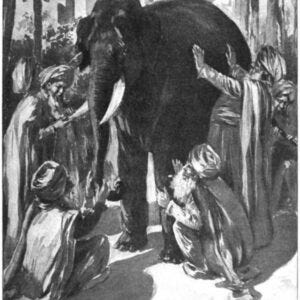
The “Blind Men and the Elephant” Parable: This image vividly illustrates how different schools of psychology (and people in general) grasp one piece of the truth and mistake it for the whole. Jungian psychology tries to honor all those perspectives.
Because this approach encompasses the diversity of human experience and the unconscious, which, by definition, can never be fully known, the parable of the blind men and the elephant is a powerful image for illustrating what is happening in both Jungian psychology, the field of psychology as a whole, and in each of us as we try to relate to our psyche and unconscious. The story concerns a group of blind men who have never encountered an elephant and learn its nature by touching it. Each blind man feels only a different part of the animal’s body, such as the side or the tusk. They then describe the animal based on their limited experience, and their descriptions of the elephant differ. In some versions, they suspect the other person is dishonest and come to blows. The moral of the parable is that humans tend to claim absolute truth based on their limited, subjective experience while ignoring others’ equally valid subjective experiences.
It is easy to see how each branch of psychology and psychotherapy, such as cognitive, somatic, emotionally focused, trauma-informed, relational, developmental, behavioral, social, psychodynamic, personality, etc, has focused itself. We can easily become grandiose when we study only one system, believing we have the right way to understand people and the proper therapeutic methods. Just like each branch of science or religion can do the same. However, as the parable illustrates, they are all just different methods of describing the same thing from a limited perspective. When we become attached to a single right way and try to defend it, it can become violent and ruin relationships, creating further division. Jungian Psychology attempts to educate the practitioner from the perspective that all ways of seeing are valid, and that it is up to the therapist to understand their own ways of seeing and being, and how they compare and relate to the other, while guiding the client to find their own, without dogmatically telling the client what to do. As you can imagine, it takes a lot of work and education to appreciate and see things from many different perspectives.
It Avoids Being Too Bossy: It requires maturity on the part of both the client and the therapist to avoid the “authoritative trap” of wanting someone to give the “right way.” It teaches you to orient yourself.
We all want someone to tell us the right way sometimes, especially when we are at our lowest or most lost. But taking the time to learn to orient ourselves to ourselves and the world around us helps us avoid getting lost and teaches us how to navigate unfamiliar terrain in the future. It Works (Eventually). When we learn what works for us and how other things work for other people, it is much easier to navigate the world and the people around us. That is why there is evidence to suggest depth-oriented approaches and Jungian Psychotherapy in particular is effective in creating long-lasting change . Recognizing we each have things that work better for us, and everyone is different, is a much-needed perspective in our modern, divisive world, which brings more peaceful interpersonal relationships.
So Many Names, Still No Perfect One. Despite being involved in many different forms of Jungian study over the years, I’ve never heard a term to describe it that I really liked. In my quest for a better name for Jungian Analysis, I asked ChatGPT for suggestions, thinking maybe I just haven’t been exposed to the best term yet, but hopefully, in its infinite scouring of the internet, maybe it found a better term. It gave me many suggestions, all accurate in their own ways, and at the same time emphasising one blind man’s perspective — that is, describing one aspect of it at the expense of others. Here are some additional names that convey its various facets.
Relational Depth Work
Relational Jungian Therapy
Depth-Oriented Relational Therapy
Experiential Depth Psychotherapy
Intrapersonal & Interpersonal Depth Work
Relational Soul Work
Soul-Oriented Psychotherapy
Archetypal Soul Work
Symbolic Process Work
Inner Life Work
Psychospiritual Depth Work
Work with the Living Psyche
Soul-Centered Therapy
Archetypal Depth Work
Therapy for the Inner Journey
Shadow & Soul Work
Depth Psychology Counseling
Inner Work Psychotherapy
Unconscious Process Work
Dream-Oriented Psychotherapy
Symbolic Depth Work
Integrative Depth Therapy
Mythopoetic Psychotherapy
Imaginal Psychotherapy
Deep Inner Work Therapy
Transformational Therapy
Therapy for Personal Meaning
Therapy for Self-Discovery
Insight-Oriented Therapy
Mind–Body–Soul Therapy
Therapy for the Deep Self
Inner Exploration Therapy
Whole-Person Depth Therapy
As you can see, many names describe one facet, but no one name can describe it all!
Avoid One-Sided Thinking: The system’s value is in recognizing and avoiding “one-sidedness,” making room for the complexity of reality. This applies to Jung’s theories, the author’s thoughts, and other psychological theories (e.g., CBT, IFS).
For me, one of the most valuable parts of the theory and process is the recognition and avoidance of one-sidedness. Many of the terms fall into this trap. But that doesn’t mean we should avoid words or terminology altogether; we need them to describe and differentiate. And then it is up to us not to let them lock us into a rigid, one-sided, rational way of thinking about things. That includes all of Jung’s theories as well! Neither Jung nor his students have the correct answers, but they point to important things to examine and relate to. So bring all the criticism of Jung and my thoughts on the process! It’s needed! And apply it to all of the other theories as well! CBT, IFS, somatic, trauma-focused, etc…. They are all helpful to a particular person at one specific moment. And let’s see if we can gently pry things open a bit more to get some more space to breathe and maneuver before we get so one-sided and fixed into one way of being in the world. That includes being “Jungian!” I consider this a key essential skill in our increasingly polarized world.
At its core, the process is one of seeing through to the core. That is where the word analysis comes in. Many people have negative associations with the word analysis. Still, the process is one of taking apart, analyzing carefully, seeing what is happening behind the scenes, so that one can be put back together more completely and function more smoothly without being derailed by habitual thoughts, feelings, or patterns. The negative views of analysis are worth unpacking in themselves. The world’s complexity and diversity, and his continued development and evolution throughout his life, account for the extensive rambling and diversity of thought in Jungian writing. However, it is aimed at seeing through, in whatever dimension the client is coming from or needs to work with, what is occurring in life at that time. Most importantly, it helps people derive meaning from and learn from their suffering, thereby growing, developing, and gaining greater mastery over their lives.
“We don’t so much solve our problems as we outgrow them. We add capacities and experiences that eventually make us bigger than the problems.” — C.G. Jung
Relational Aspects are Key: The work on alchemy shows that Jung’s ideas were very relational. The goal is to see past the personal drama to the deeper, “archetypal core” of your relationships.
In The Mystery of Human Relationship, Jungian Analyst Nathan Schwartz-Salant writes:
“In a sense, the alchemical way is one in which the analyst sees with the larger vision of the self; the scientific way is one in which he or she sees through the vision of the ego. The alchemical way sees through the eyes, whereas the scientific way sees with the eyes. Whereas the scientific way cannot encompass both opposites at the same time, the alchemical way can encompass both opposites simultaneously by situating them in a middle realm, the subtle body or the interactive field, the very existence of which scientific thinking denies” (p. 98–99).
Because of the collective cultural biases of our time and the introverted nature of many people who are drawn to Jung, the relational aspects of Jung are sometimes overlooked. Science is very important to much of our world, but it is one of many ways of seeing, all of which are important. Jung’s writings on alchemy and the Rosarium Philosophorum are foundational and closely aligned with the relational schools of psychoanalysis that emerged later in the century. But again, the key is that in a Jungian Analysis, we don’t get caught in the personal, but see through to the archetypal core of the dynamics at play in relationships with the analyst, intimate partners, family, and friends. It’s not about the ego’s desires, feelings, or unmet needs. Yet, being able to see and understand them, and their sources, can help reduce the extent to which they compel us and drive our lives.
It’s All About Individuation: This is the process of developing a relationship between your ego and your Self/soul to become your most whole self. It’s about letting the ego be a healthy part of you — no more, no less.
Lastly, as I’ve explored in other writings, Jungian Analysis is about aiding someone’s process of individuation. Individuation is a process of developing a relationship between the ego and the Self/soul, and all of the multitude of different parts of ourselves, which allows us to become as much of our full, whole self as possible in this lifetime. Not trying to destroy the ego or transcend the ego, just letting it be what it is. No more, no less. This is relativizing the ego.
Don’t Become a Jerk: Individuation means being able to enjoy and relate well to people who are different from you, rather than becoming a self-absorbed, judgmental hermit or dominating others with your beliefs.
We need a healthy ego and relationships with others as we individuate, because if we become a misanthrope who distances from or judges others, we’re only continuing to project our shadow. A good Jungian analysis helps us to appreciate people who are different from us more, rather than creating more distance. It is a process of recognizing and detaching from being controlled by the influence of the other — of our upbringing, of the other person, and of the culture, collective beliefs, and the collective unconscious, while remaining in relationship to the world. If we attend only to ourselves and do not relate well to or care for others, especially those who differ from us, we become more narcissistic. But we also cannot be infected by others’ beliefs and feelings.
It’s an Experience, Not a Theory: All the words and theories are just maps. The process itself is an experience, an initiation into yourself, the world, and transformation, using the symbols that arise in your own life.
You Have What You Need: The answers are already within you; you just need to look, listen, speak, and live.
No matter how we describe the process, it is NOT being led by the client’s, therapist’s, or someone else’s ego, or by anyone’s conceptualization of how to live one’s life. While reading more about Jung’s theories can dangerously lead to following someone else’s path or to intellectualizing the process, it can be helpful to understand the map. However, we cannot mistake the map for the terrain. There is nothing inherently bad about maps or intellectualizing; we don’t want to diminish or prioritize thinking, feeling, sensing, or intuition in our approach to ourselves or the world. We need all of these ways of being. I’ve tried to put some words to it while minimizing jargon. Still, even these words, along with the writings of other Jungian-oriented scholars, are insufficient to describe the process thoroughly. There is no adequate name to describe it. It’s an experience. It’s an initiation. Into yourself. Into the world. Into life. And death. And the natural process transformation. Through the symbols that present themselves to you in your one unique and precious life. You already have everything you need. You don’t need to look outside yourself for answers. They are right there. You just have to look. You just have to listen. And speak. And live.
Chickpea to Cook
Rumi — Translated by Coleman Barks
A chickpea leaps almost over the rim of the pot
where it’s being boiled.
‘Why are you doing this to me?’
The cook knocks him down with the ladle.
‘Don’t you try to jump out.
You think I’m torturing you.
I’m giving you flavor,
so you can mix with spices and rice
and be the lovely vitality of a human being.
Remember when you drank rain in the garden.
That was for this.’
Grace first. Sexual pleasure,
then a boiling new life begins,
and the Friend has something good to eat.
Eventually the chickpea will say to the cook,
‘Boil me some more.
Hit me with the skimming spoon.
I can’t do this by myself.
I’m like an elephant that dreams of gardens
back in Hindustan and doesn’t pay attention
to his driver. You’re my cook, my driver,
my way into existence. I love your cooking.’
The cook says,
‘I was once like you,
fresh from the ground. Then I boiled in time,
and boiled in the body, two fierce boilings.
My animal soul grew powerful.
I controlled it with practices,
and boiled some more, and boiled
once beyond that,
and became your teacher.’
Chuck Hancock, M.Ed., LPC, LMHC, is a licensed psychotherapist and Analytic Psychology Training Candidate practicing in Colorado and New York, guiding individuals, couples, and groups into greater wholeness.
Emotions, feelings, moods, all the same thing. Right? Not at all. And understanding our feelings is so foundational to understanding ourselves and being able to heal in therapy I thought it would be helpful to put together this quick guide to share with clients to help you gain more understanding of your own human system. There’s much more detail to all of this, but hopefully, this guide will help get the gist of what is happening inside you.
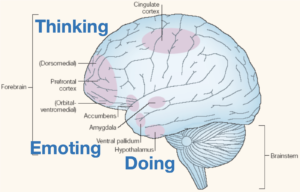
Our brains have evolved over thousands of years. Some parts of our brains we share with reptiles, some with other mammals, and some are unique to humans alone. Generally speaking, the lower parts of our brain are the most basic and most similar to reptiles. As you move upward, your brain gets more sophisticated. The lower parts of our brains are designed to keep us alive. The upper parts help us connect with others, communicate, understand, and make meaning of life. These are the parts that make us different from other animals. But we also need to understand how the lower parts of our brain affect us too!
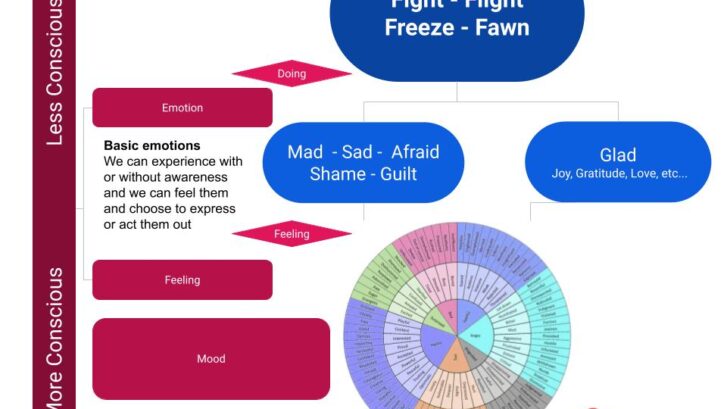
Emotionally speaking, the lower parts of our brain are responsible for instinctual survival functions in the face of a threat. These are all actions that usually happen without our consciousness involved because the impulsive instinctual brain is faster than our cognitive brain.
Fight – get stronger and attack the threat
Flight – get away from the threat
Freeze – don’t move, play dead, so hopefully, the threat will go away
Fawn – act pleasing, innocent, harmless, and endearing so the threat doesn’t see you as a threat to avoid the conflict
Where our lower brains are not so smart is that in modern-day, the threat isn’t usually a tiger or assailant but could be a look from someone, a social media post, a raised voice from a friend or family member, an insult, or any number of things that raise our hackles in big or small ways. Our brains sometimes respond in one of the above survival ways when our survival isn’t being threatened at all, especially if we have had past exposure to traumatic events.
These four survival emotions get a little more sophisticated as we move to the mid-brain and with a little more awareness, they get shaped into the basic emotions that all humans in all cultures experience. These emotions exist to help us relate to other people. Different researchers have categorized them differently, but I like to use the five basic emotions that mostly rhyme to help people remember them. MAD, SAD, AFRAD (afraid), GLAD, SHAME/GUILT. Shame and guilt feel similar, but are two different things. Shame means I’m bad (unhealthy), guilt means I did something bad (healthy) to help us have remorse and repair.
Notice most of these are what most people call “negative” feelings and only one is “positive.” I think we evolved like this for a reason, to help us avoid doing things that cause us or people we care about harm. But unfortunately, it leads to a negativity bias in our brains and a positivity bias in our external relationships trying to balance out the scales. In reality, we need all of these feelings so there is no such thing as a positive or negative feeling. They are all helpful information to help us understand our inner and external worlds.
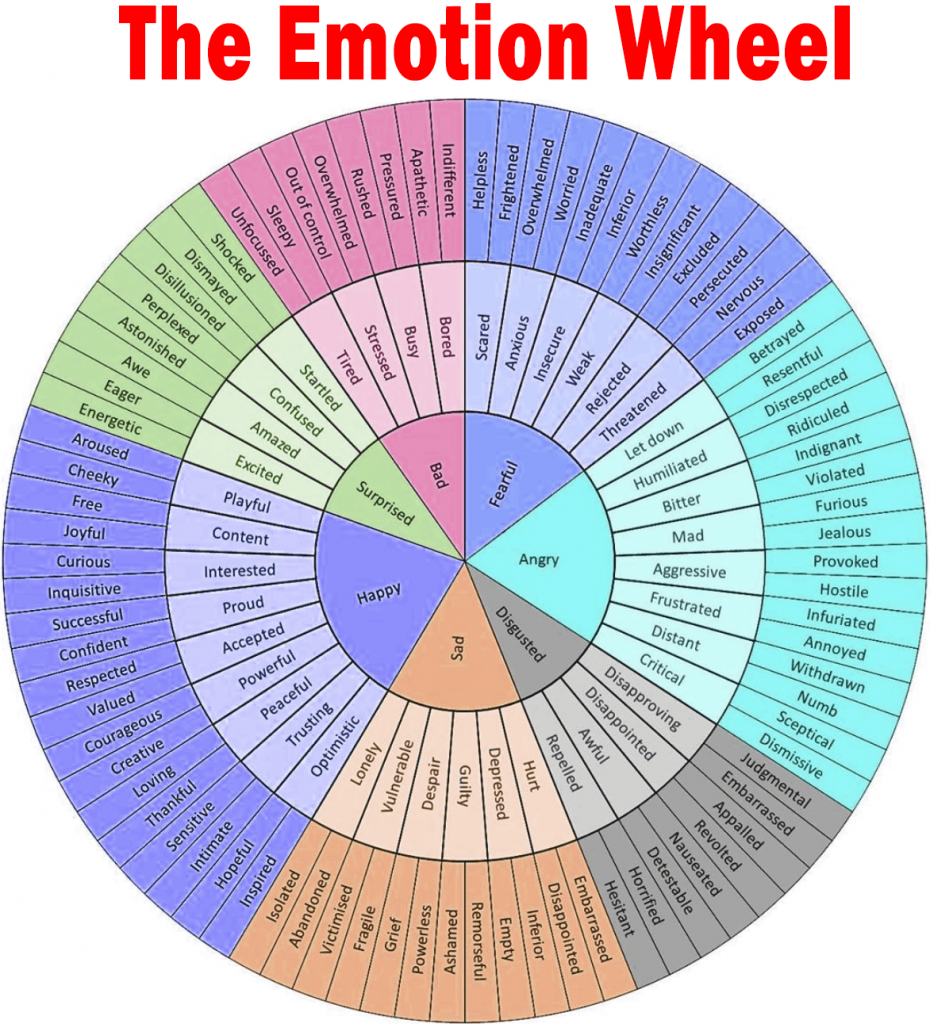
If you can get a solid grasp of being able to feel and identify when you are feeling the 5 basic emotions, you have most of what you need to be an emotionally intelligent human being. Being able to communicate emotions with others helps us to relate and connect with others, to understand and be understood, and to be able to give and receive support. I consider this to be a foundational human skill. As our relationships get more complex and we get better at communicating, we have need for more precise emotional words, so psychologists have invented various versions of the emotion wheel to show how these basic emotions get more nuanced.
Some of these feelings can overlap, and we can feel multiple emotions at the same time. So don’t misunderstand the wheel to be the ultimate truth. See if you can find your own language for your own expression of your emotions.
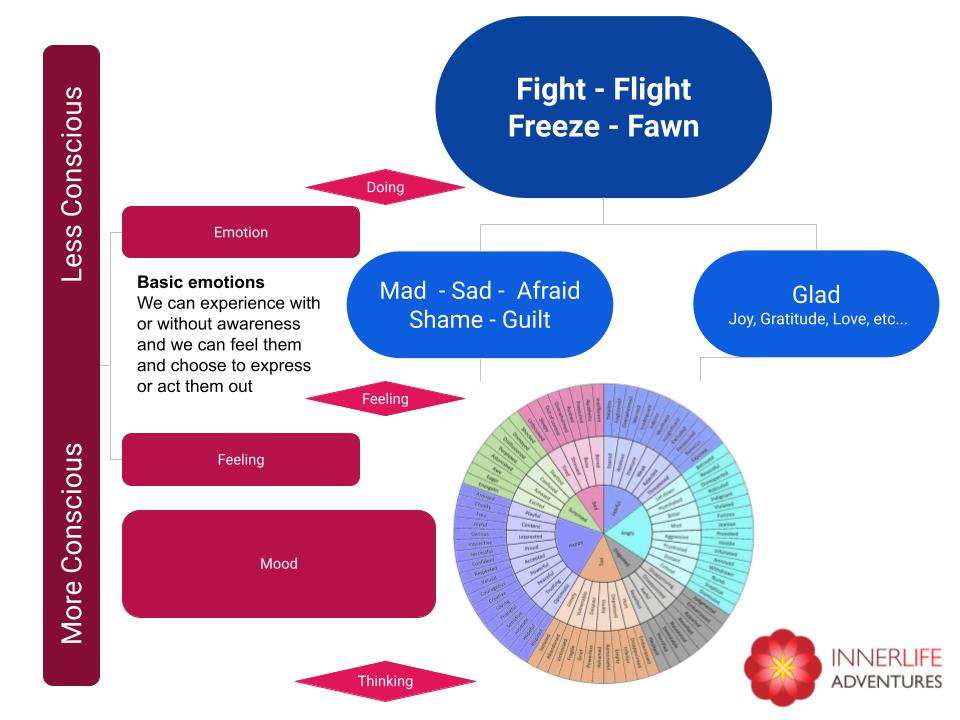
As you can see, our feelings can go from quite simplistic and primal survival to emotions of relating to quite complex and nuanced. That’s why it’s important to distinguish between emotions and feelings. Emotions can sometimes feel big and overwhelming. Almost as if the emotions have us more than we have them. Feeling overwhelmed by emotion often comes from little awareness and understanding of emotions and triggers for them. As we gain more awareness and skill, we can be a person having our emotions rather than our emotions having us. This increase in awareness and distance from the raw intensity of emotion combined with thoughts turns them into feelings. Feelings are very important information. They help us make decisions about what is right for us and what we need to stay away from and can lead us to conscious action and/or communication.
When we are consumed with emotion, we often don’t have access to critical thinking or discernment that is available when we are feeling. Sometimes we even act out of an emotion, such as yelling at someone (anger/fight) or distancing ourselves or avoiding something (fear/flight) or going numb (fear/freeze). This usually happens with little consciousness or choice. So we are acting out an emotion (doing) rather than feeling and communicating about a feeling which is usually more helpful.
The more consciousness we bring to ourselves, the more choice we have to understand and act appropriately. And we can often increase the time between the stimulus that causes the emotion and the response (impulsively or consciously) to act in a more appropriate way. Without awareness, we respond impulsively or emotionally, which might cause more harm than good.
Here’s a chart I made to visualize the process I’m talking about.
As you can see, doing, feeling, and thinking follows the evolution of the brain. Reptiles do without awareness or feeling. Mammals have the ability to feel and relate to others but may not have words and thoughts like humans. Humans have all of the above with the addition of complex language and cognitive abilities. One function isn’t necessarily better than another; we need them all. Thinking can help us make sense of and respond more effectively to our emotions and feelings. But when used to excess without connection to feeling or emotion or action, thinking can also disconnect us from ourselves, our life, and others. So thinking, too has to be used and responded to appropriately, just like emotions. We need doing, feeling, thinking, and being all accessible to us at the right time and place.
Further, overthinking and rumination often lead to a stuckness of emotion or feeling, which leads to moods. Moods are more generalized, pervasive emotional states that can last days, weeks, months, or even years. Emotions come and go, just like the weather. When we try not to feel them by suppressing or repressing them, they can get stuck and lead to moods. Unpacking moods, like being depressed, can take time to really understand all the inputs from both present and past experiences as well as the unnamed unexplored feelings that comprise the mood.
As I said, this is a quick overview of our emotional systems. There is some more information in the links above. There’s a bit more to it, and some of this is a broad generalization to help distinguish what is happening. Understanding these basics help tremendously to help you understand yourself and others. People often think that our thoughts control our feelings; and they do to some extent. But our survival instincts and the basic raw emotions that evolved out of them can be much more powerful than our thoughts. Just try to control your feelings with thoughts when you get dumped by a partner you really cared about, lose a job that you loved, get into a physical fight, or anything else that touches into our survival needs.
The way I see it, our thoughts and feelings and actions are all in relationship to each other, all equally valid, no one mode is more important than the other. The more you understand what is happening inside of you and outside of you and have awareness of what emotions and feelings are being experienced, the more you can engage your full self and your relationships to prevent things from spiraling out of control into overwhelm, unconscious action, or a stuck stagnant mood.
Chuck Hancock, M.Ed, LPC is a Licensed Professional Counselor in the state of CO. He has completed comprehensive training in the Hakomi Method of Experiential Psychotherapy, a mindfulness mind-body centered approach and is a student of depth psychology. Chuck guides individuals and groups in self-exploration providing them with insight and tools for change. He also incorporates nature as a therapy tool to help shift perspective and inspire new patterns.
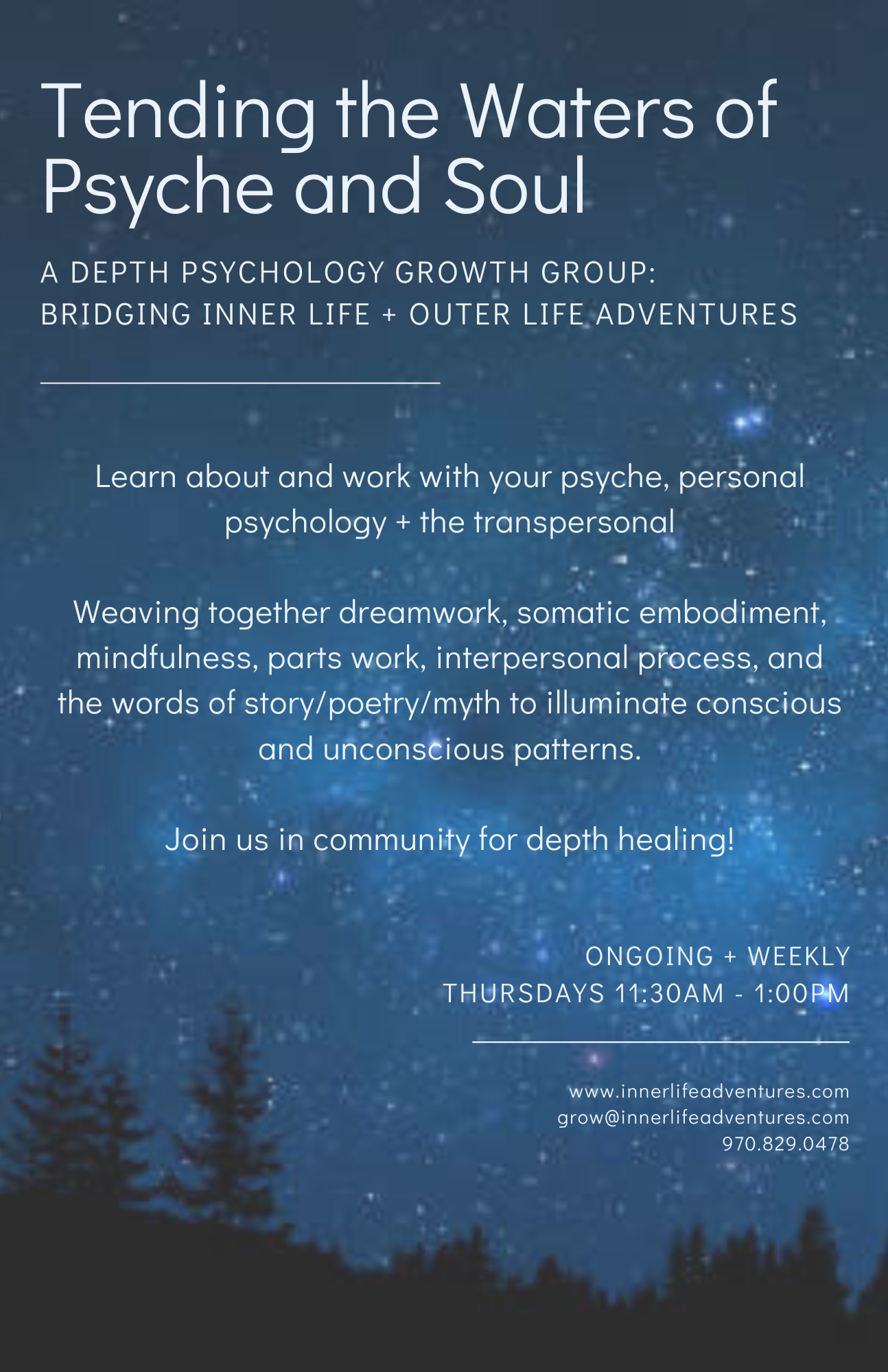
A Depth Psychology Growth Group Bridging Inner Life and Outer Life Adventures
Some Definitions of Soul
an active or essential part
the part of the human being that thinks, feels, and makes the body act
the quality that arouses emotion and sentiment
energy or power of mind or feelings; spirit; fervor
the cause of inspiration or energy; leading spirit; prime mover
spiritual or moral force
the embodiment of some quality; personification
the spirit of a dead person
the immaterial essence, animating principle, or actuating cause of an individual life
a person’s total self
You may or may not believe you have a soul. That is not a prerequisite for this group. If you have a desire to deepen your connection with, relationship to, and grow the health of any of the above descriptions, this group is for you. This group is a space to learn about and work with your psyche, personal psychology developed by your experiences and narrative about those experiences, interpersonal relationships (how you show up with others), and the transpersonal (anything bigger than and beyond yourself).
Join us in community for depth healing utilizing the map and mirrors of depth somatic experiential psychology. This group will bridge the world of our ordinary waking life roles and structures with that of our inner world. This is not a group about fixing you, teaching you skills, or requiring you to be “better” – rather it is a group where all of you, in your brilliance and in your struggle with shadow, is welcome. It is a group that is led by psyche, soul, and spirit informed by your life and experience facilitated by a trained guide (not a teacher).
In this group, you bring the topics – based on what is alive in you. What is challenging you? What is inspiring you? What is showing up in your world that feels impactful or meaningful? Whether that aliveness is a dream you had, a poem or song that moved you, a meditation practice that taught you, a social media post that triggered you or brightened your day, grief that brought you to your knees, a stuck-ness so tight it paralyzes you or a movement that opened or freed you, this group is a space to bring more life and soul into your world in a community of fellow practitioners.
Who is this group for?
In the group process, there are many “problems” or pain points that can lead someone to join. It could be anxiety in general, or about the state of the world and its political, social, economic, and health issues. It could be that you are feeling depressed, stuck, stagnant, alone, misunderstood, or constantly sad. You may have a hard time knowing your place in this ever changing world. This group starts with the philosophy that we are all human, and we are all in this together. And through working through our individual “problems” together, we help each other. And perhaps even see that they are not problems, but invitations to grow. This group is for people willing to engage in their own healing by giving and receiving support, and opening to wisdom and support of a variety of modalities that connect you with your heart, mind, body, and soul.
We aim toward self leadership and self actualization. How do we do that?
We are all struggling to know and become the fullest version of our “real,” true, unique selves. We create a space to learn more about ourselves and experience new aspects of ourselves through content, process, and interpersonal relationships with other group members.
We recognize we have the tendency to deny our own needs and feelings. To pretend to be someone we aren’t or to avoid facing our true self inhibits growth. In this group, we take responsibility for owning our needs and feelings and expressing unexpressed thoughts, so the facilitator and other group members co-create the space to meet those new places in yourself and possibly have your needs and feelings met in an embodied way.
We believe each individual is endowed with the urge to expand, develop, mature, and reach self-actualization. We believe that true growth and healing come from within, and this group is designed to help facilitate that process.
Even in the best of times, it is easy to fall into despair – by not living the life that is yours to live or by feeling disconnected from the greater story of life and your place in the order of things. In these times of chaos and uncertainty, this group will help you reconnect to the life that is yours to live and reconnect you with the bigger picture and meaning to provide fuel and inspiration for the challenges we face.
Logistics
Ongoing. Weekly. Thursdays 11:30-1:00. In person with a zoom in option for health or travel.
Open to all genders age 25+.
8-week minimum commitment to allow for relationships and group containers to form. Stay as long as the group is beneficial to you.
Financial Investment $30-$60 per group sliding scale.
About the facilitator:Chuck Hancock, M.Ed, LPC is passionate about group work being an important part of our growth and healing journey. With over a decade of experience guiding individual and group processes in council, dreamwork, interpersonal process groups, psychodrama, meditation, Hakomi somatic psychotherapy, ego state (parts) work, Jungian psychology, movement, music, and nature based practices. He weaves all of these practices together to help clients locate themselves in the world co-creating new experiences of authenticity, depth, meaning, insight, and inspiration. With the diversity of members, modalities, and lineages the community formed in a group experience offers more possibility and amplification of the growth process.
To register for more information to decide if this group is right for you, email [email protected] or call 970.829.0478.
“The guest is inside you, and also inside me;
you know the sprout is hidden inside the seed.
We are all struggling; none of us has gone far.
Let your arrogance go, and look around inside.
The blue sky opens out farther and farther,
the daily sense of failure goes away,
the damage I have done to myself fades,
a million suns come forward with light,
when I sit firmly in that world.
I hear bells ringing that no one has shaken,
inside “love” there is more joy than we know of,
rain pours down, although the sky is clear of clouds,
there are whole rivers of light.
The universe is shot through in all parts by a single sort of love.
How hard it is to feel that joy in all our four bodies!
Those who hope to be reasonable about it fail.
The arrogance of reason has separated us from that love.
With the word “reason” you already feel miles away.”
‘‘When we don’t feel safe, our brains fall into a fear mindset and don’t allow forour natural states of joy, calm and happiness to arise.’’
SAFE is a simple acronym for a practice you can use to ignite the natural anti-depressant and anti-anxiety medicine of self-compassion. In this time of uncertainty, there are lots of things being felt. To make it through, we have to be able to work with our emotions in a healthy way, not ignore them or “just think positively.” It might work for a short time, but eventually you’ll run out of energy to keep supressing other feelings and welcoming only positive ones. When you are feeling something you don’t want to be feeling, try this practice.
S – Soften into the feeling. This implies a type of gentle recognition of the feeling or sensation in your body. Focus your awareness toward it softly. If you can, maybe even naming it. “Breathing in, opening to the sadness/fear/vulnerability that is there, breathing out, softening into it.” But if you can’t name it easily, don’t get hung up on it. Sometimes it is even better to not, as words and labels may make us jump to assumptions about it. But do make sure it is a feeling or sensation in your body, not a belief or narrative about something.
A – Allow it to be as it is, without resisting, trying to change it, or clinging to it. For as long as needed, but aim for at least a few minutes. Most likely not more than a few days. If it lasts more than a few days or weeks, some outside help or support may be needed.
F – Feel into the emotion that is there even more with a kind attention and compassion for it. In doing this we can also drop in questions to connect our mind with our feelings: “What is it trying to tell me?” “What is it’s message for me right now?“ “What does this feeling believe?”” or “What do I need right now?” When we discover this we might give that to ourselves. For example, if we sense that we need to feel loved and to feel safe, we might say, “May I feel loved, May I feel safe, etc…” We may need rest, connection, care, food, movement, etc. I’d encourage you to keep your gift related to your inner process, rather than feeling like you need to take external action, especially to change or avoid the feeling.
E – Expand awareness of all people who also experience this feeling. Remind yourself that while your situation may feel unique to you, the feeling you are experiencing is also experienced by virtually every human on this planet. This feeling, this vulnerability of sadness, fear, anger, guilt, shame, depression, anxiety, resistance, or any difficult experience is a universal human experience. This is a core component of self-compassion. Here is where we understand that we are not alone and that in this very moment there are thousands if not millions of people who are experiencing this very same feeling. The “E” of SAFE is where we inspire connection with the rest of humanity. In this practice we can also take what we learned from the “F” of SAFE and send it outward to specific people you know that also experience this or to humanity in general saying, “May we all feel loved, May we all feel safe, etc… Some people find it helpful to do this with a hand on their heart, stomach or both.
If you have trouble focusing on your inner experience in this way, it may be helpful to first ground yourself with input from your 5 senses. Paying attention to information first from the outside world of what you can hear, see, smell, touch/feel, and taste. Ask yourself, am I really SAFE in this moment? Is there an immediate threat? Most likely, there is not anything that has to happen this exact moment. Then allow yourself to come back to the SAFE exercise.
SAFE Acronym by Elisha Goldstein, PhD, explanations and expansion provided by Chuck Hancock, LPC, EMDR II of Inner Life Adventures
Summary of research and a few exercises you can use
I don’t use the word should very often. It’s a dirty word. And who am I to tell anyone they should do anything? But I will right now: you should get outside more! And it’s not just me saying this, it’s science!
I’ve long been a lover of the outdoors participating in numerous sports and other outdoor activities over the course of my life. However it was about 10 years ago when I was on a 4 day backpacking trip with a self admitted stress-loving over-working friend of mine that I first caught a glimpse of the true power of the wilderness beyond being just a venue for recreation. It was on this trip that I solidified my decision to go back to grad school to become a counselor because I wanted to help people get to the place of openness, self-exploration, relaxation, and motivation that I saw in my friend that day. I’ve learned a lot of skills and tools over the years, but none have been as good as nature to get the effects I saw that trip.
One of my biggest fears is being judged, so I’ve only dipped my toe in the outdoor therapy world until this point. The last thing I want to be judged as is a long haired tree hugging hippy who takes people into the woods to reconnect with nature with drum circles to find their lost soul (Not that there is anything wrong with any of that – I’ve done them all and they are great! You may consider trying those things too 😉 ). But I know that scene is repulsive to some people so I’ve purposely stayed away from it professionally, because I know that sometimes people who are afraid to drop their guard enough to try something that far out of their comfort zone can be the people that need the power of the outdoors most.
So lately, I’ve been excited to find that more research is being done to understand what effects being outside does have on our minds and bodies. In this recent National Geographic article, the author does a great job summarizing the results of international research from the past few years. I still recommend reading it, but here are some of the main research points if you don’t have time.
Scroll down to the bold print to skip the research and get right to the exercise.
Being outside helps your brain take a break from it’s constant use. This can reduce stress, increase creativity, and produce a difference in qualitative thinking. We think it lets the pre-frontal cortex unplug for a bit (the part of our brain in charge of cognitive function, rational thought, planning, personality, social expression,
inhibitions, decision making, executive functioning, and more.) The most pronounced changes happens after being outside for 3 days.
But even a 15-minute walk in the woods causes measurable changes in physiology. Japanese researchers at Chiba University sent 84 subjects to stroll in seven different forests, while the same number of volunteers walked around city centers. The forest walkers hit a relaxation jackpot: Overall they showed a 16 percent decrease in the stress hormone cortisol, a 2 percent drop in blood pressure, and a 4 percent drop in heart rate. Researcher Miyazaki believes our bodies relax in pleasant, natural surroundings because they evolved there. Our senses are adapted to interpret information about plants and streams, he says, not traffic and high-rises.
The South Koreans have been doing research on the impact of work stress, long hours, digital addiction, and academic pressures. They are now devoting some forests as healing centers and prescribing time in nature to help combat these maladies. They have research that shows forest healing reduces medical costs
Several unrelated studies in England, Denmark, Canada, and Scotland all showed lower mortality, fewer stress hormones, less mental distress and lower incidence of 15 diseases including depression, anxiety, heart disease, diabetes, asthma, and migraines even when adjusted for confounding variables. That is levels of income, education, employment, and exercise did not effect the data. Just living near green space made a difference. If anything, lower income people seemed to benefit the most.
“In Finland, a country that struggles with high rates of depression, alcoholism, and suicide, government-funded researchers asked thousands of people to rate their moods and stress levels after visiting both natural and urban areas. Based on that study and others, Professor Liisa Tyrväinen and her team at the Natural Resources Institute Finland recommend a minimum nature dose of five hours a month—several short visits a week—to ward off the blues. “A 40- to 50-minute walk seems to be enough for physiological changes and mood changes and probably for attention,” says Kalevi Korpela, a professor of psychology at the University of Tampere. He has helped design a half dozen “power trails” that encourage walking, mindfulness, and reflection. Signs on them say things like, “Squat down and touch a plant.””
“Korean researchers used functional MRI to watch brain activity in people viewing different images. When the volunteers were looking at urban scenes, their brains showed more blood flow in the amygdala, which processes fear and anxiety. In contrast, the natural scenes lit up the anterior cingulate and the insula—areas associated with empathy and altruism. It may also make us nicer to ourselves. Stanford researcher Greg Bratman and his colleagues scanned the brains of 38 volunteers before and after they walked for 90 minutes, either in a large park or on a busy street in downtown Palo Alto. The nature walkers, but not the city walkers, showed decreased activity in the subgenual prefrontal cortex—a part of the brain tied to depressive rumination—and from their own reports, the nature walkers beat themselves up less.”
And the nature you visit doesn’t have to be in a wilderness area and it doesn’t just affect mood. Another study showed a 50-minute walk in an arboretum improved executive attention skills, such as short-term memory, while walking along a city street did not. “Imagine a therapy that had no known side effects, was readily available, and could improve your cognitive functioning at zero cost,” the researchers wrote in their paper. It exists, they continued, and it’s called “interacting with nature.”
To summarize, there is research that suggests viewing and/or being in nature can reduce stress, reduce disease (including depression, anxiety, heart disease, diabetes, asthma, and migraines), decrease blood pressure and heart rate, improve attention, improve mood, increase empathy and altruism, increase creativity, decrease depressive rumination, and while I haven’t seen research that supports this, my experience is that most people tend to enjoy themselves and have a good time. Not bad for something that is free.
So like I said earlier, you really should get outside more. Just getting outside can help. Do it regularly, do it often, and at least once in a while, go for longer periods of time. If you want to make your time outside even more restorative and connecting, here’s a few tips and tools I’ve learned from personal observation that can enhance your experience.
Disconnect from time. If you have a time limit, set a timer or alarm for 1/2 the amount of time you are willing to give to this experience. When this sounds, you will need to turn around and make your way back. Until then, don’t worry about time, your timer will tell you when you need to head back. Let yourself be fully present to the natural environment.
Mark your transition from your urban/suburban/societal/structured/scheduled life into the natural world. When you leave the parking lot, sidewalk, building, etc and enter into natural space, make a mental note that you are shifting from one way of being into another. At this point, be sure your phone is on silent, your to-do list is put away, your calendar holds your obligations, and anything that is taking mental space is put on hold for the duration of your journey.If necessary, physically stop and mentally put down stresses, issues, people, thoughts, feelings, responsibilities, or anything currently bothering you that could get in the way of you being present with the natural world. Imagine a container to hold them and/or put them near a rock, tree, or entrance and leave them there. You can pick them up again on your way out (if you want).
If there is something you are pondering or something is really bothering you and you would be open to letting your creative subconscious mind work on it for you, set an intention or ask a question as you enter this space. Then drop it. Notice what you notice (see below) while you are in the natural environment, and maybe there will be some insight into your situation. Or maybe not, but it doesn’t hurt to try.
Come back to your senses! Just notice what you notice. When in natural space, let your analytical mind take a break and instead focus on your senses. What do you sense outside of you with your sight, hearing, smell, taste, and touch? What do you notice in your body as you move? What do you notice in your emotional and
energetic state? What thoughts pop into your mind automatically? Just notice what you notice, then notice something else. Over and over again while you are there.
Let your curiosity awaken. What do your eyes get drawn to? What sounds do you hear? What made them? Don’t worry about right and wrong or really knowing the answer. Just be curious. Which direction will you head? Let your curiosity and intuition be your guide. When you find something interesting, stop and study it with all your senses. What will you discover? I’m getting excited for you!
When it is time to leave, before you leave the space pause for a minute or two and reflect on all that you noticed. Offer thanks to yourself for letting yourself have the time and thanks to the space and any creatures, insights, or special moments that presented themselves.
Bring the experience back into your ordinary life. Write about your experience and/or tell somebody that will just listen. Let these questions guide you: What happened here? (Recount as much as you can) What did you learn from it? What are the bigger picture deeper lessons? How can it inform my life? How did this time outside help me?
So there you go. Get outside. Deepen in your relationship with yourself and with the natural world. Do this with a friend or family member and deepen in your relationship with them. If you have questions or would like to share your experience with this exercise, I’d love to hear from you. Email me at [email protected]. Hope to see you outside!
Chuck Hancock, M.Ed, LPC is a Licensed Professional Counselor in the state of CO. He has completed comprehensive training in the Hakomi Method of Experiential Psychotherapy, a mindfulness mind-body centered approach. Chuck guides individuals and groups in self-exploration providing them with insight and tools for change. He also incorporates nature as a therapy tool to help shift perspective and inspire new patterns.
Is your analytic brain still not convinced? Here are links to more articles and research.
Hartig, T., Mang, M., and Evans, G. (1991). Restorative effects of natural environment experiences. Environment and behavior , 23 (1), 3-26.
Kaplan, R. and Kaplan, S. (1989). The Experience of nature . Cambridge Press.
Kaplan. S. and Talbot, J. (1983). Psychological benefits of a wilderness experience. In Altman, I. and Wohlwill, (Eds.), Behavior and the natural environment . New York: Plenum Press.
Turner, V. (1969). The ritual process . Chicago: Aldine.
Ulrich, R. S. et al. (1991). Stress recovery during exposure to natural and urban environments. Journal of environmental psychology , 11 (3), 201-230.
Do you know of a good study not cited here? Please send it my way. I’m collecting good empirical support to make time in nature an “Evidence Based Practice.”
As I was hiking this morning, I was watching myself, being aware of what I was doing, thinking, feeling, and sensing and a thought occurred, that mindfulness is about so much more than our mind. As a former software engineer, I was living in a world of thought and cognition, which of course is helpful for many things, but not everything life gives us. There is so much more to the mind than just thought, and if our definition of mindfulness is only on thoughts or the absence of thought, there’s so much more we are missing.
Don’t hear me wrong, being more aware of our thoughts, evaluating them as fact/opinion, true/false, helpful/not helpful and working to actively change thought is an essential first step. It is the foundational basis of Cognitive Behavioral Therapy (CBT) which has been the primary treatment for a couple decades now, but of course there is more.
First let’s be clear that our “mind” is different than our brain (the lump of cells in our skull). And even our brain is not just thought. As anyone who has seen the movie Inside Out will know, there are memories, emotions, core beliefs, and more that shape our personality and all are contained in our brain. (As a side note, if you have not seen this movie yet, go see it!) Our “mind” is much broader and includes all of the components of the brain mentioned above, the remainder of our nervous system, body, and more. Dr. Dan Siegel, clinical professor of psychiatry at UCLA School of Medicine defines the mind as “an embodied and relational process that regulates energy and information flow.”
His definition is dense and can be broken down into much detail, but for now I just want to elaborate on a couple of points. The mind regulates information flow – taking in information from our environment, information occurring within us, and information that may or may not leave us through expression. The mind regulates energy input and output, such as the clamping down and low energy state known as depression. The mind is embodied, that it is includes our central nervous system and peripheral nervous system that runs throughout our body and feels and expresses through the body. And the mind is relational – our mind is influenced, shaped, impacted, and includes our relationships of the past and present.
So when we talk about mindfulness, we have to keep in mind that our mind is not just our brain, which is not just our thoughts. It’s helpful to start with tools that help us learn awareness and focus, but then we also need to keep in mind that when we talk about mindfulness, we also need to consider and work with body-fulness, emotion-fulness, sense-fulness, thought-fulness, memory-fulness, self-fulness, other-fulness, relation-fulness, heart-fulness, personality-fulness, habitual behavioral pattern-fulness, and all the other components of being human.
You can try some exercises and see a diagram of this on my Mindful Practice page.
To explore all these areas, it takes awareness, skill, willingness, patience, and it is quite helpful to have a guide. After all, how do you explore the relational aspects of mind by yourself? Further, most of us tend to stay in our habitual comfort zone, and having someone to help point out the things we are not seeing on our own is an important part of the process of growth and healing. Exploring all of this is what Dan Siegel calls “Mindsight,” and I call it your Inner (and outer) Life Adventure.
Happy exploring!
Chuck Hancock, M.Ed, LPC is a Licensed Professional Counselor in the state of CO. He has completed comprehensive training in the Hakomi Method of Experiential Psychotherapy, a mindfulness mind-body centered approach. Chuck guides individuals and groups in self-exploration providing them with insight and tools for change. He also incorporates nature as a therapy tool to help shift perspective and inspire new patterns.
Authentic, attuned relationship is a huge focus of mine both personally and in my therapy practice. There is a lot of research supporting the importance of relationship as a healing factor. In this video, psychologist and sociologist Sherry Turkle who has been studying how technology changes not only what we do but who we are discusses the impact of technology on our lives. Some highlight quotes to tempt your curiosity:
“We expect more from technology and less from each other.”
“Technology appeals to us most where we are most vulnerable.”
“We are lonely, but we are afraid of intimacy.”
“From social networks to sociable robots we are designing technologies that give us the illusion of companionship without the demands of friendship. We turn to technology to help us feel connected in ways we can comfortably control.”
Relationships are hard, and messy, and we often don’t know what to say. Communicating only through technology gives us time to present our best self, craft the perfect message, but we miss each other in our authenticity. Despite being more connected than ever, I talk to more people than ever reporting feeling alone.
Chuck Hancock, M.Ed, LPC is a National Certified Counselor, Licensed Professional Counselor, and a Registered Psychotherapist in the state of CO. He has completed comprehensive training in the Hakomi Method of Experiential Psychotherapy, a mindfulness mind-body centered approach. Chuck guides individuals and groups in self-exploration providing them with insight and tools for change. He also incorporates nature as a therapy tool to help shift perspective and inspire new patterns.
It is a trap – feeling good enough. So many people I know, myself included, have a complicated relationship with feeling good enough. It is a constant desire to improve, to be better, to do more, and accomplish more. We think this is a good thing – who doesn’t want to improve, be better, and accomplish more? So not
feeling good enough is helpful to a point that it can provide motivation to grow and improve.
However so many of us fall prey to the dark side where it leads us to not feeling good, period. Not feeling like where we are and what we are doing right now is good enough can lead to dissatisfaction, disappointment, sadness, and eventually depression. Obviously, when we believe we are not good enough in this way it brings us down rather than motivates us. It saps us of our energy robbing us of our drive and ambition.
When confronted with this paradox, most of us put up a fight. We don’t want to let go of the feeling that we are not good enough and accept that we are actually good enough. We fear that we will stop striving for more if we let ourselves feel good enough as we are. We ignore how much the belief that we are not good enough is limiting us – causing us suffering because we are stuck, and we think telling ourselves we are not good enough will provide the motivation to become unstuck through our striving to be good enough. But by feeling not good enough we don’t have the energy to move.
Obviously, there is nothing wrong with wanting to grow, improve, and be a better person. That is what I attempt to help people do every day. So yes, take the time to define who you want to be and how you want to improve. Define the person you see yourself when you are living life fully and feeling good about it. It gives us goals to strive for. And we have more ability to reach our goals if we aren’t beating ourselves up about not being there now. The feeling “I want to be…” is only helpful as long as “I am good enough just as I am” is also equally true.
Chuck Hancock, M.Ed, LPC is a National Certified Counselor, Licensed Professional Counselor, and a Registered Psychotherapist in the state of CO. He has completed comprehensive training in the Hakomi Method of Experiential Psychotherapy, a mindfulness mind-body centered approach. Chuck guides individuals and groups in self-exploration providing them with insight and tools for change. He also incorporates nature as a therapy tool to help shift perspective and inspire new patterns.





 and produce a difference in qualitative thinking. We think it lets the pre-frontal cortex unplug for a bit (the part of our brain in charge of cognitive function, rational thought, planning, personality, social expression,
 difference. If anything, lower income people seemed to benefit the most.
 analytical mind take a break and instead focus on your senses. What do you sense outside of you with your sight, hearing, smell, taste, and touch? What do you notice in your body as you move? What do you notice in your emotional and