

There are No Shortcuts Here: Forget TikTok attention spans and bullet points. This process takes time, and you can’t rush it. Your conscious “ego” isn’t the boss.
This will be a long article. It will be long because it is a broad framework, and much can be said about Jungian Analysis, Jungian-oriented psychoanalysis, or Analytic Psychology, as it is most often called, or Archetypal Psychology, as James Hillman developed from his Jungian training. However, I hope this will not be overly rambling, as is common in Jung’s writings. In the modern age, when attention must be captured in short TikTok bursts or in bulleted lists, I will do exactly as Jungian work does. I will go against the grain and take as much time as it takes to develop, share, and reveal as much as I can about the process with words. The ego is not in charge here. It cannot be shortened or simplified by ideas alone, as understanding Jungian work from a cognitive dimension is at best only 1/4 of the picture. It is counter-cultural and non-consumerist, in that there is no linear set of steps to follow, no specific set of diagnoses it treats (though there are certainly contraindications), no guaranteed outcome, and it can’t be reduced to a bullet-point list or described in a social media post.
It Evolves as We Evolve: Unlike some other theories, this approach recognizes that people and ideas evolve over lifetimes (even Jung contradicted himself repeatedly — this is a sign of growth, not a weakness of the theory).
I reserve the right to change my mind and describe it completely differently in the future. This is being written in December 2025, after about five years of study in Jungian Psychology and about eight years of my own analysis. This may sound like a lot of time, but I’ll be the first to admit I’m not fully cooked yet, and I’m still learning, growing, and being shaped by my studies and analytic process. Many people don’t take this much time, but everyone’s timeline is different. One of the reasons I’ve chosen to study this approach is that it recognizes that we grow, change, and learn over time. Every day, there is more to learn from life and from our unconscious, which for many presents itself nightly through dreams. But dreams are by no means the only way the unconscious presents itself to us. When you study Jung, you find many contradictions and conflicts as he refined his ideas and continued his own individuation. I believe we should all continue to grow and approach life differently as we mature. Most other theories in practice today don’t account for differences across the lifespan and try to apply the same theory and method to all people at all stages of life. This is short-sighted and disrespectful to the soul.
That said, there is an end goal, and this is the modern age. I’ll do my best to summarize and provide bold bullet-point headings so you can decide whether it is worth your time to go further. I’ll honor both the spirit of the depths and the spirit of the times in this way.
TL;DR: The Main Goal: It’s a custom-tailored, in-depth “initiation” that helps you relate your conscious self (ego) with your personal unconscious and the collective unconscious. The aim is to build a solid inner core, minimize “projecting” your stuff onto others, and recognize your unique role in the world. The core idea of Jungian Psychology is that people are in a constant process to try to be who they are, and when that process gets thwarted, as it does by countless obstacles, people become various flavors of neurotic and miserable.
There is no single good name for it because it is a diverse, in-depth process tailored to each client and therapist at each phase of life, and when it is most effective, it is born anew in each moment of each session. It aims to help each unique person develop a healthy relationship between their conscious ego and the unconscious, to develop a solid internal structure, which helps them project less onto others, be more effective in building healthy relationships, bring their unique gifts and contributions to the world, and recognize their place in the world. I’ve come to see it as a relational process of initiation into the depths of the self and the other (where the other includes other people, the world, the unknown, the unconscious, the not-understandable, the mysterious, etc. ). It is an initiation into the rich depths of both the inner and outer worlds, recognizing archetypal patterns and forces that possess us while recovering wholeness and humanness through individuation across the lifespan.
The primary aim of Analytical Psychology is to facilitate a durable and functional relationship between the conscious ego and the unconscious. As a diverse, custom-tailored process, its effectiveness lies in its capacity to continually renew itself within the unique relational field of the client-analyst relationship. This in-depth work fosters a robust internal structure, which reduces projection, enhances relational capacity, and facilitates the realization of the individual’s unique purpose. Fundamentally, it is an archetypal process of initiation into both the inner and outer worlds-a confrontation with the unknown that restores wholeness through the life-long journey of individuation.
If you want to unpack it all a bit further, let’s carry on:
It’s About Finding Your Own Language: Good analysis helps you learn the unique “symbolic language of your own soul,” rather than forcing you to speak the system’s jargon. Beware of therapists who think they have the answers for you or force you to learn their language!
If you ask other Jungian Analysts, you’ll get many different answers because the process recognizes the uniqueness and subjectivity of each person. When done well, it helps the client learn the unique symbolic language of their own psyche and soul.
Jungian thought has been integrated into many other psychological theories and pop-psychology without attribution (or with criticism). (I’ll refrain from a detailed discussion on how Internal Family Systems (IFS) is a scripted approach working with complexes — maybe in another article.) You may encounter vocabulary commonly used in Jungian thought, such as shadow, complex, persona, anima/animus, ego, psychological types, introversion, extroversion, alchemy, archetypes, projection, personal unconscious, collective unconscious, individuation, etc. In some ways, understanding the structure of the psyche through this vocabulary can be helpful. Still, it can also be a trap, as, without a relational guide to help us see what we can’t see in ourselves, this knowledge can keep us locked into an intellectual understanding alone, which keeps distant the development of the relationship between the ego and soul and the multitude of parts or complexes we contain. To me, any good therapeutic process does not require you to learn the language of its system to participate, but rather to find your own language to describe and understand your unique experience, and to work with and relate to it more effectively. It’s not about drinking anyone’s “Kool-Aid.” However, plenty of misguided therapists, including Jungians, may try to get you to do so, believing they have the answer for you.
It’s “Care for the Soul”: Jungian psychology gets back to the root meaning of “psychology” — the study of the soul — but it’s not tied to any specific religion.
While the movement in academia and business over the last century has been to specialize and silo schools of thought, Jung approached psychology from the perspective that everything that humans have developed has come through the psyche; therefore, psyche and psychology are integrated into everything and found everywhere, and everything has been shaped by psychology. Rather than claiming a single school of thought as the one right way, this system works to integrate diverse systems, just as the diverse ecosystems that make up our planet do. Furthermore, Jung’s psychology stays close to the etymology of the word , which means “study of the soul,” or in other words, Jungian therapy can be seen as care for the soul.” But not from any religious or spiritual tradition, but a care for the soul that recognizes that each person has their own unique path that their soul is on, that may or may not involve a particular spiritual orientation.
James Hillman in Re-Visioning Psychology writes:
“ Soul is rediscovered, and with it comes a rediscovery of human-kind, nature, and world. One begins to see all things psychologically, from the viewpoint of the soul, and the world seems to carry an inner light. The soul’s freedom to imagine takes on preeminence as all previous divisions of life and areas of thought lose their stark categorical structures. Politics, money, religion, personal tastes and relationships, are no longer divided from each other into compartments but have become areas of psychological reflection; psyche is everywhere “ (Re-Visioning Psychology, p. 196).
Why the Name “Jungian” is a Problem: Jung didn’t want a “school” or followers because he didn’t want the work to become dogmatic or rigid. The name risks drawing attention to Jung himself rather than the actual process.
Since the model is based on reclaiming and integrating diverse ways of being, and because every person’s journey is unique and requires different methods and approaches, it is difficult to name. That is probably why people call it Jungian Psychology after the founder. However, this is problematic because Jung did not want a school and didn’t want Jungians to follow him. Yet he eventually agreed to establish a school because he recognized the need for in-depth training to undertake such work. Furthermore, Jung, in the transparency of his own process, made numerous mistakes, which people like to latch onto and discredit everything he wrote. The danger of calling it Jungian is exactly what Jung tried to avoid with his system: he didn’t want it to become dogmatic or codified in any way, which can happen when people focus more on the originator and/or his words than on the process he was describing. A finger pointing to the moon is not the moon, as they say. And the process of sorting what is useful from what is not helpful in our own lives and in what we read is something we all must do.
As we each travel our own unique paths, we can better understand ourselves and one another by examining diverse ways of seeing the world. We all see it differently. This was analyzed using the theory of psychological types. That is, we all have different strengths and weaknesses in thinking, feeling, sensing, and intuition, and the combination of these creates different ways of seeing and interacting with the world. They are not static and fixed; they are fluid and dynamic, and, in fact, we deepen our understanding of ourselves and each other by developing the areas in which we are weaker. In reality, Jung himself recognized that the system was incomplete, but it served as a starting point for understanding how different modes of perception shape consciousness. Modern conversations about consciousness often exhibit a one-sided bias toward either Eastern spirituality or Western science. Still, consciousness is not a monolithic phenomenon over which any discipline, school, or tradition can claim ultimate authority.
The “Blind Men and the Elephant” Parable: This image vividly illustrates how different schools of psychology (and people in general) grasp one piece of the truth and mistake it for the whole. Jungian psychology tries to honor all those perspectives.
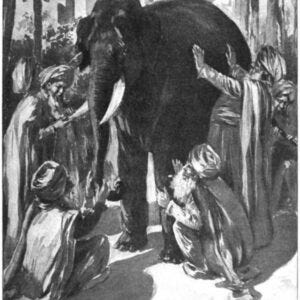
Because this approach encompasses the diversity of human experience and the unconscious, which, by definition, can never be fully known, the parable of the blind men and the elephant is a powerful image for illustrating what is happening in both Jungian psychology, the field of psychology as a whole, and in each of us as we try to relate to our psyche and unconscious. The story concerns a group of blind men who have never encountered an elephant and learn its nature by touching it. Each blind man feels only a different part of the animal’s body, such as the side or the tusk. They then describe the animal based on their limited experience, and their descriptions of the elephant differ. In some versions, they suspect the other person is dishonest and come to blows. The moral of the parable is that humans tend to claim absolute truth based on their limited, subjective experience while ignoring others’ equally valid subjective experiences.
It is easy to see how each branch of psychology and psychotherapy, such as cognitive, somatic, emotionally focused, trauma-informed, relational, developmental, behavioral, social, psychodynamic, personality, etc, has focused itself. We can easily become grandiose when we study only one system, believing we have the right way to understand people and the proper therapeutic methods. Just like each branch of science or religion can do the same. However, as the parable illustrates, they are all just different methods of describing the same thing from a limited perspective. When we become attached to a single right way and try to defend it, it can become violent and ruin relationships, creating further division. Jungian Psychology attempts to educate the practitioner from the perspective that all ways of seeing are valid, and that it is up to the therapist to understand their own ways of seeing and being, and how they compare and relate to the other, while guiding the client to find their own, without dogmatically telling the client what to do. As you can imagine, it takes a lot of work and education to appreciate and see things from many different perspectives.
It Avoids Being Too Bossy: It requires maturity on the part of both the client and the therapist to avoid the “authoritative trap” of wanting someone to give the “right way.” It teaches you to orient yourself.
We all want someone to tell us the right way sometimes, especially when we are at our lowest or most lost. But taking the time to learn to orient ourselves to ourselves and the world around us helps us avoid getting lost and teaches us how to navigate unfamiliar terrain in the future. It Works (Eventually). When we learn what works for us and how other things work for other people, it is much easier to navigate the world and the people around us. That is why there is evidence to suggest depth-oriented approaches and Jungian Psychotherapy in particular is effective in creating long-lasting change . Recognizing we each have things that work better for us, and everyone is different, is a much-needed perspective in our modern, divisive world, which brings more peaceful interpersonal relationships.
So Many Names, Still No Perfect One. Despite being involved in many different forms of Jungian study over the years, I’ve never heard a term to describe it that I really liked. In my quest for a better name for Jungian Analysis, I asked ChatGPT for suggestions, thinking maybe I just haven’t been exposed to the best term yet, but hopefully, in its infinite scouring of the internet, maybe it found a better term. It gave me many suggestions, all accurate in their own ways, and at the same time emphasising one blind man’s perspective — that is, describing one aspect of it at the expense of others. Here are some additional names that convey its various facets.
- Relational Depth Work
- Relational Jungian Therapy
- Depth-Oriented Relational Therapy
- Experiential Depth Psychotherapy
- Intrapersonal & Interpersonal Depth Work
- Relational Soul Work
- Soul-Oriented Psychotherapy
- Archetypal Soul Work
- Symbolic Process Work
- Inner Life Work
- Psychospiritual Depth Work
- Work with the Living Psyche
- Soul-Centered Therapy
- Archetypal Depth Work
- Therapy for the Inner Journey
- Shadow & Soul Work
- Depth Psychology Counseling
- Inner Work Psychotherapy
- Unconscious Process Work
- Dream-Oriented Psychotherapy
- Symbolic Depth Work
- Integrative Depth Therapy
- Mythopoetic Psychotherapy
- Imaginal Psychotherapy
- Deep Inner Work Therapy
- Transformational Therapy
- Therapy for Personal Meaning
- Therapy for Self-Discovery
- Insight-Oriented Therapy
- Mind–Body–Soul Therapy
- Therapy for the Deep Self
- Inner Exploration Therapy
- Whole-Person Depth Therapy
As you can see, many names describe one facet, but no one name can describe it all!
Avoid One-Sided Thinking: The system’s value is in recognizing and avoiding “one-sidedness,” making room for the complexity of reality. This applies to Jung’s theories, the author’s thoughts, and other psychological theories (e.g., CBT, IFS).
For me, one of the most valuable parts of the theory and process is the recognition and avoidance of one-sidedness. Many of the terms fall into this trap. But that doesn’t mean we should avoid words or terminology altogether; we need them to describe and differentiate. And then it is up to us not to let them lock us into a rigid, one-sided, rational way of thinking about things. That includes all of Jung’s theories as well! Neither Jung nor his students have the correct answers, but they point to important things to examine and relate to. So bring all the criticism of Jung and my thoughts on the process! It’s needed! And apply it to all of the other theories as well! CBT, IFS, somatic, trauma-focused, etc…. They are all helpful to a particular person at one specific moment. And let’s see if we can gently pry things open a bit more to get some more space to breathe and maneuver before we get so one-sided and fixed into one way of being in the world. That includes being “Jungian!” I consider this a key essential skill in our increasingly polarized world.
At its core, the process is one of seeing through to the core. That is where the word analysis comes in. Many people have negative associations with the word analysis. Still, the process is one of taking apart, analyzing carefully, seeing what is happening behind the scenes, so that one can be put back together more completely and function more smoothly without being derailed by habitual thoughts, feelings, or patterns. The negative views of analysis are worth unpacking in themselves. The world’s complexity and diversity, and his continued development and evolution throughout his life, account for the extensive rambling and diversity of thought in Jungian writing. However, it is aimed at seeing through, in whatever dimension the client is coming from or needs to work with, what is occurring in life at that time. Most importantly, it helps people derive meaning from and learn from their suffering, thereby growing, developing, and gaining greater mastery over their lives.
“We don’t so much solve our problems as we outgrow them. We add capacities and experiences that eventually make us bigger than the problems.” — C.G. Jung
Relational Aspects are Key: The work on alchemy shows that Jung’s ideas were very relational. The goal is to see past the personal drama to the deeper, “archetypal core” of your relationships.
In The Mystery of Human Relationship, Jungian Analyst Nathan Schwartz-Salant writes:
“In a sense, the alchemical way is one in which the analyst sees with the larger vision of the self; the scientific way is one in which he or she sees through the vision of the ego. The alchemical way sees through the eyes, whereas the scientific way sees with the eyes. Whereas the scientific way cannot encompass both opposites at the same time, the alchemical way can encompass both opposites simultaneously by situating them in a middle realm, the subtle body or the interactive field, the very existence of which scientific thinking denies” (p. 98–99).
Because of the collective cultural biases of our time and the introverted nature of many people who are drawn to Jung, the relational aspects of Jung are sometimes overlooked. Science is very important to much of our world, but it is one of many ways of seeing, all of which are important. Jung’s writings on alchemy and the Rosarium Philosophorum are foundational and closely aligned with the relational schools of psychoanalysis that emerged later in the century. But again, the key is that in a Jungian Analysis, we don’t get caught in the personal, but see through to the archetypal core of the dynamics at play in relationships with the analyst, intimate partners, family, and friends. It’s not about the ego’s desires, feelings, or unmet needs. Yet, being able to see and understand them, and their sources, can help reduce the extent to which they compel us and drive our lives.
It’s All About Individuation: This is the process of developing a relationship between your ego and your Self/soul to become your most whole self. It’s about letting the ego be a healthy part of you — no more, no less.
Lastly, as I’ve explored in other writings, Jungian Analysis is about aiding someone’s process of individuation. Individuation is a process of developing a relationship between the ego and the Self/soul, and all of the multitude of different parts of ourselves, which allows us to become as much of our full, whole self as possible in this lifetime. Not trying to destroy the ego or transcend the ego, just letting it be what it is. No more, no less. This is relativizing the ego.
Don’t Become a Jerk: Individuation means being able to enjoy and relate well to people who are different from you, rather than becoming a self-absorbed, judgmental hermit or dominating others with your beliefs.
We need a healthy ego and relationships with others as we individuate, because if we become a misanthrope who distances from or judges others, we’re only continuing to project our shadow. A good Jungian analysis helps us to appreciate people who are different from us more, rather than creating more distance. It is a process of recognizing and detaching from being controlled by the influence of the other — of our upbringing, of the other person, and of the culture, collective beliefs, and the collective unconscious, while remaining in relationship to the world. If we attend only to ourselves and do not relate well to or care for others, especially those who differ from us, we become more narcissistic. But we also cannot be infected by others’ beliefs and feelings.
It’s an Experience, Not a Theory: All the words and theories are just maps. The process itself is an experience, an initiation into yourself, the world, and transformation, using the symbols that arise in your own life.
In closing, I’ll leave you with a poem and a link to learn more about Analytical Psychology directly from the IAAP — the international accrediting body for this work . At its core, Jungian Analysis is about working relationally, in a fully embodied way, with yourself and others, through thought, feeling, sensation, and intuition, and through an image or symbol of transformation, for transformation in your own life.
You Have What You Need: The answers are already within you; you just need to look, listen, speak, and live.
No matter how we describe the process, it is NOT being led by the client’s, therapist’s, or someone else’s ego, or by anyone’s conceptualization of how to live one’s life. While reading more about Jung’s theories can dangerously lead to following someone else’s path or to intellectualizing the process, it can be helpful to understand the map. However, we cannot mistake the map for the terrain. There is nothing inherently bad about maps or intellectualizing; we don’t want to diminish or prioritize thinking, feeling, sensing, or intuition in our approach to ourselves or the world. We need all of these ways of being. I’ve tried to put some words to it while minimizing jargon. Still, even these words, along with the writings of other Jungian-oriented scholars, are insufficient to describe the process thoroughly. There is no adequate name to describe it. It’s an experience. It’s an initiation. Into yourself. Into the world. Into life. And death. And the natural process transformation. Through the symbols that present themselves to you in your one unique and precious life. You already have everything you need. You don’t need to look outside yourself for answers. They are right there. You just have to look. You just have to listen. And speak. And live.
Chickpea to Cook
Rumi — Translated by Coleman BarksA chickpea leaps almost over the rim of the pot
where it’s being boiled.‘Why are you doing this to me?’
The cook knocks him down with the ladle.
‘Don’t you try to jump out.
You think I’m torturing you.
I’m giving you flavor,
so you can mix with spices and rice
and be the lovely vitality of a human being.Remember when you drank rain in the garden.
That was for this.’Grace first. Sexual pleasure,
then a boiling new life begins,
and the Friend has something good to eat.Eventually the chickpea will say to the cook,
‘Boil me some more.
Hit me with the skimming spoon.
I can’t do this by myself.I’m like an elephant that dreams of gardens
back in Hindustan and doesn’t pay attention
to his driver. You’re my cook, my driver,
my way into existence. I love your cooking.’The cook says,
‘I was once like you,
fresh from the ground. Then I boiled in time,
and boiled in the body, two fierce boilings.My animal soul grew powerful.
I controlled it with practices,
and boiled some more, and boiled
once beyond that,
and became your teacher.’
Chuck Hancock, M.Ed., LPC, LMHC, is a licensed psychotherapist and Analytic Psychology Training Candidate practicing in Colorado and New York, guiding individuals, couples, and groups into greater wholeness.